Your body is done. Your legs are heavy, your eyes sting, you were yawning on the couch an hour ago — and now that you're finally in bed, your mind has decided it's the most awake it's been all day. So you reach for your phone and type the question exactly as it feels: why can't I sleep even when I'm tired?
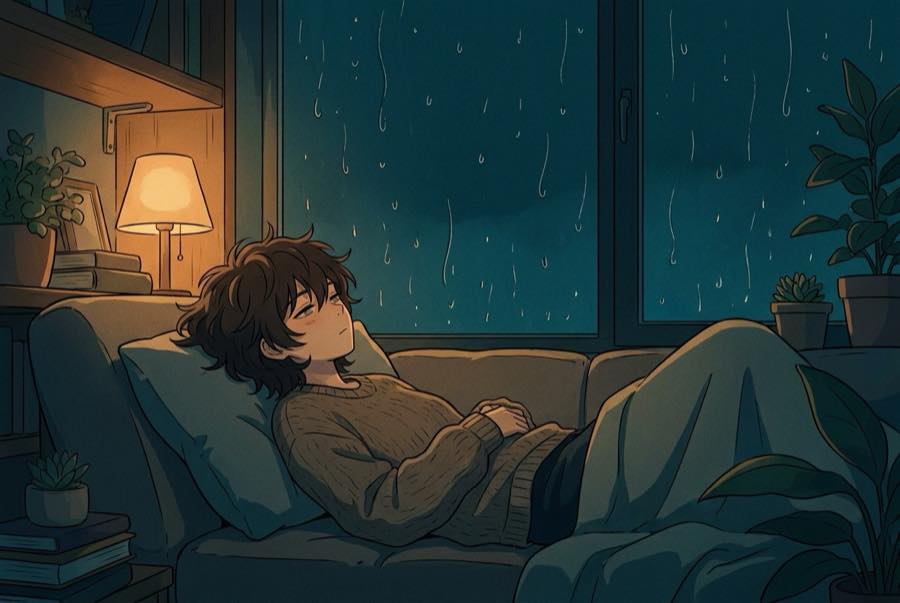
You're not broken, and you're not doing sleep wrong. What you're feeling has a name people use for a reason — tired but wired — and it's one of the most common versions of a hard night. Let's take the pressure off first, then look at what's likely going on, then keep tonight simple.
If you'd rather skip straight to something calm to give your attention to, this is the playlist we curated for exactly this state: Rain for Anxious Evenings — low, steady rain, built to loop. Set it to repeat so it carries on past its own length, keep the volume low, and let it be the one thing in the room that asks nothing of you.
Tired isn't the same as sleepy
Here's the distinction that makes the whole night make more sense: tired and sleepy are two different things.
Tired is your body's account of the day — muscles used, energy spent, a long list of things handled. Sleepy is something narrower: the actual pull toward sleep, the heavy-lidded drift you can't argue with. You can be deeply tired without being sleepy at all. Most people have felt it after an intense day: exhausted, flat, and somehow still humming.
Sleep tends to arrive when both are true — the body worn down and the mind willing to stand down. When you're tired but your mind is still running, only half the conditions are met. That's not a personal failing. It's just the state you're in, and states pass.
Why you can't sleep even when you're tired
There's rarely one clean cause, but a few ordinary things explain most tired-but-wired nights. None of this is exotic, and none of it means something is wrong with you.
Stress that hasn't landed yet. A demanding day keeps your system in a kind of low-grade alert, and that alertness doesn't switch off just because the lights did. Many sleepers find there's a lag — the body needs a stretch of genuinely calm time before it accepts that the day is over. If you went straight from doing things to attempting sleep, your mind may simply still be mid-descent.
Screens right up to the last minute. It's less about any single mechanism and more about what a screen is: bright, fast, and interesting. Scrolling holds your attention at daytime speed, and attention at daytime speed is the opposite of drifting off. The NHS's sleep guidance points in the same plain direction — winding down before bed, away from screens, helps many people fall asleep more easily.
An irregular rhythm. Late nights on the weekend, early alarms midweek, a nap that ran long — your sense of when sleep should arrive can drift. On those nights, bedtime says one thing and your body says another, and the body usually wins the argument for a while.
The trying itself. This is the quiet trap of the tired-but-wired night. The more you monitor yourself for signs of sleep — checking the clock, doing the arithmetic on tomorrow — the more alert you become. Sleep is one of the few things that retreats when chased.
Notice what's not on this list: anything you need to solve at 11:40pm. Every one of these eases when you stop demanding sleep and start simply resting.
What to do tonight
Keep it small. Tonight is not the night to overhaul your habits — tonight the only job is to lower the temperature.
Put the day somewhere. If your mind is replaying or rehearsing, give it one minute of honesty: jot the loudest two or three thoughts on paper or in a note, then set them down. They'll keep until morning. If your thoughts tend to spiral rather than list, the advice in how to stop overthinking at night goes deeper.
Trade the feed for one sound. Let the phone do a single job: press play on Rain for Anxious Evenings, set it to repeat, place the phone face-down, and let the room fill with low, steady rain. We kept only the gentlest recordings for this playlist — nothing that swells or startles — and the full checklist a track has to pass is in what makes a rain sound work. Steady sound also softens the small noises that spike against silence; the fuller story of why that helps is in why rain sounds help sleep.
Rest instead of hunting sleep. Lie comfortably, eyes closed, and give your attention to the rain rather than to the question of whether you're asleep yet. Resting quietly is worth something in itself, even before sleep comes — and sleep tends to arrive more easily through the side door of rest than through the front door of effort.
If you're still wide awake after a while, don't lie there fighting. Getting up briefly, keeping the lights low, and returning when you feel heavier often works better than wrestling the pillow — there's a calm walkthrough of that in what to do when you can't sleep at night.
If this keeps happening
One tired-but-wired night is ordinary. A run of them usually points back to the list above — stress with nowhere to land, screens until lights-out, a rhythm that keeps shifting — and gentle, boring consistency tends to fix more than any single trick. A regular wind-down, a steadier bedtime, and a familiar sound cue can slowly teach your evenings where they're headed. There are more calm places to start in our sleep guides.
But be kind to yourself about the limits of self-help. If you're lying awake most nights, or you're exhausted no matter how much time you spend in bed, that's worth a conversation with your doctor — not as a last resort, but as the sensible next step.
Tonight, though: heavy body, busy mind, low rain, nowhere to be. Let the rain stay awake so you don't have to.
This article is for general information and isn't medical advice. If sleep problems persist, talk to your doctor.