You're awake and you didn't choose to be. The house is quiet, tomorrow is already forming a list in your head, and you've reached the point of typing "can't sleep at night" into a phone that's too bright for the room. Nothing is wrong with you. This happens to almost everyone, more nights than anyone admits, and you don't have to solve your whole relationship with sleep before morning. You only have to get through the next hour gently.
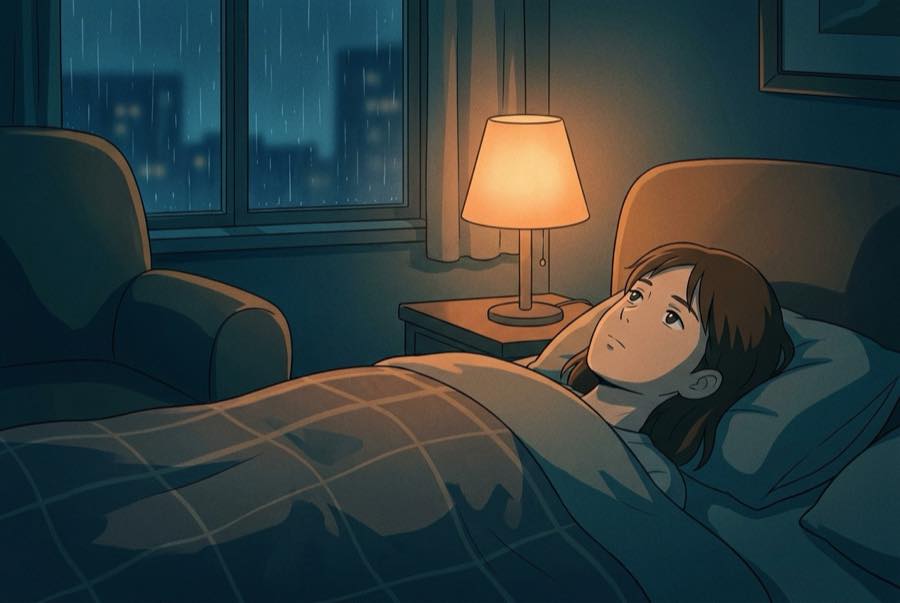
So let's lower the stakes. This page is a plan for right now — what to do while you're still in bed, and when it's actually better to get up for a while. None of it requires effort, which matters, because effort is exactly what's keeping you up.
Start here, without leaving the bed
First, stop trying to fall asleep. That sounds backwards, but sleep is one of the few things that retreats when chased. Lying there commanding yourself to drift off turns your bed into a place where you work, and your body responds to work by staying alert. Many sleepers find the night turns when they quietly give up the project — you're allowed to just rest, eyes closed, going nowhere. Rest still counts — resting quietly tends to leave most people better off than fighting the night, even before sleep arrives.
Second, give your mind one soft thing to settle on that isn't your thoughts. This is where sound earns its place. A steady sound helps mostly by masking — smoothing over both the small noises of the night and the loud silence your brain keeps checking — and the full explanation of why lives in why rain sounds help sleep. But right now the mechanism matters less than the effect: rain gives your attention somewhere undemanding to sit.
Rain on the Roof — All Night Sleep — a deep pool of steady rain you can hand the rest of the night to, hand-picked and sequenced so it quietly begins again without you noticing. Set it to repeat so it starts over instead of running out mid-night, keep the volume low — behind the room, not in front of it — and put the phone down out of reach, screen to the floor.
We're careful about what goes in there because a sleep playlist has one job: to be uneventful — every track is chosen against the checks we lay out in what makes a rain sound work. Nothing swells, nothing startles, nothing asks anything of you.
Then settle in and listen. Not to analyze it — just follow the rain the way you'd watch it through a window. When your thoughts wander off, and they will, drift back to the sound without scoring yourself on it.
Why you can't sleep at night when you want it most
Because wanting is the problem. Falling asleep is a letting-go, not a task, and the more tonight matters — an early meeting, a long day, a stretch of bad nights you're afraid of repeating — the more your mind treats bedtime as a deadline. Deadlines produce alertness. That's the whole cruel loop, and it's not a character flaw; it's just how arousal works.
Which is why every move on this page is a form of doing less. Less effort, less light, less math. Speaking of math: don't check the clock. Counting the hours you have left is the fastest way to turn a quiet night into an urgent one, and the number never helps — you can't sleep harder because it's late. If the clock faces you, turn it around.
When to get up for a while
If you've been lying awake long enough that the bed has started to feel like a struggle — somewhere around twenty minutes by feel, not by clock — getting up for a little while is often the kinder move. Both NHS guidance and the Sleep Foundation suggest leaving the bed when sleep clearly isn't coming, so that your brain keeps associating bed with sleeping rather than with lying awake.
Keep the interlude deliberately boring. Low light, or as little as you can manage. A slow page of a paper book, some quiet stretching, sitting in a chair with the rain still playing softly nearby. No email, no feeds, no bright screens, and no big thoughts — 2am is a terrible hour for decisions, and every problem you audit tonight will still be there in the morning, smaller. When your eyes get heavy — actually heavy, not just bored — go back to bed and let Rain on the Roof — All Night Sleep carry you from there, still on repeat, still low.
One round of this is normal. Two rounds is still normal. You're not failing at anything; you're waiting out a wave.
If this keeps happening
A rough night now and then is part of being a person. But patterns are worth understanding. If you tend to fall asleep fine and then surface in the small hours, the middle-of-the-night wake has its own page — waking up at 3am. If you're exhausted all day and still wired the moment the light goes off, that's the tired-but-can't-sleep loop, and we've written about it in why can't I sleep even when tired. And if you'd rather try a different sound family entirely, the whole collection lives in our sleep sounds library.
And if most nights look like this one — weeks of lying awake, dread at bedtime, days that feel eroded — please talk to your doctor. Persistent insomnia is common and treatable, and it deserves better care than any playlist can offer. Asking is simply good sense — the same as getting a tooth looked at when it keeps aching.
For the rest of tonight
Here's the whole plan, small enough to hold: stop chasing sleep, start the rain, set it to repeat, turn the clock away, and rest without a goal. If the bed turns into a struggle, step away into low light for a little while and come back when your eyes are heavy.
This article is for general information and isn't medical advice. If sleep problems persist, talk to your doctor.