Every night, the same thing. The lights go off, and your mind clocks in — replaying today, rehearsing tomorrow, auditing conversations from years ago. If this happened once in a while, you'd shrug it off. But it's become the pattern, and by now you half expect it before your head touches the pillow. If you're searching for how to stop overthinking at night, you've probably already noticed the hard part: you can't argue your way out of it at midnight. The spiral doesn't respond to reason once it's spinning.
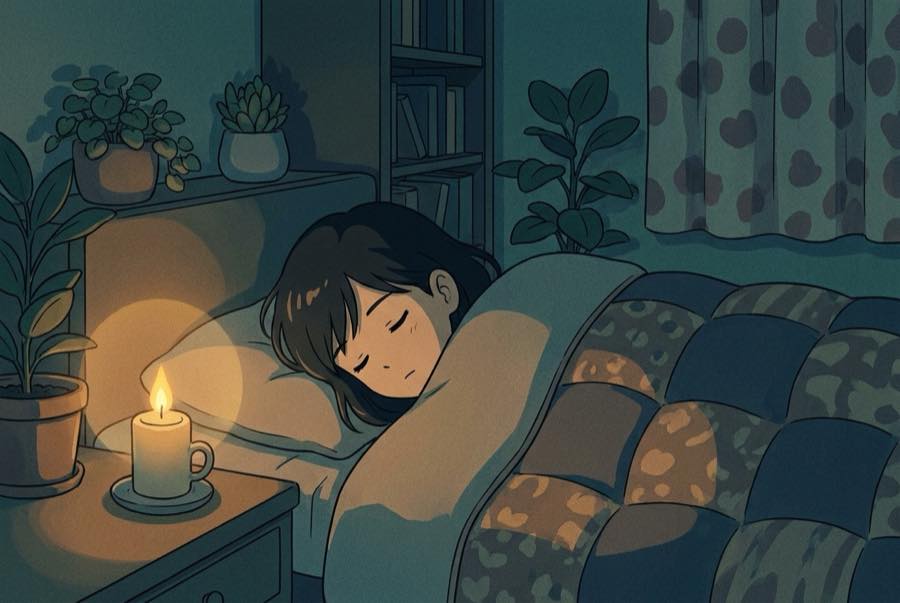
What it does respond to is the shape of your evening. Nightly overthinking is less a midnight problem than an evening one — the hours before bed either feed the pattern or starve it. This page is about starving it.
One note before we start: if your mind is racing right now and you need something for tonight, not a new routine, go to how to sleep with a racing mind — that page is built for the night you're already in. This one is for changing what next week's nights look like.
Why the overthinking shows up at night
Nothing mysterious is happening. Night is simply the first time all day your brain has no input to process — no messages, no tasks, no screens, no other people. Whatever you didn't get to think about during the day is still in the queue, and the quiet dark is when the queue finally gets serviced.
Do that enough nights in a row and something less helpful happens: bed itself becomes the cue. Your brain learns that lights-out is when the thinking starts, the way it learns that a kitchen smell means dinner. That's why the spiral can start before there's even anything to spiral about — the association fires on its own.
The good news sits inside the bad news. If the pattern was learned, it can be unlearned. Not by force of will at midnight, but by giving the thinking somewhere else to happen and giving bedtime a different job.
How to stop overthinking at night: teach bedtime a different job
The single most useful move here isn't another technique for arguing with thoughts — it's changing what the end of your evening means. If your brain has learned that lights-out is when the thinking starts, the fix is to teach it, one deliberate evening at a time, that lights-out is when something else starts instead.
To be clear about what this page is not: the in-the-moment tools — parking the circling thoughts on paper, coming back to one steady sound — are covered in how to sleep with a racing mind, and they belong in your pocket for the nights the spiral wins anyway. Those tools handle the symptom on the night it happens. The pattern gets treated earlier, in how the evening runs — and the treatment has only three parts.
Let the evening slope downward. Dimmer light, slower activities, no new problems after a certain hour — NHS sleep guidance points in the same direction: a consistent wind-down routine before bed, kept roughly the same each night, teaches the body what's coming. If you want a fuller version of that hour, how to relax before bed walks through it step by step.
Keep the phone out of the last stretch. Not as punishment — because a feed is an input machine, and inputs at 11pm are new items for the queue. If the phone comes to bed at all, let it do exactly one job: play sound, screen down.
The same sound, at the same point, every night
Here's the heart of the method. If bed has become the cue for thinking, you install a different cue — something your brain can learn to associate with the day being over. A steady sound does this well, but only if you treat it as a ritual rather than a rescue: not reached for at midnight when the spiral has already started, but started deliberately at the same point of your wind-down every single night — when the lights go down, when you close the bedroom door, wherever you choose to draw the line. The consistency is the mechanism. A sound your brain has met at the end of enough days stops being audio and starts being a signal: this is the part where we stop.
For exactly this use, we curate Rain for Anxious Evenings — low, unhurried rain with nothing sudden in it, built to loop without a seam; the checks a track passes before it earns a place are laid out in what makes a rain sound work. Set it to repeat and it holds until morning. Start it at the beginning of your wind-down, not at lights-out, so the sound belongs to the whole slope of the evening — after a couple of weeks, the rain starting is the day ending. Steady sound also quietly covers the small noises that hand a ruminating mind something new to react to; the fuller explanation of that effect lives in why rain sounds help sleep.
The routine, then, is small enough to actually keep: lights down at the same hour, Rain for Anxious Evenings on at the same point, phone face down. Same order, every night. Boring is the point — patterns are broken by other patterns, not by effort.
Be patient with the pattern — and honest about its size
A habit your brain rehearsed for months doesn't dissolve in two nights. Expect the first week to be uneven: some nights the spiral shows up anyway. That's not failure; that's the old cue firing while the new one is still being learned. When it happens, don't fight it in bed — the in-the-moment tools in how to sleep with a racing mind are for exactly those nights, and there are more calm sounds to build your cue from in our full library.
And one thing we'd rather say plainly than skip: if the thoughts that keep you up feel bigger than a busy mind — if worry is stealing sleep most nights, or following you into the day — that's worth a conversation with your doctor. An evening routine can retrain a habit; it isn't a treatment for anxiety, and you deserve more than a playlist if that's what this is.
Tonight, start small: lights a little lower, the rain on a little earlier, and the same again tomorrow. Let the evening do the arguing for you.
This article is for general information and isn't medical advice. If sleep problems persist, talk to your doctor.