A friend stays over, hears the rain still going at midnight, and raises an eyebrow. Or you're changing the bedding one evening and realise you've had something playing every single night since spring, without once choosing to. Either way the question arrives sideways rather than head-on: is it bad to sleep with sound every night, or have you quietly built a habit you can't get out of? The calm version of the answer is this — there's no good reason to think a low, steady sound in a healthy adult's bedroom is doing you harm, and we're not going to claim it's doing anything miraculous either. What you almost certainly have is a sleep cue, and knowing the difference between a cue and a problem settles most of the worry.
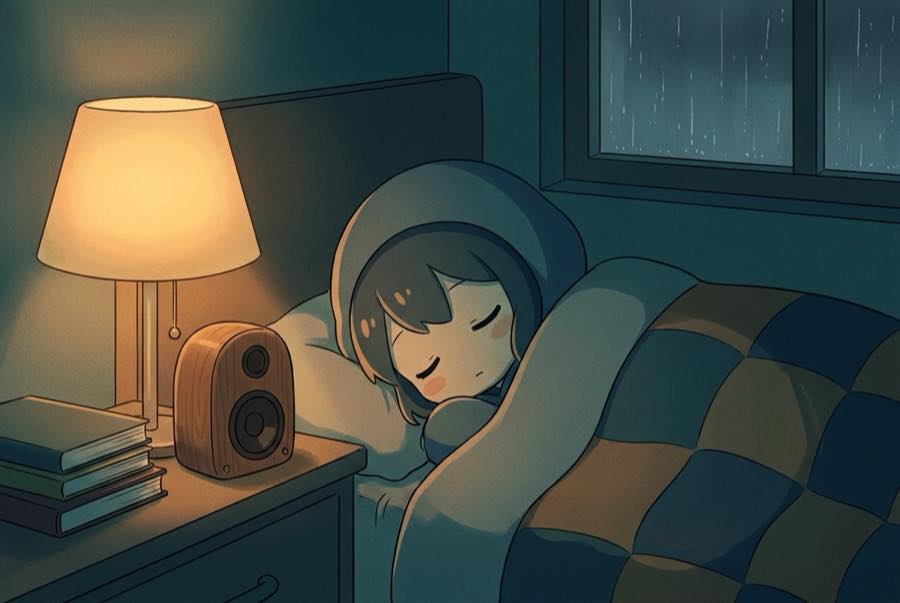
Is it bad to sleep with sound every night, or just unusual?
People asking this are usually asking two different questions at once, and they deserve separate answers.
The first is whether the sound is bad for you physically. We're a playlist curator, not a clinic, so we'll stay firmly inside what we can honestly say: we know of nothing that would make a quiet, continuous sound at low volume a health risk for an adult sleeping in their own bed. Volume and headphone habits are worth thinking about, and we'll get to both. The audio itself, kept low and steady, is closer to a cool room or a dark curtain than to anything you'd need to justify.
The second question is the one that actually keeps people up: have I made myself unable to sleep without it? That one has a real answer, and it isn't the alarming one.
Whether sound is even the right choice for your nights is its own question, and it doesn't have a universal answer — we work through when a quiet room genuinely wins in sleep sounds vs silence. This page assumes you've already landed on sound and are now wondering what it costs you.
Habit is not the same as harm
Almost everyone sleeps with cues. A specific pillow. The weight of your own duvet. The room at the temperature you like it, the door open or shut the way you always leave it, your side of the bed. Take any of those away and the first night feels wrong. Nobody calls that dependence, because a pillow doesn't feel like a device.
Sound feels different because it's coming out of a phone or a speaker, and anything on a screen carries a whiff of habit you're supposed to feel guilty about. But mechanically it's the same trade. A repeated signal at the same point every night becomes something your body reads as: this part of the day is over. That association is the whole reason a familiar sound helps in a hotel room or a first week in a new apartment.
There's also a plainer job going on underneath the cue — a steady sound raises the background level of a room so passing noises have less to cut through, which is the mechanism we explain properly in why rain sounds help sleep. If your street, your building, or your partner supplies interruptions, then the sound isn't a psychological crutch at all. It's covering something real, and it will keep being useful for exactly as long as that something exists.
So the honest cost of the habit isn't damage. It's logistics. If your nights depend on a sound, you want the sound to be reliably available — on a plane, at your parents' house, on a dead battery, in a shared room where a speaker isn't polite. That's an inconvenience to plan around, not a condition to worry about.
The two things actually worth watching
Volume is the real one. Keep it low. Low enough that you can still hear your alarm, a child down the hall, a smoke alarm, a door. If you've been creeping the volume up over months because it stopped feeling like enough, that's worth noticing — the useful setting is the quietest one that still smooths the room, not the loudest one you can sleep through. Our own rule, which we apply to everything we put out: modest on headphones, with nights off from them, because a whole night is a long stretch of listening even at a level that feels like nothing. Set it once before lights out and leave it alone; the tests for finding that level are in what volume for sleep sounds.
Earbuds all night are a comfort question too. Side sleepers usually end up with a sore ear by 3am, and cables in a bed are their own nuisance. If you have the room to yourself, a speaker across the room is kinder to both your ears and your sleep position; if you don't, the shapes that survive a full night are compared in sleeping with headphones or a speaker.
Neither of those is really about the habit. They're about the equipment, and both have a fix that takes one evening. The habit itself stays where we left it: not a problem.
What does deserve a second look is the recording. A track that fades out, swells, or hands over abruptly gives you an event to surface for every night rather than once, which is where a nightly habit either earns its place or quietly costs you — the checks that make something workable overnight are in what makes a rain sound work.
A sound you're going to play every night for a year has one extra requirement that a one-off doesn't: it must never give you a reason to reach for the dial. Rain on the Roof — All Night Sleep is built to that spec — steady rain overhead with no thunder, no swells, and nothing that arrives suddenly, so there is no loud moment to set the level for and no quiet stretch that leaves the room bare. Set it to repeat, keep it low, and you should be able to leave it exactly where it is for months. If you'd rather compare families before committing to one every night, they're all in the guide library.
How to test a night off
If the wondering won't leave you alone, the fastest way to settle it is to find out rather than to speculate.
Pick a low-stakes night. Not the night before a flight or an interview — a Friday, or any morning you could afford to be a little slow. Expect the first quiet night to feel strange, because you've removed a cue, and removing a cue always feels like something is missing. That first-night oddness is not the same as an inability to sleep, and one restless evening isn't a verdict.
Give it two or three nights before you decide anything, and judge it in the morning rather than at midnight. The question is not whether the room felt weird at 11pm. It's whether you woke up rested. Many sleepers find they sleep perfectly well without the sound and simply prefer the night with it — which is a completely reasonable place to land, and not a problem you need to fix.
If the quiet nights come out better, keep them. If they come out worse, you've learned that the sound is doing real work in your particular room, and you can stop treating it as a guilty habit.
There's one result worth taking seriously in a different direction. If you're lying awake most nights whatever the room sounds like — sound on, sound off, doesn't matter — then the audio was never the variable, and the trouble deserves more than a playlist. Persistent sleep problems are worth an unhurried conversation with your doctor, who can look at the parts a curated sound can't touch.
Worth repeating the experiment once or twice a year, incidentally, and not because we expect the answer to change. Rooms change. You move, a neighbour moves out, a road gets resurfaced, a baby starts sleeping through. The sound that was doing genuine work in one flat can become purely a cue in the next one, and it's a good deal easier to notice that on a night you chose than on a night a dead battery chose for you.
This article is for general information and isn't medical advice. If sleep problems persist, talk to your doctor.