For most people on most nights, a small speaker is the better answer, and headphones are the specialist tool you reach for when the room gives you no choice. That's the honest verdict on sleeping with headphones or a speaker, and it has almost nothing to do with sound quality. It comes down to what your body has to put up with for seven or eight hours, and what you still need to be able to hear while you're under.
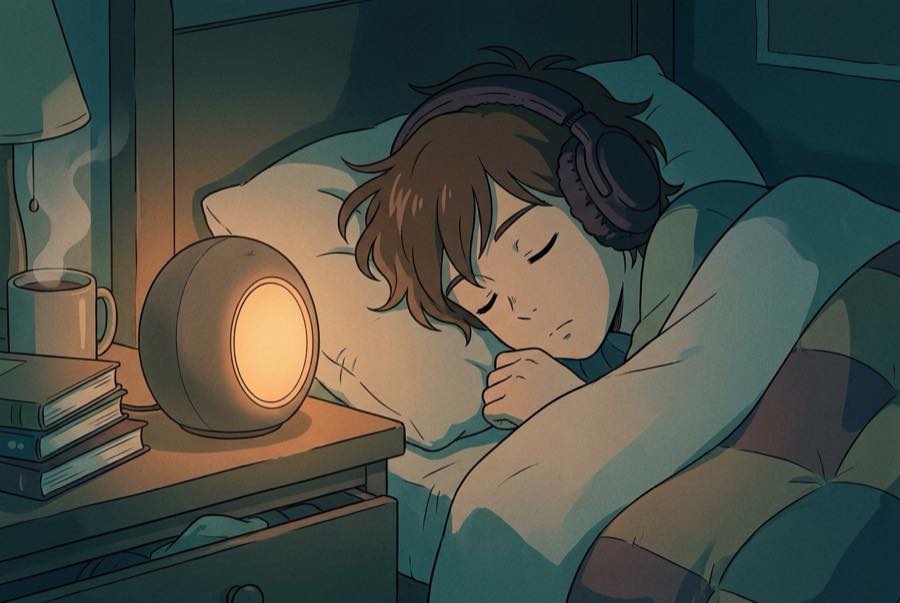
Why a speaker is the default
A speaker asks nothing of you. You can turn over, sleep on either ear, bury your head in the pillow, and the sound stays exactly where it was. Nothing presses into your ear, nothing tugs when you move, nothing has to be found again at 3am after it worked its way into the sheets.
It also keeps the sound in the room rather than at your eardrum, which matters more than it sounds like it should. Sound in a room arrives softened, reflected off walls and ceiling before it reaches you — a gentler version of itself. And because it fills the space instead of sealing you into it, the sound does the one job you actually want from it: raising the floor of the room so passing noises have less contrast to cut through. If you want the mechanism explained properly, it's in why rain sounds help sleep.
The last argument for a speaker is the one people only appreciate after a bad morning: you can still hear your life. Your alarm. A child at the door. A smoke detector. Someone knocking. Headphones, especially the sealed kind, quietly take those away from you, and there is no volume setting that gives them back.
Practical version: a phone on a charger, playing to a small speaker across the room, is the most reliable all-night setup there is. It doesn't run out of battery, it doesn't need charging by your face, and it never becomes uncomfortable.
When headphones genuinely win
There are nights the speaker simply isn't available, and headphones stop being a compromise and start being the whole solution.
Someone else is sleeping in the room. A partner who hates rain, a roommate on a different schedule, a hotel room with your family in it, a hostel bunk. Headphones let you have your sound without making it everyone's sound — and that's a better outcome than lying there in a silence you didn't choose.
The room is loud in a way a quiet speaker can't reach. A ward, a corridor, a night train, a floor above you that never settles. Headphones put the sound closer than the noise, which is sometimes the only way to win.
You want detail rather than a wash. Close-recorded rain — the kind where each drop has its own small weight, landing an arm's length away — only fully arrives when the sound goes straight to each ear. On a speaker it's still lovely; on headphones it's a different experience, near and enclosing. That's the one case where headphones aren't a fallback but the point. If that's the reason you're wearing them, Rain ASMR — Dark and Close is recorded for exactly that distance: rain that sits beside your head rather than across the room, which is the one thing a speaker cannot hand you. The tracks are cut to hand off without a gap — set it to repeat and switch off any sleep timer. The longer version of that idea lives in rain ASMR.
Sleeping with headphones or a speaker when you're a side sleeper
This is where the decision usually gets made for you. An earbud between your ear and the pillow is a small pressure at midnight and a sharp one by 3am, and no amount of good sound makes up for waking with a sore ear. Over-ear headphones are worse — they push the whole cup into the side of your head.
If you sleep on your side and still want headphones, the shape of the thing matters more than the brand:
- A sleep headband — flat drivers inside a soft band — is the only design most side sleepers tolerate all night. It doubles as an eye cover, which is a quiet bonus in a bright room.
- Low-profile buds designed for sleep sit almost flush with the ear instead of sticking out. Ordinary earbuds are not these, no matter how comfortable they feel sitting up.
- A pillow speaker — a flat speaker that slips into the pillowcase — is the underrated middle option. Nothing in your ear, sound only you can really hear, and you can turn over freely.
- One ear only, with the free ear on the pillow, works surprisingly well and leaves you connected to the room.
Back sleepers have an easier time and can use almost anything. If you switch positions all night, assume whatever you're wearing will be somewhere in the bed by morning, and choose accordingly.
Cables, batteries, and the parts nobody mentions
A cord in a bed is worth taking seriously. It wraps around your arm, your neck, or the bed frame as you turn, and in a narrow bunk or a child's bed that's a real hazard rather than a theoretical one. If you use corded buds, run the cable up over the headboard so the slack is above you, never coiled beside your face. Wireless removes the problem entirely.
Batteries are the other quiet annoyance. Wireless buds tend to give out partway through the night, which means the sound stops at the exact hour you're most vulnerable to noticing. If you sleep light, that silence can be the thing that wakes you. A plugged-in speaker never has this problem, which is another point in its column.
And keep the charging out of the bed. Devices under pillows get warm, and a warm thing pressed against your head is not a sleep aid.
What it costs to wear them, night after night
The hardware questions above are the ones that decide whether you last the night. There's a longer-term one underneath them: headphones put the sound an inch from your eardrum for seven or eight hours at a stretch, which is a genuinely different exposure from a speaker across the room — so set the level lower for buds than for a speaker, and see what volume for sleep sounds for the method and the warning signs worth watching for in the morning.
The other cost is a comfort debt that builds. A pair that feels fine on night one can leave a tender ear by night four, and side sleepers usually notice it first on whichever side they favor. If that starts happening, alternate sides, alternate nights, or move to a headband or pillow speaker before it becomes the reason you stop using sound at all. Nothing on this page is worth more than the sleep it's supposed to protect.
A middle path most people land on
You don't have to pick one forever. A common arrangement: headphones for the falling-asleep part, when you want the sound close and the room shut out, and a speaker — or nothing — for the rest of the night. This is the one situation where a sleep timer is the right tool rather than the thing sabotaging you, and how to loop sleep sounds all night covers when to use one and when to switch every last one of them off.
The other honest approach is to test it. One night with headphones, one night with the speaker, same sound both times, and judge by how the mornings felt rather than how the first ten minutes sounded. Preference here is genuinely personal, and there are more sound families to try in the guide library.
What to actually put in the bed tonight
If the room is yours, put nothing in the bed at all. A small speaker set a little away from your head, with the phone on its charger, is the arrangement that asks least of you and survives every position you sleep in.
If the room isn't yours, the choice is about shape rather than brand. A headband if you sleep on your side and want something you can lie on. Low-profile sleep buds if you want less on your head and can tolerate something in your ear. A pillow speaker if you'd rather have nothing in your ear at all and can accept that it only really works lying down. One bud, free ear on the pillow, if you want to stay connected to the room. Whichever you pick, run any cable up over the headboard so the slack is above you, and keep the charging out of the bed. Then leave it alone until morning.
This article is for general information and isn't medical advice. If sleep problems persist, talk to your doctor.