Heating makes noise for ordinary mechanical reasons. Metal expands as it warms and contracts as it cools, water pushes past air that shouldn't be in the pipe, and a pipe clamped tight against a joist has to move somewhere. That's your tick, your gurgle, and your bang. Which means anyone looking up how to sleep with a noisy radiator is actually holding two different problems: a share of that noise can be reduced in an afternoon with a radiator key and some felt, and the rest of it has to be covered. Sorting out which is which is daytime work. At 3am there is only the covering.
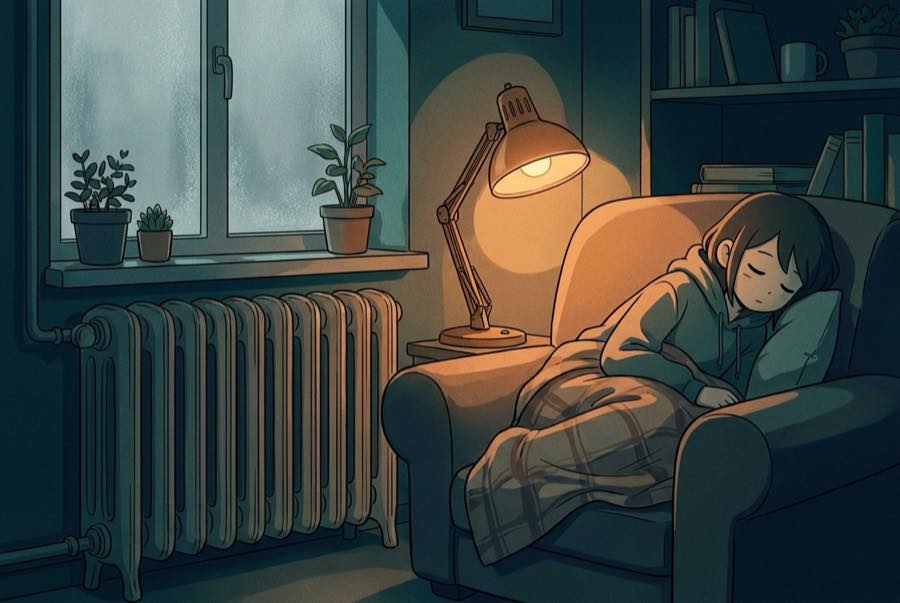
Why a radiator wakes you when a busy road doesn't
People sleep through motorways and air conditioning and the hum of a city, and then sit bolt upright at a single clank from the corner of their own bedroom. An unpredictable peak landing in a quiet room startles far harder than a loud, level sound does, and it leaves you braced for the next one — the full version of that mechanism is in how to sleep during a storm, and it works the same whether the peak is thunder or a pipe.
What's different about heating is that this particular peak has a cause you can walk over to. Thunder is weather and you take what you're given. A knock in a radiator is a machine reporting something specific about itself, and the noises are legible enough that most people can name theirs in a minute and fix or escalate it in an afternoon. So this page spends its length on reading the noise and dealing with it, and leaves the covering until the end where it belongs.
How to sleep with a noisy radiator: read the noise before you fix anything
The sounds aren't interchangeable. One of them is a ten-minute job with a key that costs less than a coffee, one is a strip of felt, and one is a phone call you should make rather than a noise you should get used to. Match yours first, because the wrong fix on the right noise just wastes an afternoon.
Ticking, gurgling, or a sound like a trickling stream: that's air. In a hot-water system, air trapped where water should be makes exactly those noises, and it also leaves a radiator hot at the bottom and cold across the top. Bleeding it with a radiator key is a standard household job — let the system cool first, hold a cloth under the valve, open it a quarter turn until the hiss turns to water, close it, then check the boiler pressure and top it back up if it has dropped. If the same radiator needs bleeding again within a few weeks, stop bleeding it and get someone in: air that keeps coming back is usually a leak somewhere or corrosion in the system, and repeating the fix hides the fault. If you rent, none of this is yours to do — message your landlord tonight so the request exists in writing rather than in your head.
A creak or a slow groan while it heats up: that's metal moving. Expansion noise is a contact problem — a pipe rubbing on a floorboard, a bracket screwed down too hard, a radiator resting against a skirting board. It's the most fixable noise on the list. Follow the sound while the system is firing, find the point where metal meets wood, and pad it: a wrap of pipe insulation, a strip of felt, or a rubber washer under an over-tightened bracket. Where a pipe passes through a joist and has been notched in tight, the fix is to give it room rather than to hold it harder. Check the radiator sits level while you're down there, since a lean leaves water sitting where it shouldn't.
A hiss with the heat on: usually a steam vent doing its job. A small vent that hisses briefly and then stops is normal. One that hisses continuously, or spits water, is generally worn — it's an inexpensive part and a quick swap. Steam radiators also want a very slight tilt back toward the pipe so condensate drains away instead of being pushed around by the next cycle, and their valves are meant to sit all the way open or all the way shut, never half. A steam system that knocks is a common complaint with common causes, which is a good reason to have it looked at rather than to spend a winter under it.
Ticks from the wall or ceiling rather than the radiator: that's ductwork. Forced-air systems tick as sheet metal warms and cools, and the loudest thing in the room is frequently a loose register cover vibrating in its frame rather than anything mechanical. Felt pads under the cover, or a couple of screws driven properly, take that out. A filter left too long makes the whole system work harder and louder, which is worth ruling out before anything more ambitious.
When to stop fixing and call someone. A hard bang or hammering when the heat kicks on, a noise that is new since last winter, water anywhere it shouldn't be, boiler pressure that keeps falling, or a radiator that stays cold after a proper bleed — those are reports, not quirks. Each of them tends to be quick and cheap for a heating engineer and slow and expensive to live with, and a system making a noise it didn't used to make is telling you something before it becomes urgent. If you rent, that phone call isn't yours to make, but the written request is, and dated messages are what eventually move things.
Move the schedule off your sleep
The single loudest moment in most systems is the first firing after a long cold gap — which, on a default timer, is often somewhere between 4:30 and 6am. That's a bad hour to be startled, because it's the stretch where sleep is already lightest and getting back down is hardest.
So change when it happens. Bring the heat up in the evening before you go to bed, let it fall overnight, and set it to come back after your alarm rather than before it. If you'd rather keep the house warmer, narrow the setback instead — a system that never gets fully cold cycles more gently than one asked to go from cold to hot in one go. A cooler bedroom tends to suit sleep anyway, so this often solves the noise and the stuffiness in the same move. Keep a low baseline going in genuinely freezing weather; the goal is a gentler cycle, not an unheated house.
The steady hum that swallows the clanks
Some of it will survive all that. Old buildings tick, and shared systems answer to other people's thermostats.
This is where sound does the last part of the job, and the aim is smaller than people expect: not drowning out the pipes, just filling the quiet between them so a knock has nothing to cut through. What decides whether a recording can do that is density and evenness — enough sound, spread flat, with no thin patches for a bang to land in. Which family that comes from is preference, and there's no wrong answer: rain does it, a river does it, a fan does it. We point readers with noisy heating at the fan family for a plainer reason than acoustics. You already share this room with a mechanical sound. A hum belongs to that world rather than arguing with it, and a lot of people find it easier to accept a second machine than a weather system that isn't outside.
Fan Sounds for Sleep — Steady Hum is that, deep and unchanging. Each track is edited to end where the next one starts, so put it on repeat and disable any sleep timer before you get in — a hum that quits by itself at 3am leaves you uncovered for exactly the hour the system is most likely to fire.
Placement matters more than volume here. Put the speaker between your head and the wall the pipes run through, low down and pointed into the room rather than at you. For the level, wait until the heating is actually running, then bring it up only to the point where the ticking stops being an event — still quiet enough that your alarm and a door get through. What volume for sleep sounds is the longer version of that judgment. A loud clank may still surface now and then. It will just arrive as part of a room that already has sound in it, which is a very different experience from arriving in silence.
If the hum turns out to suit you generally, fan sounds for sleeping covers what else it's good for. If the heating is only one voice in a genuinely loud building — footsteps above, a street below — the broader tactics in how to sleep in a noisy apartment apply. And if a flat hum isn't your thing at all, the other families are in the guide library.
What to do tonight
Move the timer so nothing fires from cold in the early hours. Name the noise while you can still hear it — ticking and gurgling means air, a groan means metal against wood, a bang means a phone call — and write the fix on tomorrow's list, or send the landlord a message now so it exists in writing. Pad the one contact point you can reach without tools. Then start a low, even hum before the light goes off, on repeat with the sleep timer disabled, at a level you have to listen for. The repairs belong to daylight; tonight only needs the covering.
This article is for general information and isn't medical advice. If sleep problems persist, talk to your doctor.