Some people can fall asleep anywhere. You can fall asleep anywhere there's a fan. Maybe yours finally gave out, maybe you're in a room where running one isn't an option, maybe it's the middle of winter and the airflow you don't need comes attached to the hum you do. Whatever brought you here, the fix is simple: fan sounds for sleeping — the hum without the hardware. Put on a steady recording, set it to repeat, keep the volume low, and the room sounds like your room again.
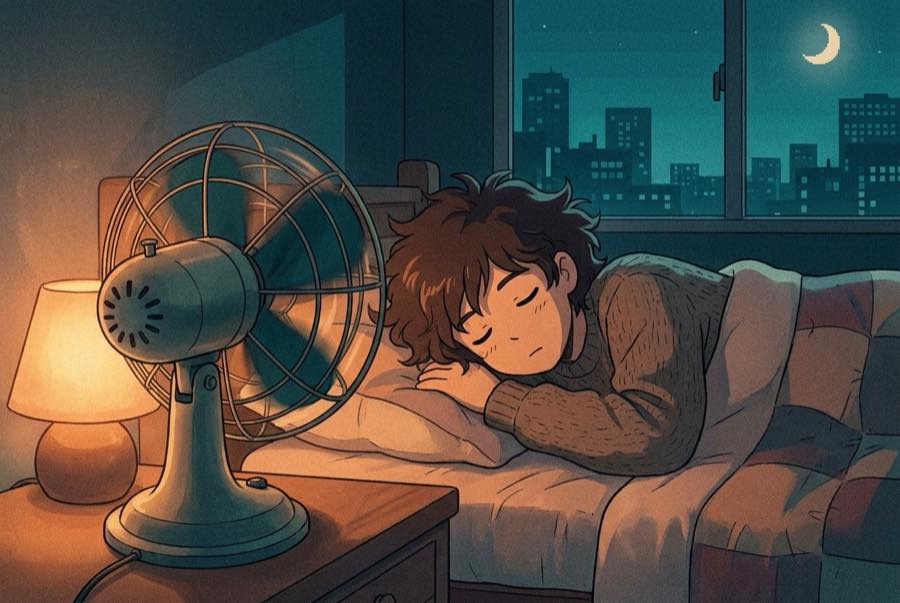
That's exactly what this playlist is for.
Play Fan Sounds for Sleep — Steady Hum — the hum you've been falling asleep to for years, hand-picked and steady, for the nights the machine itself can't be there. Every recording holds one even tone from start to finish, and with repeat on, the playlist carries that tone until morning. Repeat matters: no playlist is a full night on its own, and the last thing a fan sleeper needs is the hum cutting out at 2am.
Choose your volume while the lamp is still on — low enough to talk over, present enough to notice when you listen for it — and consider that decision made until morning.
Why fan sounds for sleeping actually work
Part of it is masking: a constant hum raises the floor of the room so that doors, pipes, and traffic register as smaller events, and we've written the full explanation of that in why rain sounds help sleep. That single sentence is the science. The rest of the fan's power is something science has less to say about and every fan sleeper knows in their body: the hum is a cue.
If you've slept beside a fan for years, that sound has been paired with falling asleep thousands of times. Many sleepers find that the cue itself starts to do the work — the hum comes on, and somewhere below thinking, the body files it under "this is where sleeping happens." That's why a silent room can feel not peaceful but wrong, the way a familiar picture looks wrong when it's hanging slightly crooked. You're not addicted to the fan. You've just trained a very good bedtime signal, and there's no reason to untrain it. There's every reason to make it portable.
What we listen for in a fan recording
Not every fan recording can hold a night. We listen through every track before it earns a place in the playlist, and we check three things.
Steady. The hum in minute forty has to match the hum in minute one. Real fans wobble — a bearing catches, the head oscillates, someone changes the speed — and every one of those shifts is a small event that can pull a light sleeper back to the surface. The tracks that made the cut hold one even tone the whole way through.
No fades. A recording that fades out leaves a pocket of silence before the next one begins, and for a fan sleeper, silence is precisely the thing that wakes you. Ask anyone whose fan has ever been switched off mid-night by a well-meaning partner. Every track here ends at full level and hands off cleanly to the next.
Loopable. With repeat on, Fan Sounds for Sleep — Steady Hum cycles without an audible seam, so the hum never appears to stop. The fan just runs, the way a fan should.
Traveling without your fan
This is where a playlist earns its keep. Hotel rooms are hard on fan sleepers twice over: the familiar hum is missing, and an unfamiliar room tends to keep the brain slightly on watch the first night — sleep researchers have described this first-night effect for years. A hallway ice machine and a stranger's door at midnight don't help.
Bringing your sound with you answers both problems at once. The hum masks the hallway, and — more importantly for you — it makes a strange room sound like home. Same cue, same signal, same "this is where sleeping happens," four hundred miles from your own bed. Phone on the nightstand, repeat on, volume low. If travel sleep is a recurring struggle, our guide on how to sleep in a hotel covers the rest of the routine.
The same trick works closer to home: a partner who can't sleep with real airflow, a rented room with no outlet where you need one, a nursery where a plugged-in fan isn't practical. The recording separates the sound from the machine, and the sound was always the part you needed at night.
An honest note about hot nights
If you searched for fan sounds because your bedroom is warm, we owe you a plain answer: a recording moves no air. On a genuinely hot night, the fan's cooling is doing real work, and no playlist replaces it — start with how to sleep on hot nights for what actually lowers the temperature. Where the recording helps is the in-between cases: the room is cool enough, but it doesn't sound like summer, and some part of you won't settle until it does. That part, the hum can reach.
Tonight, then
You don't need a fan tonight. You need what the fan gave you: one steady, familiar sound that tells your body it's time.
Play Fan Sounds for Sleep — Steady Hum — set it to repeat so it runs until morning, keep the volume low, and follow it so it's waiting the next time you're in a room that's too quiet. If the hum ever isn't your sound, there are other families to try in our full sleep sounds library.
The fan is on. Close your eyes.
This article is for general information and isn't medical advice. If sleep problems persist, talk to your doctor.