Is there any way to sleep through a storm when every rumble pulls you back to the surface? That is the honest question behind most searches for how to sleep during a storm, and the honest answer has two halves. You cannot make the weather quieter. You can make the gap between the storm and your room much smaller, and you can stop spending the night waiting for the next crack — which, for a lot of people, is the harder half of the problem anyway.
If storms make you uneasy, you are in ordinary company. Plenty of adults who are perfectly calm about everything else find their heart rate climbing at the first low roll on the horizon. It is not childish and it does not need explaining away.
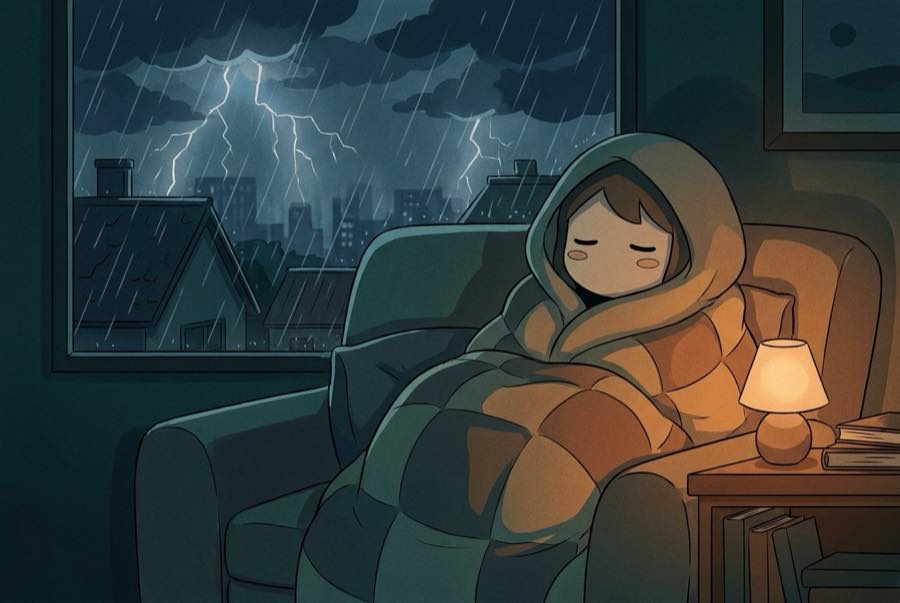
Why the thunder gets you, and why the waiting is worse
A thunderclap is loud, but loudness alone is not what jolts you out of near-sleep. It is the contrast. Your bedroom at midnight is quiet, your ears have settled to that quiet, and then something arrives that is enormously louder than everything around it, with no warning ramp. The flinch that follows is a reflex. You do not decide to do it, and you cannot decide not to.
Then there is the second thing, which nobody warns you about: the bracing. After the first close crack, you lie there half-listening for the next one. Every flicker at the curtain edge starts a countdown. Your body stays a few notches above the level it needs to fall asleep, not because of any single sound, but because it has been assigned a job — watch for the next one — and it will not put that job down.
That is why the plan below works on both at once. Fewer sudden arrivals reaching you, and less reason for the watching part of your brain to stay on shift.
How to sleep during a storm: settle the room first
Do this while you are still awake enough to move around. Ten minutes now beats twenty minutes of annoyance at 1am.
Close the windows and pull the curtains all the way. Two jobs in one. Glass takes some of the edge off the sound, and heavy curtains take most of the lightning out of the room. A flash you do not see is a countdown you do not start.
Find the rattle before it finds you. Indoors, one culprit usually owns the night — a loose window catch, a blind cord tapping, a vent flap. Wedge it, tie it, take the tension out of it. Those small repeating noises are what turn a distant storm into an all-night presence. If the wind is doing as much work as the thunder, the full walk-around is in how to sleep when the wind is loud.
Sleep in the room with the fewest windows if you want to. The spare bed, the couch, the side of the house facing away from the weather. Nobody is grading this.
Check the forecast once, then stop. Refreshing a radar map every twenty minutes is the surest way to keep yourself alert until sunrise. Look once, decide there is nothing more to do tonight, and put the phone face down.
On safety, keep it simple and boring. Indoors, in bed, away from windows, is the ordinary place to be while a storm passes over. We curate sleep playlists and we are not going to invent weather expertise on top of that — if you want real guidance for your region, your local emergency service publishes it, and it is worth reading in daylight rather than at 2am.
Cover the peaks with rain of your own
Here is the trick that changes storm nights: you are not trying to block the thunder, you are trying to shrink the distance between the storm and the silence it lands in. Raise the floor of the room with a steady sound and the same thunderclap arrives with far less contrast — it becomes part of a wet, busy night instead of a bang in a silent one.
Worth being straight about the evidence, since this is the one page in the set where we lean on it. The review of continuous sound and sleep (Riedy et al., 2021, Sleep Medicine Reviews) found the picture mixed: study quality varies a lot, and the results do not point the same way. Nobody should hand you certainty here. Our own reading, and it is ours rather than theirs, is that the clearest case for steady sound is the narrow one — masking an environment that keeps interrupting you. A storm night is about as plainly disruptive as an environment gets, which is why we are comfortable recommending it for this and more careful elsewhere. The longer version is in why rain sounds help sleep.
Rain is the natural choice here because it matches what is already happening outside. Your ears do not have to reconcile two different worlds; the room simply sounds rainier than it is. And the rain coming from your speaker is rain that will never crack, never swell, never surprise you — which is the entire point tonight.
Gentle Rain — No Thunder, No Surprises is the one we reach for when someone is bracing, and the reason is what has been taken out of it rather than what is in it: every rumble and swell is gone, so there is nothing in the recording that can imitate the thing you are flinching at. The tracks are cut to hand off without a gap, so set it to repeat before lights out and switch off any sleep timer your app applies by default — a playlist that stops at 2am hands the silence straight back to the storm. What we listen for before a track goes in is in what makes a rain sound work.
Two practical notes. Keep the volume comfortable rather than loud — you want it under the room, not on top of it, and low enough that you would still hear an alarm or a child. And accept the honest limit: a strike directly overhead will get through anything. Sound narrows the gap, it does not close it. Narrower is still a much better night.
If quiet rain is your register generally, the whole family lives in rain sounds with no thunder, and the other families are in the guide library. For the record, some people sleep beautifully to recorded thunder and seek it out on purpose — a different kind of listener entirely, covered in thunderstorm sounds for sleeping. Nothing is wrong with you for being on the other side of that.
If it wakes you anyway
It might. Storms move, though, and that is the useful thing to hold onto at 3am: whatever is over your roof now is on its way somewhere else.
Do not check the clock. Knowing the number never once helped anyone get back to sleep, and it hands your brain a fresh calculation to chew on. Do not reopen the radar either. Keep the lights off, let the rain keep running, and breathe out slowly a few times — a long exhale is unglamorous but it does take the edge down. If you are still wide awake twenty minutes later, get up briefly, keep the lighting low, do something dull, and come back. Lying there negotiating with the sky is the one approach that reliably fails.
One more thing, gently. If storms frighten you enough that storm season shapes your week — checking forecasts days out, dreading the evening, losing several nights in a row — that is worth mentioning to your doctor. Fear of that size is a recognized thing, real help exists for it, and a rain playlist is not the tool for that job.
Tonight, though, the job is small: curtains closed, phone down, and Gentle Rain — No Thunder, No Surprises on repeat until the storm has moved on without you.
This article is for general information and isn't medical advice. If sleep problems persist, talk to your doctor.