Light timing is where most general jet lag advice starts; everything else mostly makes the waiting more comfortable. That is the short version of how to sleep with jet lag, and it is worth knowing before you spend a third night staring at an unfamiliar ceiling, doing arithmetic about what time it is at home. The room, the bed, the sound in it — those all matter for tonight. But the reason you are wide awake at 3am in a city where everyone else is asleep is probably not the mattress. It is that your internal clock is still keeping time somewhere you left two days ago, and that is not a thing effort moves.
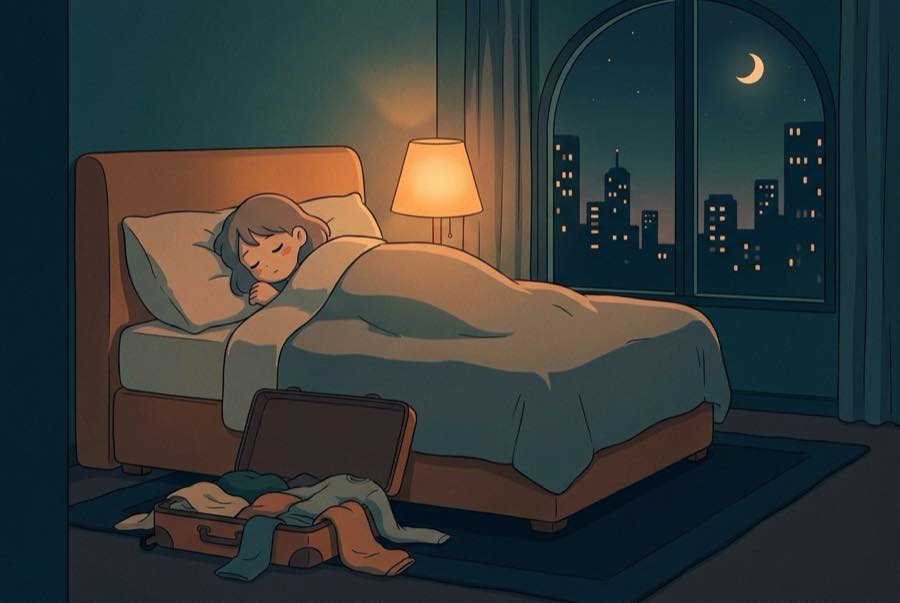
Jet lag is a timing problem, not a tiredness problem
You can be genuinely exhausted and still not sleep, because two different systems are arguing. One says you have been awake a long time and should rest. The other — the body clock — says it is the middle of the afternoon and there is no reason to shut down. Sleep pressure loses that argument more often than people expect.
That mismatch also explains why jet lag comes with the strange extras: appetite at odd hours, a wall of fatigue at 4pm, sharp alertness at midnight, digestion that feels a little off. Your body runs a whole schedule, not just a sleep switch, and the whole schedule has to move.
Two things follow from that. First, adjustment takes days, not one heroic night — a common rule of thumb is roughly a day per time zone crossed, and most travelers find eastward trips harder than westward ones, because going east asks you to fall asleep earlier than your body is ready to. Second, the fastest way to help is to give your clock the signal it actually reads.
Light timing does the heavy lifting
Light is the main input your body clock uses to decide what time it is, and light timing sits at the center of most general jet lag guidance, including the Sleep Foundation's. The trick is that the same light helps or hurts depending on when you get it.
Flying east (say, US to Europe): you need your clock to move earlier. Get outside in the morning light at your destination, even when you feel terrible, and go easy on bright light late in the evening — dim the room, keep the screens low.
Flying west (Europe to the US, or heading toward Asia the long way): you need your clock to move later. Take the late-afternoon and early-evening light, and be careful with very early morning light in the first days, which pulls you in the wrong direction.
Get outdoors for it if you can. Even an overcast sky outside is a stronger signal than a well-lit room, so a walk beats a window. On the first full day this is the single most useful thing you can do, and it costs nothing but a coat.
Alongside light, eat on local time as soon as it is reasonable, and get your caffeine early in the local day rather than as a rescue at 3pm. Anything you swallow to force the issue — melatonin included — is a conversation for a doctor or pharmacist, not for a sleep-playlist page.
How to sleep with jet lag on arrival night
The night you land is the one that sets the tone, and it goes better with a few decisions made in advance instead of at midnight.
Do not go to bed at 5pm. If you land wrecked, hold out to a plausible local bedtime — even a slightly early one is fine. If you must lie down, keep it short and early in the afternoon, then get up and get into daylight.
Set the room up while you still have energy. Curtains pinned shut, standby lights covered, room cooler than feels necessary, phone on its usual side of the bed. Deciding any of this at 2am is how a mediocre night turns into a bad one. If the flight itself is still ahead of you, the seat, light, and timing decisions in how to sleep on a plane will make the arrival easier.
Do your normal wind-down in the normal order. Shower, low light, a few pages, phone down. The city is unfamiliar; the sequence does not have to be.
Take the clock out of the room. Nothing on this trip is improved by knowing it is 3:12am here and 9:12pm at home. Turn the display away, set the alarm, and let it be tomorrow's problem.
Get up at the local morning time anyway. This is the hard one, and it is the one that pays. A short, honest night followed by morning daylight moves you forward. Sleeping in until noon keeps you exactly where you were.
What sound can and can't do here
Be clear about the job: sound does not move your body clock. It will not fix jet lag, and any page that tells you otherwise is selling something. What it can do is take care of the other half of the problem — a room you have never slept in, in a building full of noises you have no reference for, while a tired brain stays slightly on watch and catalogs every one of them. A steady sound gives that cataloguing one predictable thing to hold instead of a dozen unidentified ones, which is the whole mechanism, explained properly in why rain sounds help sleep.
There is a second, quieter benefit. If the same sound plays in every hotel, guest room, and rented apartment you sleep in, it stops being background and becomes a cue — a familiar thing in an unfamiliar place. For travel we tend to reach for water, because slow surf is about the least location-specific sound there is: it belongs to no city and gives a strange room nothing to argue with. Ocean Waves for Sleep — Slow and Steady is a deep pool of even, unhurried surf with no gulls, no crashing, nothing that arrives suddenly, and we hold every track in it to the same curation checklist. Put it on loop before you get in, at a volume low enough that the alarm you cannot afford to sleep through still lands.
If you are sharing the room with someone on a different schedule, low headphones work; if you want other options, the whole library sits at our guides.
The days after
Expect the second and third nights to be uneven, and expect a rough patch each afternoon. Naps are allowed, with limits: short, early, and never the long collapse that eats your evening sleep pressure.
If the trip is short — two or three days — you may be better off staying close to home time rather than half-shifting and feeling wrong in both zones. If you are home again and the schedule has drifted, the repair is a different job with a different method, laid out in how to fix your sleep schedule.
So: outside for morning light going east, evening light going west. Meals on local time. Caffeine early. A plausible local bedtime on arrival night, the clock turned away, and the local wake time held even after a bad night. Set the room up before you are tired, put something steady on repeat at low volume, and let the days do the rest.
This article is for general information and isn't medical advice. If sleep problems persist, talk to your doctor.