The fix has one lever, and it isn't bedtime. If you're looking for how to fix your sleep schedule after weeks of drifting later and later, the honest version is this: you set the time you get out of bed, you hold it every day, and you let bedtime come to you. Bedtime isn't really under your control — you can lie down at ten, but you can't decide to be asleep at ten. Getting up is under your control, even when it's unpleasant. Everything else here hangs off that one decision.
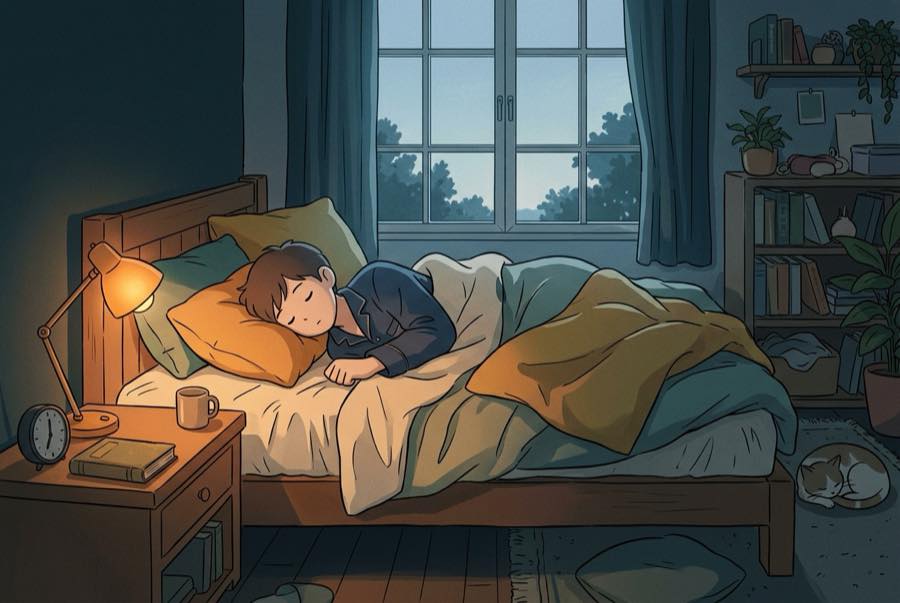
How to fix your sleep schedule: anchor the wake time
Pick the wake time your actual life requires on its most demanding weekday — not the aspirational 5:30 you saw somewhere, the real one. Then get up at it every day while you're resetting, including Saturday and Sunday. Feet on the floor, out of the bedroom, into the brightest room in the house.
This is the part people quietly negotiate with, and it's the part that decides whether the reset works. After a rough night, sleeping in feels like repaying a debt. It isn't. A long lie-in takes the pressure out of the following night, so you're not tired at your new bedtime, so you're up late again, so the next morning is worse. Two extra hours on a Sunday morning is close to moving yourself two time zones west without going anywhere — the same lag, the same Monday. If that pattern is familiar, the mechanics are the ones described in how to sleep with jet lag, minus the flight.
Hold the wake time for a few days before you touch anything else. It will make you tired. That tiredness is not the plan failing; it is the raw material the plan runs on.
Move bedtime in small steps, not one heroic night
The instinct is to fix it all tonight: you've been falling asleep at 3am, you need 11pm, so you'll lie down at 11 and force it. What happens instead is four hours of ceiling. Worse, you spend those hours teaching yourself that bed is a place where you lie awake, which is a lesson that takes far longer to unlearn than the schedule takes to move.
Shift in increments of about fifteen to twenty minutes, and hold each new bedtime for two or three nights before moving again. Some nights the shift happens by itself — with the wake time anchored, sleepiness arrives earlier on its own and you simply follow it. Following is much easier than forcing.
Two rules make the increments stick:
Only go to bed when you're actually sleepy. Heavy-eyed sleepy, not tired-of-being-awake sleepy. Sitting in the living room with the lights low for another twenty minutes is a better use of the time than lying in the dark negotiating.
Get up if it isn't happening. Lying there wrestling a bedtime that hasn't arrived yet teaches you that bed is where you wrestle, which is exactly the association a reset is trying to rebuild — the practical version of getting back up and going back is in how to fall back asleep.
Morning light moves the clock more than bedtime does
Sound and routine make the night easier. Light is what actually tells your body what time it is. Get outside within an hour of waking if you can, even for ten minutes, even under a gray sky — outdoor light on an overcast morning is far brighter than anything indoors. Then run the evening the other way: dim the room in the last hour, not just the phone. The Sleep Foundation's guidance points at the same lever, describing melatonin as the hormone that helps make you sleepy and noting that bright light late in the evening can delay it.
If you work nights or your mornings are dark for half the year, this gets harder and slower, and it's fair to say so rather than pretend a routine solves it.
Give the new bedtime a cue it can recognize
A schedule is a habit, and habits start with a signal. Right now your bedtime probably has no signal at all — you stop scrolling when your eyes give out, and that moment lands at a different hour every night. So give the new bedtime something consistent to arrive with: the same order of small actions, and the same sound underneath them, starting at the same point in the evening.
The sound is the easiest cue to keep, because it costs one tap and never depends on how the day went. We use rain for this, every night, and the reason it works as a cue rather than just as noise is that it is always the same: Rain on the Roof — All Night Sleep is sequenced so a whole night reads as one long night rather than a stack of separate recordings, which is exactly what you want from something you are trying to make automatic. The checks behind that are in what makes a rain sound work. Start it while the light is still on, not after you're already frustrated in the dark; the point is that it marks the boundary of the evening. Keep the volume behind the room rather than in front of it, and leave it looping, so the new bedtime isn't undone by a silence arriving at 3am.
Be clear-eyed about what the sound is doing. It won't move your body clock; light and wake time do that. What it does is make an unfamiliar bedtime pleasant enough to keep showing up for, which is the part most resets fail on.
How long this honestly takes
Longer than a weekend, shorter than you fear. A small correction — an hour, maybe ninety minutes — often settles within a week of holding the wake time. For a larger one, the kind where 4am has become normal, our rule of thumb is to plan for a two-to-four-week project rather than a fortnight of willpower, with the first several days the worst of it. Many sleepers find the mornings improve before the nights do: you're still lying awake a little, but getting up stops feeling impossible.
Expect setbacks, because they're not optional. There will be a late dinner, a deadline, a flight, a night where none of it works. A broken night doesn't restart the clock. Only one thing needs to survive it: get up at your anchor time anyway, take the tired day, and let that night's sleep pressure do the repair work for you. The schedule breaks at the wake time or nowhere.
If you want the cues around bedtime to outlast the reset itself, how to build a bedtime routine covers the durable version — three small actions in the same order, kept simple enough to survive an imperfect week. And if the trouble is a specific kind of night rather than the schedule as a whole, the situation-by-situation pages are in the guide library.
The short version
Choose the wake time your worst weekday needs and hold it every day, weekends included. Get outside light into your eyes within an hour of waking. Move bedtime fifteen to twenty minutes at a time, only lying down when you're genuinely sleepy, and getting back up when you aren't. Dim the evening, start the same sound at the same point every night, and give it the two to four weeks we'd budget for it. When a night goes badly, change nothing except getting up on time.
This article is for general information and isn't medical advice. If sleep problems persist, talk to your doctor.