The cabin lights go down, the last cart rolls away, and a few hundred strangers all decide at once that it is bedtime in a narrow room moving at cruising speed. Nobody designed this for sleeping. So the honest version of how to sleep on a plane is not a promise of a full night at 35,000 feet — it is a plan for getting several usable stretches of sleep instead of five hours of fidgeting. The good news is that a plane hands you one enormous advantage before you even sit down, and most people spend the flight fighting it.
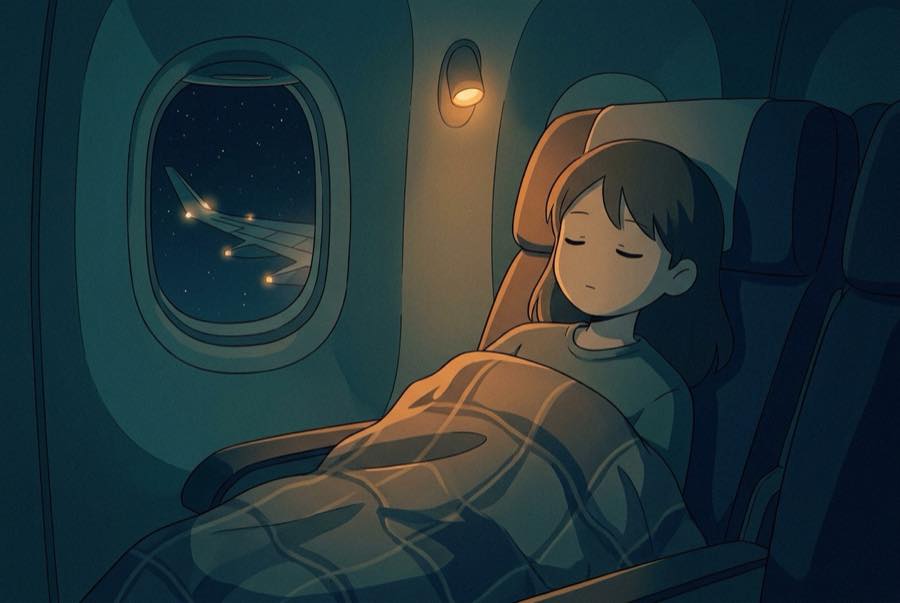
The cabin drone is already on your side
That constant wash of engine and air conditioning is about as close as ordinary life gets to a sound machine you can't switch off. It is broad, low, unchanging, and it never resolves into anything your brain has to identify. Most people don't lie awake because of the drone. They lie awake because of what pokes through it: the seatbelt chime, the galley door, the tray table snapping up behind them, a toddler three rows forward, the person in 24C deciding it's time for the overhead bin.
That's the whole strategy in one line — stop trying to escape the noise and start using it to hide the spikes. Research on continuous background sound and sleep is genuinely mixed overall, with the strongest case being exactly this one, masking a disruptive environment (Riedy et al., 2021, Sleep Medicine Reviews); the longer version is in why rain sounds help sleep.
Which is why the first decision is a mental one, and it happens on the ground: you are not going to win a fight with this cabin. Accept the drone, cover the spikes, get comfortable enough to stop noticing your own body, and let sleep arrive in pieces.
How to sleep on a plane starts before you board
The things that make the difference are almost all decided while you're still in the terminal, when deciding anything is easy.
Choose whether this is a sleeping flight. A short daytime hop probably isn't. An overnight into a new time zone probably is. Set your watch to the destination as you board, look at the window where sleep would actually help, and commit to it — the rest of the flight becomes reading and resting, which is a much kinder assignment than "sleep or else."
Eat before, not during. Meal service tends to land exactly when the cabin finally goes quiet. Eat something reasonable in the terminal, then tell the crew you'd rather not be woken for the tray. Most airlines will happily leave you alone if you say so before the service starts.
Go easy on the drinks. Coffee close to boarding is an obvious own goal, and alcohol, while it makes the first half hour feel easier, often makes the back half of the night shallower. Water is dull advice and still the right one — cabin air is dry, and waking up parched is a wake-up you can prevent.
Pack the seat pocket first. Eye mask, headphones, socks, water, anything you'll want later, out of the bag and within reach before takeoff. Digging through an overhead bin at midnight resets you completely.
The seat buys fewer interruptions, not more comfort
No economy seat is comfortable, so choose for interruptions instead. A window gives you a wall to lean against, control of the shade, and nobody climbing over you at 3am — for sleeping, it beats the aisle nearly every time. Seats near galleys and lavatories mean light, doors, and a queue of people standing beside your head. The very last row often reclines little or not at all. Rows ahead of the wing tend to be a touch quieter than the ones sitting behind the engines, though the difference is smaller than seat maps suggest.
If you can, avoid the bulkhead when you're hoping for a quiet night; it's frequently where the bassinets go. And bring a layer regardless of the forecast at either end. Cabins run cold once the lights are down, and cold feet in particular will keep you surfacing.
Hold your head, and stop the falling-forward wake-up
The classic plane wake-up isn't noise at all. It's your head tipping forward, your neck catching it, and your whole system jolting back online. Fix that and you've fixed the most reliable interruption of the flight.
A U-shaped pillow does more work turned around, with the opening at the back of your neck, so it props your chin rather than pushing it down. If yours is inflatable, leave it a little under-inflated — firm pillows push your head off the headrest. Many headrests have wings that bend inward; bend them. A rolled hoodie wedged between your head and the window works as well as anything sold in an airport, and a second roll under your thighs takes the strain off your lower back.
One small trick worth more than it sounds: fasten your seatbelt over the blanket, visibly. Crew check belts during turbulence, and a visible belt means they don't need to wake you to do it.
Dark, and then covered
Eye masks are the single highest-return item in your bag. Cabin darkness is a suggestion — screens two rows ahead, someone's reading light, a raised shade at sunrise, and on eastbound flights dawn arrives absurdly early. A mask that seals at the nose beats one that doesn't, and it also tells your seatmate you're not up for conversation.
Then cover the sound. Noise-cancelling headphones are genuinely good on a plane, but they do something slightly awkward: by pulling the drone down, they can make the chimes and voices stand out more sharply than before. Putting a steady sound back into that quiet is what makes them work for sleep.
For flights we use the fan family, because a low even hum sits so close to the cabin's own frequency that it disappears into it and takes the spikes with it: Fan Sounds for Sleep — Steady Hum — a deep pool of low, even hum with nothing in it that asks for your attention. Download it before you fly so it isn't waiting on a signal you don't have, set it to repeat so it doesn't stop mid-flight, and keep the volume low enough that you'd still hear an announcement.
If you already sleep to a fan at home, that's a second advantage — the same sound in an unfamiliar place works as a portable cue, the same way it does in a strange room in how to sleep in a hotel. The longer story on why the hum works so well is in fan sounds for sleeping, and the rest of the sound families are in the guide library if hum isn't yours.
What to expect, honestly
Upright sleep is lighter sleep, and plane sleep comes in fragments. That's normal and it's still worth having — a few short stretches leave you in noticeably better shape at the gate than none. Many travelers find the drowsiness comes more easily once they've stopped checking how long is left, so put the flight map away.
And if a stretch simply isn't happening, don't turn it into a contest — put the reading light on its lowest setting, read something undemanding for twenty minutes with the hum still running, and try again when your eyes start losing the page.
The short version
Decide on the ground whether you're sleeping, and tell the crew to skip you for the meal. Take the window, dress for cold, and get your mask, headphones and socks into the seat pocket before takeoff. Turn the neck pillow around so it holds your chin up, roll something under your thighs, and fasten the belt over the blanket. Start the hum before the lights go down rather than after, set to repeat and low enough to hear an announcement. Expect fragments rather than a night, and take them as they come.
This article is for general information and isn't medical advice. If sleep problems persist, talk to your doctor.