"How am I this tired and still this awake?" That's the real question behind how to sleep while camping — you hiked all day, you ate outside, you were yawning at the fire an hour ago, and now you're lying in a bag staring at a nylon ceiling with your feet cold and your ears working overtime. The good news is that camping insomnia is usually mechanical rather than mysterious. Four things account for most bad nights out: the ground, your feet, unfamiliar sound, and the walk you're dreading at 3am. Each one has a fix, and none of them costs anything at midnight if you set them up at dusk.
The ground is taking your heat, not the bag
Most people who sleep badly outdoors blame their sleeping bag. The bag is usually not the problem. Insulation works by trapping still air, and the moment you lie down you flatten every bit of loft underneath you. Under your back and hips there is essentially nothing left between you and a surface that has been quietly cooling since sunset. Ground pulls heat out of a body far faster than air does, which is why you can be sweating at your shoulders and shivering at your spine in the same bag.
So the number that matters most is your pad's insulation rating, not the temperature printed on your bag. Foam pads insulate reliably and never deflate. Inflatable pads with an insulation rating are warmer than they look. A bare air mattress — the kind you'd put a guest on indoors — is close to the worst thing you can sleep on outside, because it's a bag of cold air pressed against you all night.
If your pad is thin and the night turns colder than you planned for, stack. Anything dry and lofty goes underneath you: a closed-cell foam pad, spare clothing laid flat, an empty backpack under your hips, dry leaves under the tent floor if you're somewhere it's allowed. Two mediocre layers under you beat one good layer over you almost every time.
One flat rule before anything else: never bring a burning stove, a fuel heater, or a charcoal anything into a tent to stay warm. Whatever the temperature, the answer is more insulation under you and more layers on you, never combustion inside a small enclosed space.
Cold feet will keep you awake longer than a cold body
Feet are the part that decides. They're far from your core, they have very little muscle to generate heat, and once they get cold they tend to stay that way through the night no matter how warm the rest of you is. Falling asleep is commonly described as involving your body shedding heat from the extremities, and cold feet that can't warm up seem to leave people hovering just short of sleep for hours.
The fixes are all small. Change into a completely dry pair of socks that you have never worn during the day, even if the ones you have on feel dry — hiking socks hold more moisture than they let on. Keep those sleep socks in the bottom of your bag so they're warm when you put them on. Do something briefly active before you get in, like twenty squats or a short walk around the site, so you enter the bag already producing heat instead of asking the bag to make it for you. A hot water bottle at the foot of the bag, if you have the fuel to spare, is worth more than any extra layer.
Eat something before you turn in, too. A cold night burns through you, and going to bed genuinely hungry after a long day of walking is a common reason for waking at two in the morning feeling wired and chilled.
How to sleep while camping when every sound is unfamiliar
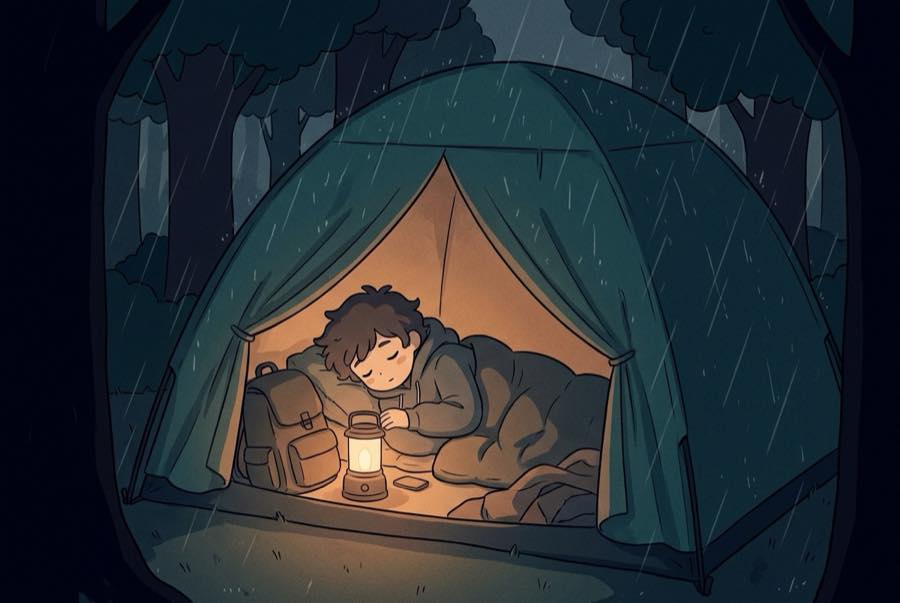
Here's the part no equipment list covers. A tent is a shelter that doesn't block sound — it blocks weather. So you lie there processing a whole catalog of noises you've never had to sort before: something moving in the leaves, a branch settling, wind changing direction, whatever that was over by the food bags. At home your brain ignores the fridge and the pipes because it has filed them as harmless. Out here, nothing is filed yet, so it checks everything. That watchfulness is a sensible instinct doing its job in a place your body doesn't know, and you cannot talk it out of it.
What you can do is give it something ordinary to listen to. A steady sound running in the background means a rustle in the leaves is no longer the only thing happening out there, which is a much smaller question for your body to answer — that's masking, and the honest version of what it does and doesn't do is in why rain sounds help sleep. It won't erase a noise. It softens the edge that makes you sit up.
For a night under canvas the closest thing we curate is Tropical Rain and Rainforest Nights, and the reason is texture: warm, close rain with a living night behind it is roughly what a tent already half-suggests, so it arrives as the woods rather than as a device in your ear. Everything in it is chosen to stay steady and loop cleanly, which is the whole checklist in what makes a rain sound work. Play it quietly on a phone speaker near your head rather than through headphones, low enough that you'd still hear anything that genuinely needs your attention, and leave it running on repeat — a playlist that ends at 1am drops you straight back into the raw silence you were trying to soften.
Battery is the practical limit here. Download before you leave signal, put the phone in airplane mode, and dim the screen all the way before lights out. If you'd rather match the sound to the trees around you than to rain, forest sounds for sleeping covers that family, and if it's the patter on the fly you're chasing, rain on a tent is the one. The other families live in the full guide library.
The 3am problem, planned for in daylight
Almost everyone camping drinks less water in the evening specifically to avoid the middle-of-the-night walk, then sleeps badly because they're mildly dehydrated and cold. It's the wrong trade. Drink normally, and instead make the trip so easy that it barely wakes you.
Sort it out while it's still light. Know where you're going and what the route looks like. Put your headlamp inside the bag with you, not in a pocket somewhere across the tent — hunting for a light in the dark is what actually wakes you up, not the cold air. Set your shoes right at the door, facing out, so your feet find them without a search. Leave the tent zipper partly open at the bottom so you're not fighting it half-asleep.
Then keep the trip boring. No bright white light if you can help it — red mode, or the dimmest setting you have. Don't check your phone. Don't look at the time. Get back in, get your socks and hat back on, and let the sound you left running pick you back up.
Set it up at dusk, in this order
Pitch on the flattest ground you can find and clear the stones. Put your best insulation underneath you and stack anything spare under your hips and shoulders. Change into dry sleep socks and a hat, and warm yourself up briefly before getting in. Eat something. Put your headlamp inside the bag, your shoes at the door pointing out, and your phone charged, downloaded, dimmed, and running something steady on repeat. Then stop optimizing and let a tired body do what it already wants to do — and if the first night is still rough, the second one out is usually much better.
This article is for general information and isn't medical advice. If sleep problems persist, talk to your doctor.