Some nights the problem isn't noise, exactly. It's the room. The same four walls, the same hum of the building, and a mind that keeps pacing inside all of it. What you're reaching for isn't silence — it's somewhere else. Trees overhead, soft ground, a dark that sounds alive without asking anything of you. That's the instinct behind searching for forest sounds for sleeping, and it's a good one. The night side of a forest is one of the gentlest places a tired head can go.
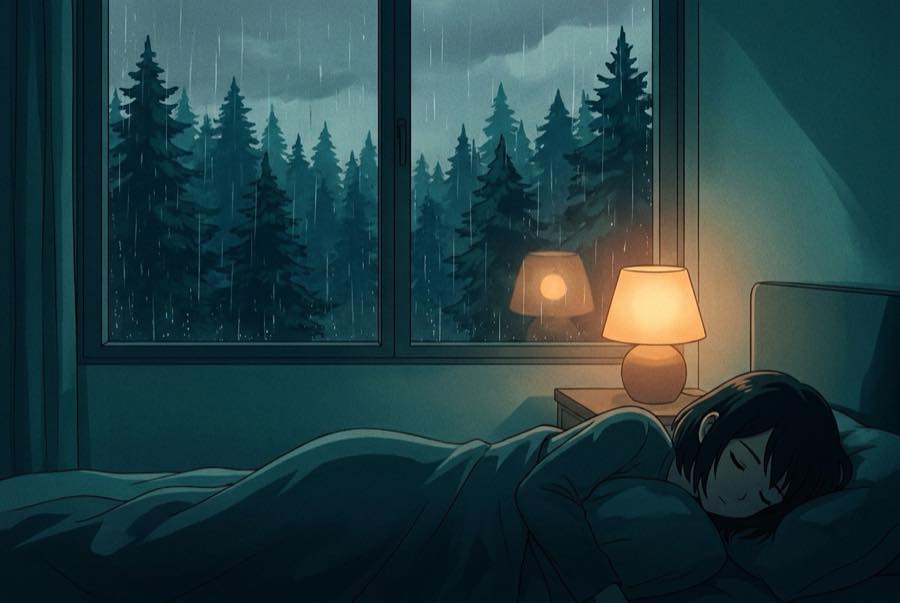
Here's the version of it we'd hand you tonight.
Play Forest, River and Night Nature — a deep well of hand-curated forest floor: leaves moving in slow air, water running somewhere below, the low hush of woods after dark. Repeat on, volume low — just enough that the room stops sounding like your room.
The rest of this page is the longer walk: what a night forest actually sounds like, why that particular quiet settles people, and how to tell a sleep-ready forest recording from one that turns theatrical at 3am.
What forest sounds for sleeping actually sound like
A daytime forest is a busy place — birdsong, wind gusts, things moving. Almost none of that belongs in your bedroom. The forest that helps you sleep is the forest floor at night, and it's made of three quiet layers.
Leaves. Not gusts — a gust announces itself, and anything that announces itself can drag a light sleeper back to the surface. What works is the slow, continuous stir of a canopy in light air: a soft, papery wash that never quite starts and never quite stops. It's the forest's version of steady rain, and it does the same patient work on a restless room.
Water. Somewhere in the mix, usually below and to one side, a stream keeps moving. Running water is the most reliably constant sound in nature — it doesn't pause, swell, or change its mind. If you notice, mid-listen, that the water is the part your attention keeps resting on, that's worth knowing about yourself; we wrote a whole page on river sounds for sleeping for exactly that sleeper.
The birdless dark. This is the layer people don't expect. Real woods at night are almost empty of birdsong — the dawn chorus is a sunrise phenomenon, which is precisely why it has no place in a sleep recording. A track that drifts toward chirps and calls is quietly telling your brain it's morning. The recordings that hold a whole night keep the birds asleep too: maybe a distant owl, maybe crickets low in the mix, mostly just air and leaves and water. Green quiet.
And notice what the canopy itself is doing in all of this. A forest recorded from the floor is a room with a ceiling — the leaves overhead don't just make sound, they shape it, taking the edge off the wind before it ever reaches you and closing the open sky into something nearer and softer. That's a large part of why night woods feel sheltering rather than exposed: you're under something. Rain gives you the roof of your own house; a forest lends you a roof of leaves, and the green quiet underneath it is the sound of that roof holding.
Why the green quiet settles you
Part of the effect is ordinary masking — a steady wash of sound raises the floor of the room, so the door down the hall or the car outside registers as a smaller spike — and the full explanation of how that works lives in why rain sounds help sleep.
But with forest sound there's usually a second thing going on, and it's less mechanical. Many sleepers find that a familiar natural setting works as a cue: the body seems to file "woods at night" under safe, outside, nothing to monitor. You're not listening for meaning the way you do with voices or music. Nothing in a night forest is addressed to you. For a mind that's been answering things all day — messages, questions, its own looping thoughts — a soundscape with no content to process can feel like finally being off duty.
We'd hedge that honestly: it isn't a switch, and it lands differently for different people. Some settle into leaves and water within minutes; others find rain or plain steady noise sits better. The way to know is a few unhurried nights of trying, not a promise from us.
How we choose the tracks
Every recording in Forest, River and Night Nature is listened through start to finish and held to the steady, no-fade, loopable bar we lay out in full in nature sounds for sleeping — and what makes a rain sound work explains why those three checks are the whole game. Set the playlist to repeat once, before lights out, and the forest simply starts over instead of running out beneath you.
If the forest isn't quite your sound
Nobody owes a landscape their loyalty, so a few honest redirections.
If it's the moving water you love and the leaves feel like clutter, go straight to river sounds for sleeping — a river on its own is even more constant than a forest around one.
If you're still circling — forest, rain, ocean, night air — the chooser in nature sounds for sleeping walks through the families by feel, and the full library of guides is there when you want to wander.
Tonight
Low volume. Repeat on. Forest, River and Night Nature — leaves, water, and birdless dark, running until morning.
Put the phone face down and let the trees have the night.
This article is for general information and isn't medical advice. If sleep problems persist, talk to your doctor.