Somewhere in your memory there's a night in a tent — rain starting softly on the canvas a foot above your head, and you, warm in a sleeping bag, feeling more sheltered than any house has ever made you feel. That's the feeling you're looking for tonight, and you don't need a campsite to get it back. Rain on a tent sounds different from every other kind of rain, and the right recording of it can turn your bedroom into that small, safe space again.
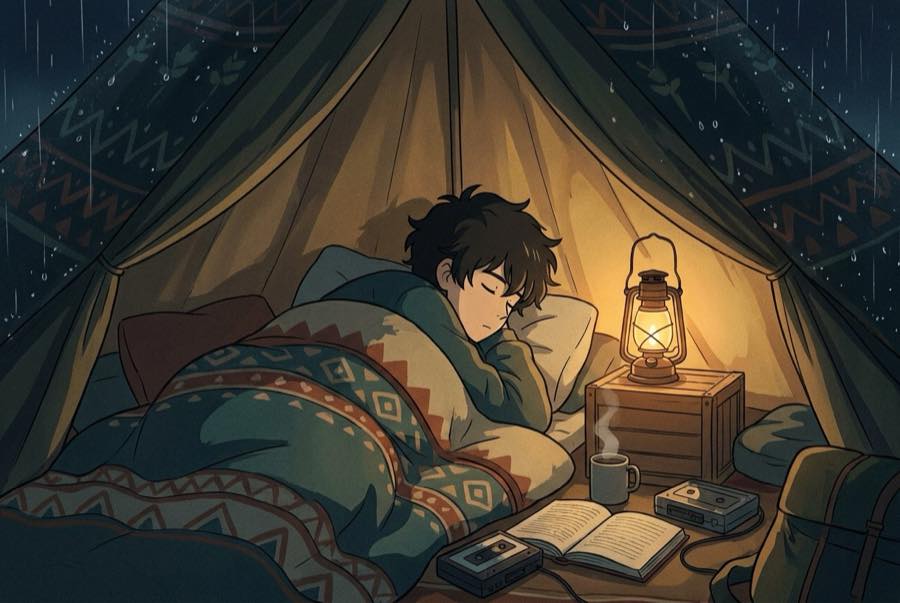
One honest note before anything else: we don't have literal rain-on-canvas recordings. What we do have is Tropical Rain and Rainforest Nights — warm, close tropical rain, the nearest texture we curate to rain landing on a tent fly, and it stays steady from the first minute to the last. Set it to repeat before lights out; that's what carries the rain through the whole night instead of leaving you in silence at 1am. Volume low, phone face down, and let the closeness do the rest.
The rest of this page is for the part of you that's still awake and curious: why tent rain feels the way it does, how we choose recordings that hold that feeling, and where to go if canvas isn't quite your sound.
Why rain on a tent sounds so close
Most rain you hear in life is far away — on the street, on the window, on someone else's roof. Tent rain is the opposite. The fabric is inches from your ears, so every drop lands as a soft, rounded tap, and thousands of them together make a texture that's more like being wrapped in the rain than listening to it.
Canvas does something metal and glass can't. It's a soft surface, so there's no ping, no rattle, no hard edge to any single drop. The result is a low, muffled patter — intimate without being sharp. Many sleepers find that closeness is exactly the point: the rain isn't weather happening out there, it's a blanket of sound happening right here.
And then there's the shelter feeling. A tent is the smallest roof you'll ever sleep under, and hearing rain land on it — close, constant, and completely unable to reach you — is one of the clearest safe signals a brain can get. You're not imagining the coziness. The sound is doing real work too: steady rain masks the small noises that would otherwise pull you awake, and we've written the full, honest explanation of how that works in why rain sounds help you sleep.
If it's the memory itself that matters — a specific camping trip, a cabin summer, a childhood — that's worth honoring. A familiar sleep sound can act as a cue: your body has fallen asleep to this before, and it remembers how.
What makes a tent-rain recording sleep-safe
Not every recording of rain on canvas will hold a night. Out at a real campsite, rain gusts and eases, wind shakes the fly, a branch drops somewhere in the dark. Charming at a bonfire, terrible at 3am — every gust and dropped branch is a surprise, and surprises are what pull a sleeper back to the surface.
So we listen through every track before it earns a place and hold it to the same steady, no-fades, loopable bar as everything we curate — what makes a rain sound work walks through those three checks.
Tropical Rain and Rainforest Nights is built from recordings that pass that bar — warm, close tropical rain whose soft canopy character comes closer to canvas than anything else we have, sequenced so nothing startles. No playlist lasts the whole night on its own, which is why repeat isn't optional: turn it on and the playlist becomes an all-night tent.
Setting up your tent for the night
The method is small on purpose. You're trying to fall asleep, not manage equipment.
Set the volume before the lights go off. Aim low — the level of rain landing on fabric above you, present but never demanding. If you have to raise your voice over it, it's too loud.
Turn repeat on. This is the one setting that matters. A playlist that stops mid-night hands you back to silence, and the contrast can wake you as surely as a noise would.
Put the phone out of reach, face down. The tent works because there's nothing to do inside it. Once the rain is running, your only job is to lie there and let it fall.
Speaker over headphones, if you can. Rain filling the room reads as weather around your shelter. Headphones can work for travel or a shared bed, but a soft speaker across the room is closer to the real thing.
If canvas isn't quite your rain
Tent rain is one texture in a bigger family, and the right sleep sound is the one your body relaxes into without arguing.
If your memory is a cabin rather than a campsite — rain drumming on metal, brighter and more percussive — you want rain on a tin roof instead. Same shelter feeling, harder roof.
If what draws you is the warmth and depth around the rain — a living, humid night rather than just the patter — go one layer further into rainforest sounds for sleep, where the same playlist's jungle character gets room to breathe.
And if you're still deciding what kind of sleeper you are, the full library of sleep sound guides walks through every family, from ocean to thunder to plain steady rain.
Tonight, though, the tent is already pitched. Put on Tropical Rain and Rainforest Nights, set it to repeat, zip the day out, and let the rain land just above your head.
This article is for general information and isn't medical advice. If sleep problems persist, talk to your doctor.