Most people who sleep well with sound at home lose that sound the moment there's a second bed in the room. The speaker stays off, the phone goes face down, and the one reliable part of the routine is the part that gets cut. If you're working out how to sleep when sharing a room — a hotel with your family, a hostel bunk, a guest room at your in-laws', a friend's floor — the problem is rarely the other person being loud. It's that your usual fix has become impolite, and nothing has replaced it.
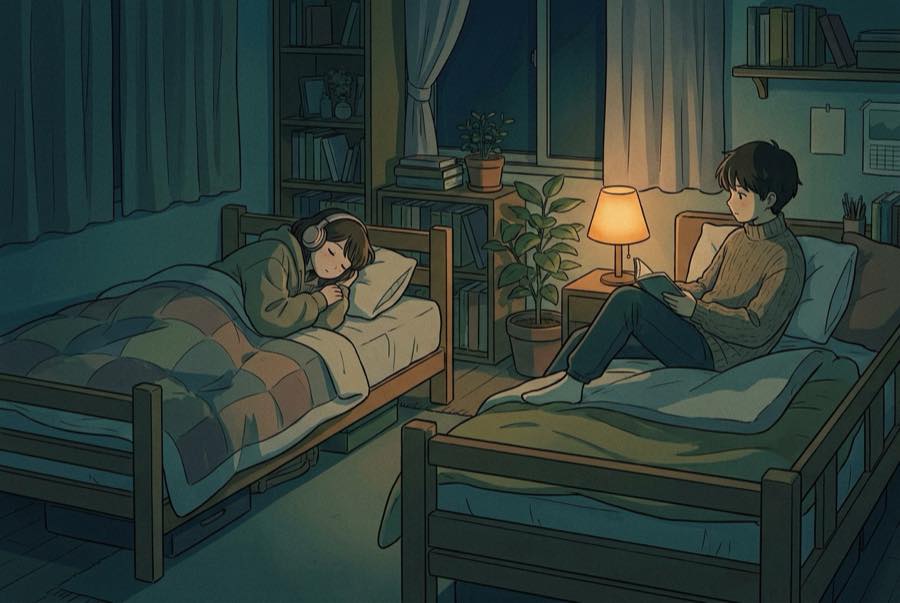
This page is about borrowed rooms: the ones you are in for a night or a week, where you have no standing to change anything and will be gone before any arrangement could settle. That constraint is the whole design brief. If the shared room is your own bedroom and the other person is your partner, you can actually negotiate, and the long-run version of that conversation is in sleep sounds for couples.
A shared room has two noise problems, not one
The first is obvious: their sounds reach you. Breathing, turning over, a zipper, someone getting up in the night, the bathroom door. None of it is loud, but a shared room is full of small changes, and changes are what your ear checks on. A steady background sound blurs those changes so they arrive with less edge — the mechanism is explained properly in why rain sounds help sleep.
The second problem is the one that actually keeps people awake, and almost nobody plans for it: your solution reaches them. You can't run a speaker at your usual volume next to someone who sleeps in silence. So you lie there with no sound at all, listening to a room you're not used to, doing the polite thing and paying for it half the night.
Almost everything below is about solving the second problem so you can use the first solution. In a borrowed room the sound has to be private by default, because you cannot assume anything about the person in the other bed and you will not be there long enough to find out.
How to sleep when sharing a room without keeping anyone else awake
One ear, not two. The single most useful habit in a borrowed room: play the sound in one ear and leave the other open. You get the masking and you stay reachable — a knock at the door, a child, a fire alarm, your own alarm in the morning. It also means you can sleep on the free ear, which solves most of the discomfort of wearing anything overnight.
Wireless, or a pillow speaker — not the wired buds in your bag. A cord in a bed is worth taking seriously. It wraps around your arm, your neck, or the bed frame as you turn, and in a narrow bunk or a child's bed that's a real hazard rather than a theoretical one. So no tucking one side of a wired pair in and letting the other hang, and nothing corded anywhere near a child's bed. A single wireless bud, a flat sleep headband, or a thin pillow speaker slid inside the pillowcase all avoid the problem outright; which of those actually suits your sleeping position is worked out in headphones or a speaker for sleep.
Volume lower than feels right. Hours of sound at close range is a different thing from a track on the bus. Set it quiet — quiet enough that the room still exists around it — and set it before lights out, not half-asleep in the small hours when your judgment about volume is at its worst. In a borrowed room, low volume is also what keeps you a reasonable roommate: at the right level, nothing leaks past your own pillow.
Start it before you lie down, then keep your hands off it. The worst outcome in a shared room is fumbling for a phone in the dark because the sound stopped and now you're awake, staring at a bright screen, in a room where you can't turn on a light. Put it on repeat while the lights are still on and make that the last thing you touch.
What to play when it's inches from your ear
Close range changes what works. Big, wide rain recorded to fill a whole bedroom sounds odd arriving from a single bud or from inside a pillow — the width has nowhere to go, and the low end turns to mud. Something small and near holds up far better.
That's why we reach for Rain ASMR — Dark and Close in borrowed rooms specifically: it was recorded tight, drops with their own weight landing about an arm's length away, and it's built to be played quietly rather than filled out — which is exactly the constraint you're under when the person in the next bed sleeps in silence. The tracks are edited to run into each other with no gap at the join, so put it on repeat and check that your app hasn't quietly set a sleep timer for you. The rest of what we listen for is in what makes a rain sound work.
The rooms you're most likely to be sharing
A hotel room with family. The constraint is bedtimes that don't match — kids down early, you much later, everyone up at whatever hour the youngest decides. One ear keeps you listening and on call at the same time. Do the room setup while the lights are still on: bags unpacked, chargers placed, tomorrow's clothes out, so the last stretch of the evening is quiet and you're not opening zips in the dark.
A hostel dorm. More people, more arrivals, more phones, and no way to influence any of it. Something in your ears is effectively mandatory, and the bunk is narrow enough that wireless is not a luxury. Keep your phone and a small light within reach so you're never groping around after midnight, and use the eye mask — hostel light discipline is nobody's strength. The longer version of living with mismatched schedules is in how to sleep in a dorm room.
A guest room at someone's house. The awkward one, because you feel you can't ask for anything. You can ask for one thing, and it should be the thing that helps most: a fan, an extra blanket, or permission to close a door. Beyond that, being self-sufficient is the polite move — private sound saves everyone the conversation and saves you the second night of lying there being gracious.
A friend's floor or couch. Least control of all, and usually the shortest stay, so optimise for the things you brought with you rather than the room. Sound in one ear, an eye mask, a jumper for a pillow. Nobody is going to reorganise a living room for you, and you don't need them to.
Bunk beds, or a room with children in it. Both are reasons to be stricter, not more relaxed. Nothing corded goes in a bunk or in a child's bed, for the reason above. For children specifically, the better answer isn't headphones at all: one low, steady sound out loud on a small speaker across the room does the job for everyone in it and doubles as a bedtime cue.
When you can't renegotiate the room
At home, a shared room is a standing arrangement and you can improve it over weeks. In a borrowed room you get one night to work with, and asking for changes costs social capital you may not want to spend. So the rules invert.
Assume nothing about the other person's tolerance. Someone who says they don't mind at eleven can mind a great deal at three, and by then they are not going to say so. Private sound removes the question entirely.
Bring your own room with you. Eye mask, something to play sound through, earplugs if you use them. Anything you can carry is a thing you don't have to ask for. A borrowed room is easier to fix from your bag than from a conversation.
Ask for one thing, early, in daylight. If there is a single change worth requesting — a window closed, a door ajar, a lamp off — ask before bedtime rather than at midnight, and ask for one thing rather than a list.
Accept a worse night gracefully. A trip is not a sleep schedule. One rough night in a hostel is not worth troubleshooting at 4am, and treating it as a temporary cost rather than a crisis is itself the thing that gets you back to sleep.
What to do tonight
Charge one wireless bud, or pack a sleep headband, and use one ear so the other stays open for the room. Set the volume before you get into bed, lower than feels necessary, and start it on repeat while the light is still on. If a pillow speaker suits you better, put it inside the pillowcase rather than under the pillow, where it's muffled. Leave the corded pair in your bag. Other options for the sound itself are in the guide library.
This article is for general information and isn't medical advice. If sleep problems persist, talk to your doctor.