Loneliness keeps hours. It is survivable at two in the afternoon, with a task in front of you and people moving around somewhere nearby, and it gets considerably heavier around eleven, when the last of the day's noise drops away and there is no one to say goodnight to. The search that brings most people to a page like this one — how to sleep when lonely at night — usually gets typed at exactly that hour, one-handed, in the dark, by someone who would rather not be thinking about it at all.
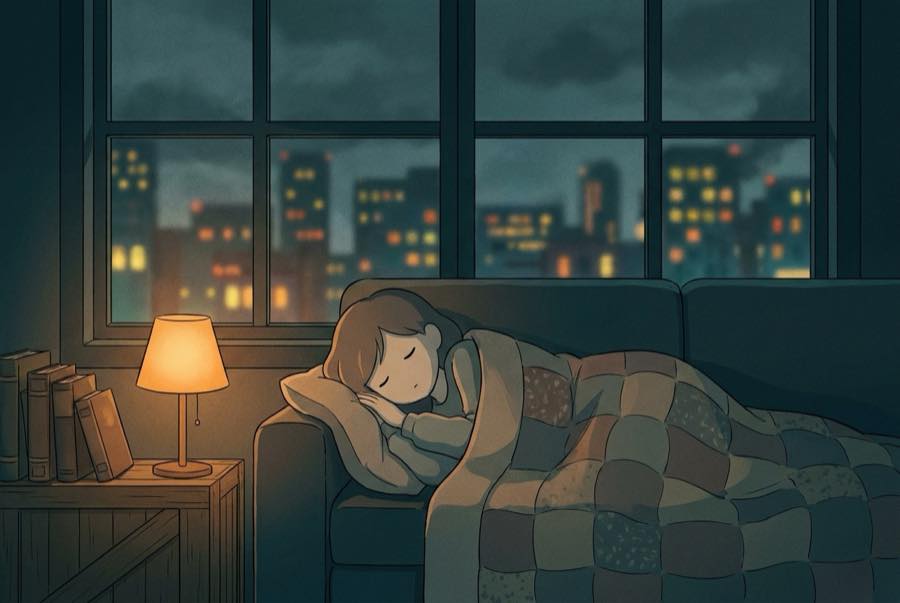
So this page won't pretend the feeling is a scheduling error. It's about the hour itself: why it lands harder after dark, what genuinely takes the edge off it, and what a sound can honestly do for you between now and morning.
Why the dark makes it louder
Nothing about your life changes at 11pm. What changes is how much else there is to hear. During the day you are surrounded by low-grade evidence of other people — traffic, a colleague, a delivery, someone laughing on the street below. It doesn't add up to connection, but it fills a gap you don't notice until it empties. At night the gap is the whole room.
Then the mind, given nothing to do, starts drawing conclusions from it. The dark is very good at making a temporary situation feel permanent and a private one feel unique, and at running comparisons against a version of everyone else that doesn't exist. Almost none of the thoughts that arrive at 1am survive contact with 10am, but that isn't much comfort while they're arriving.
Worth saying plainly: this is an ordinary thing to be experiencing. It shows up for people who live alone and people who don't, in new cities, after a move, on the wrong side of a shift schedule, when the kids have grown up and gone, when a partner is away, when everyone you'd text is asleep. It is not evidence of anything being wrong with you. It's the predictable result of a quiet room and a mind that evolved to notice when the group had moved on without it.
How to sleep when lonely at night: give the hour a shape
The evening that goes badly is usually the one with no edges — the one that drifts from the sofa to the phone to bed without anything marking the difference. Structure does a surprising amount of work here, because a shaped hour is one you're moving through rather than sitting inside.
Pick a finish time and mean it. Not a bedtime — a finish time, after which the day is closed and nothing further is required of you. Loneliness gets worse in open-ended time, and an evening with a stated end is a much smaller thing to get through.
Put the phone somewhere it takes effort to reach. It's the hardest one, because at this hour the phone is contact-shaped: messages that might arrive, faces of people who aren't here, an endless scroll of everyone's edited good time. It offers the appearance of company and quietly deepens the actual feeling. Charge it across the room and let the last twenty minutes of your day be yours.
Use warmth, since your body doesn't know the difference. A hot shower before bed, socks, a heavier blanket, a hot water bottle at your feet, something to hold. Physical comfort is not a substitute for a person and it isn't pretending to be one — it's a real signal to a nervous system that reads warmth and weight as safety.
Bring the light down, not just off. One low lamp for the last stretch instead of the overhead, and the overhead never after that. A dim room is a smaller, closer room, and a smaller room feels less empty than a bright one with all its corners visible.
Leave one thing for tomorrow. Something small and specific waiting in the morning — coffee somewhere you have to walk to, a message you'll send when it's a decent hour, a class, a shift, an errand that puts you near other people. Reaching out is a daylight activity. Tonight's job is only to get you to daylight.
The company of sound
A room with sound in it is not the same room as a silent one. Part of that is ordinary and physical, and why rain sounds help sleep covers that part properly. The rest is simpler than any mechanism. Silence at 1am has a way of confirming that nothing is happening anywhere, to anyone, and that is the exact thought this hour is built out of. Weather in the room says otherwise without having to say anything.
The coast suits it better than plain rain does, and for a reason worth stating plainly: rain over water has two things going at once — the rain arriving, the sea working underneath it — so there is always something moving without anything ever happening. It sounds like standing at a dark window in a house where the weather is outside and you are not. Sea and Rain — Coastal Night is that window. Let it play straight through the night rather than run to a timer, because the whole point is that the room is still occupied at four in the morning, and set it just present enough to be there without filling the space.
Nothing in it swells or breaks or fades out on you, which is the standard we hold every sound to — what makes a sleep sound work has the rest of it. If weather feels like too much presence and you'd rather have a quiet landscape than a loud sky, night sounds for sleep is the gentler end of the same idea. And if the emptiness has a specific shape — a person who used to be on the other side of the bed — how to sleep after a breakup is the closer fit.
The honest part
A playlist is not company. It doesn't know you're there, it isn't thinking about you, and it can't do the thing you actually want, which is to be less alone. What it can do is make the room less bare and give your attention something to rest on that isn't the inside of your own head — and on a hard night, at midnight, that's a fair trade rather than a small one. We'd rather say that straight than dress it up.
The part that changes things happens in daylight and it's unglamorous: one message sent, one standing arrangement in the week, one place where somebody notices whether you turned up. Those are slow and they feel like nothing at first. They also work in a way that no amount of good sleep advice does.
And there's a line worth watching for. If the loneliness has settled into weeks where the mornings are heavy and stay heavy, where food stops mattering, where nothing you used to enjoy lands anymore, or where the thoughts turn dark — please talk to a doctor. That's a common thing to bring them and they take it seriously, and it is not an overreaction to ask.
Tonight
Tonight only has to be gotten through, not solved. Put Sea and Rain — Coastal Night on before you turn the lamp off, leave it playing, and let the coast keep the room occupied until morning. Everything else we've written is in the guide library when you want it.
This article is for general information and isn't medical advice. If sleep problems persist, talk to your doctor.