Stand outside a country house an hour after midnight and listen: crickets keeping slow time, air moving through trees somewhere off in the dark, water working over stones a field away. Nothing is happening, and it sounds like it. That's what night sounds for sleep are — not weather, not music, just the low signal of a world that has already gone to bed. Put a recording of it on, and a sealed, humming bedroom — the wrong kind of quiet — gets to borrow the right kind.
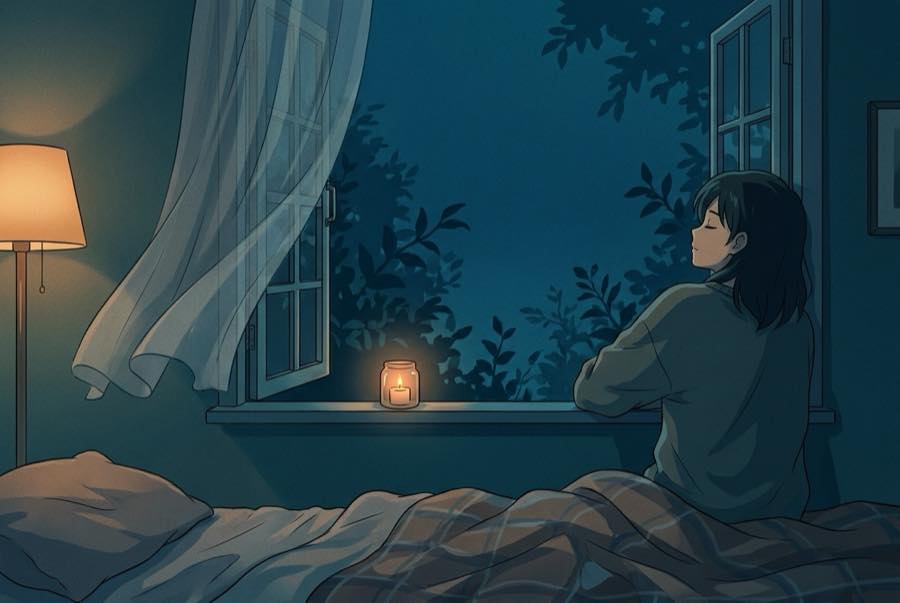
Play Forest, River and Night Nature — a deep pool of hand-curated night: crickets, soft river water, leaves, distant air. Set it to repeat and it holds that open-window feeling until morning.
The rest of this page is the longer answer: what counts as a night sound and what doesn't, why this particular texture settles so many people, how we choose the recordings, and what to reach for if crickets aren't your thing.
What night sounds for sleep actually are
A night sound is the ambience of a landscape at rest, recorded after dark. In practice that means a few layers sitting together: crickets or other night insects pulsing at an even rate, a low bed of moving air, sometimes a river or stream far enough away to read as texture rather than splashing, and the occasional soft shift of leaves. Nothing announces itself. Nothing asks to be listened to.
Just as important is what a good night recording leaves out. An owl calling close to the microphone, a dog barking two yards over, a single loud insect that wandered up to the recorder — each is an interruption, and 1am is the worst possible hour for one, arriving right as you were starting to let go. The best night sounds are background in the truest sense: a scene your mind can rest inside without ever needing to check on it.
What defines the family, more than any single ingredient, is distance. In a good night recording everything is far away — the water is a field off, the air is moving in someone else's trees, even the crickets seem to be singing from the edge of the property rather than under the window. Night ambience is the quietest, most spacious thing we curate; where rain fills a room and a river runs through it, the night mostly just widens it. That's why it suits sleepers who find every other sleep sound slightly too much: it isn't really a sound you play so much as a horizon you open.
Why the sound of night helps you drift off
Part of it is plain masking — a steady bed of sound raises the floor beneath the door-slams and pipe-clicks of your building so they register less, and the full explanation of how that works lives in why rain sounds help sleep.
But night sounds bring something the mechanical sounds don't: meaning. For many people, crickets are the sound of a childhood window left open in July, a tent, a porch, a holiday somewhere warm. Many sleepers find that a sound their body already files under "safe summer night" does half the relaxation work before any masking happens. There's an old intuition in it, too — steady crickets have always meant that nothing out there is stirring. When they stop, something is moving. When they keep going, all is well. A recording that keeps going all night is, in a quiet way, a continuous all-clear.
And crickets are remarkably steady collaborators. A healthy field of them holds its rhythm for hours — an even, unhurried pulse that gives your mind one soft thing to settle on while everything else dims.
How a track earns its place
Real nights are full of small dramas — a bird startles, a branch drops, a plane crosses — so night recordings fail curation more often than you'd think. The tracks in Forest, River and Night Nature are the ones where nothing happens, on purpose: each was listened through and held to the checks we lay out in nature sounds for sleeping, for the reasons what makes a rain sound work explains.
If crickets aren't your sound
Not everyone relaxes to insects, and that's fine — no sound helps if you have to talk yourself into it. If you want the calm of night without any wildlife at all, try Fan Sounds for Sleep — Steady Hum — no crickets, no water, no weather, just an even hum; set it to repeat like anything else you sleep to. There's more on scene-free sleeping in ambient sounds for sleeping.
And if you're not sure which family is yours — forest floor, rainforest, ocean, open night — the chooser in nature sounds for sleeping walks through them by feel, and the full library has every family in one place.
Letting the crickets take the last shift
Setup is a single habit — repeat on, volume low, playlist started before the phone goes face down — and the full walkthrough of it lives in nature sounds for sleeping.
Then let the crickets take the last shift. They're good at it — they've been keeping watch over sleeping houses for as long as there have been houses. Play Forest, River and Night Nature, on repeat until morning, and follow it so the next wrong-kind-of-quiet night is one tap from the right kind.
This article is for general information and isn't medical advice. If sleep problems persist, talk to your doctor.