Grief usually rearranges sleep before it rearranges anything else. Nights that were ordinary a month ago turn long and strangely lit; sleep shows up at four in the afternoon on the couch and refuses at midnight in a bed. If you have been looking up how to sleep when grieving, it is worth saying plainly at the start: this is a normal response to a loss, not a malfunction, and nothing written here is going to fix it. Grief is not a problem to be solved. It is something you are carrying, and carrying it is tiring in a way that does not reliably turn into sleep.
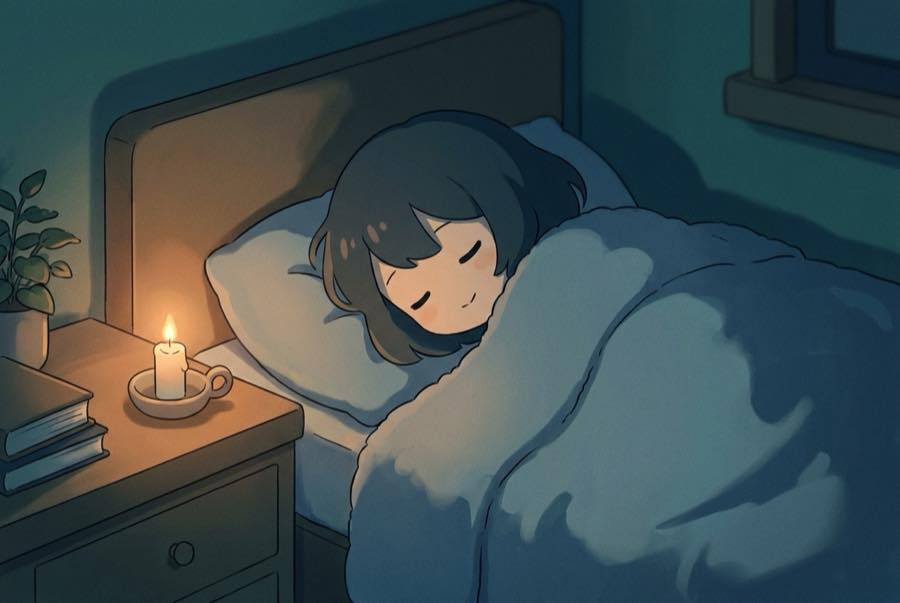
So what follows is smaller than a solution and honest about its size — a few gentle practicalities for the hours between lying down and morning, and a nudge toward the kind of support a web page cannot give you.
What grief tends to do to nights
Sleep after a loss rarely goes wrong in one tidy way. It goes strange in several, and they can trade places from week to week.
Falling asleep gets harder because the day finally stops. All day there are people, calls, forms, and something to do with your hands. In the dark, the mind has the room to itself, and it goes where it has been trying to go since morning.
Early waking is common — three or four in the morning, wide awake, with the whole thing waiting for you. So is the reverse: sleeping heavily, for a long time, and waking up feeling as though you have not slept at all. Vivid dreams of the person are often reported by grieving people, and so is the small cruelty of waking up, having a clear second, and then remembering. That second is one of the hardest parts of the day, and it is not a sign that you are doing grief wrong.
None of this follows a schedule. Some nights are unremarkable and the next one is bad for no reason you can name.
How to sleep when grieving: lower the bar first
Before any tactic, there is a decision that helps more than any of them, which is to stop grading the night. Eight hours is not the target right now. Rest counts. Lying warm in the dark with your eyes closed counts. A broken night with two long stretches counts. If you are awake at three and quietly falling apart, you are not failing at sleeping, and you are not failing at grief.
Two small versions of that, if they fit:
Turn the clock away. Doing arithmetic at three in the morning about how much is left adds pressure to a night that already has enough.
Do not let it become a standoff. On a grieving night the bed is where the missing is loudest, so getting up for a while is a relief rather than a defeat — the reasoning, and what to do with the time, is in how to fall back asleep.
Small things that help around the edges
Keep one anchor in the day, if you can. Days often lose their shape after a loss, and sleep drifts with them. Getting up at roughly the same time and getting outside into daylight fairly early is a modest anchor, and it asks very little of you.
Move the admin out of the evening. Death brings paperwork — accounts, certificates, calls with people who put you on hold. Doing any of it after dark almost guarantees it comes to bed with you. Give it a window in daylight and let the evening be plain.
Answer the messages tomorrow. Condolence texts arrive at all hours and each one asks for something. They will keep. Replying at one in the morning tends to cost more than it gives.
Watch the long evening nap. Grief drops sleep on you at odd hours, and an hour gone on the couch at seven borrows directly from tonight. You are not obliged to fight it off — but if it keeps happening, taking it earlier and shorter costs the night less than taking it late and long.
Eat something in the evening. Appetite often goes missing while grieving. Going to bed on nothing is not a good setup for a steady night, and something small is easier than a meal you cannot face.
Be careful with a nightcap. Alcohol is a common way to get to sleep in a hard week, and it often makes the second half of the night worse rather than better. It is worth mentioning to your doctor if it has become the way you get down.
The bed itself
If the person you lost slept next to you, the bed is not a neutral object anymore, and no amount of sleep advice makes it one. You are allowed to change it. Sleep on their side, or move to the middle. Use a different pillow, or keep their sweater on the spare one. Leave a lamp on low. Sleep in another room for a while if that is where sleep is. People sometimes hold back from these things because changing anything feels like a betrayal — it is not one, and any of it can be undone.
If your loss is the end of a relationship rather than a death, the nights rhyme but the practical parts differ; that version is in how to sleep after a breakup.
Something in the room besides the silence
Silence at two in the morning gives your thoughts a very clear stage. A steady, low sound quietly takes the stage away, and asks nothing of you in return — the longer version of why that works is in why rain sounds help sleep.
For grieving nights, water tends to sit better than weather. Rain can feel close and busy; slow surf has a long rise and fall with nothing sudden anywhere in it, which is easier company when you are already raw. That is what Ocean Waves for Deep Relaxation holds — slow, unhurried surf, sequenced to hand off cleanly from one wave to the next so that nothing in the night arrives with an edge on it. Start it before you turn the lamp off, leave it repeating so it begins again instead of stopping at three, and keep the volume under the level where you would notice it.
Every track is checked against the same steadiness checklist, because on a night like this the last thing you need is the sound itself doing something unexpected. And the honest limit: this does not touch the grief. It makes the room less bare while you lie in it. That is all it is for, and on some nights that is worth having.
If sleep is refusing across the board and you want the general playbook rather than the grief version, it is in what to do when you can't sleep at night, and the rest of the library is at our guides.
Tell someone, and tell your doctor if it drags
A playlist and a dark room are not support. Real support is a person: a friend who can take a call late, a grief support group, a counselor who works with loss, a faith community if you have one, or a bereavement service — hospices often run them for families, not only for the people they cared for, and you usually do not have to have been their patient. If you do not know how to ask, "I don't need advice, I just don't want to be alone tonight" is a complete sentence.
And bring it to your doctor if it is not easing. Specifically: if months have passed and you are still barely sleeping and running on empty, if you have lost your appetite along with your sleep, if the flatness in the mornings does not lift, or if you have started needing something every night to get down. None of that will surprise a doctor, and they will not tell you to be over it. If you are having thoughts of not wanting to be here, that is not a wait-and-see conversation — contact your doctor, a crisis line, or your local emergency number today.
What to actually do tonight
Keep the wake time roughly steady and get outside into daylight early. Put the paperwork and the condolence replies in a daytime window and leave the evening plain. Eat something, even a little. Turn the clock to the wall. Change whatever you need to change about the bed. If the night turns into a standoff, get up in low light for a while and come back when you feel heavy. Start a steady sound on repeat at low volume before you turn the lamp off. Tell one real person how the nights are going, and tell your doctor if this keeps going the way it is going.
This article is for general information and isn't medical advice. If sleep problems persist, talk to your doctor.