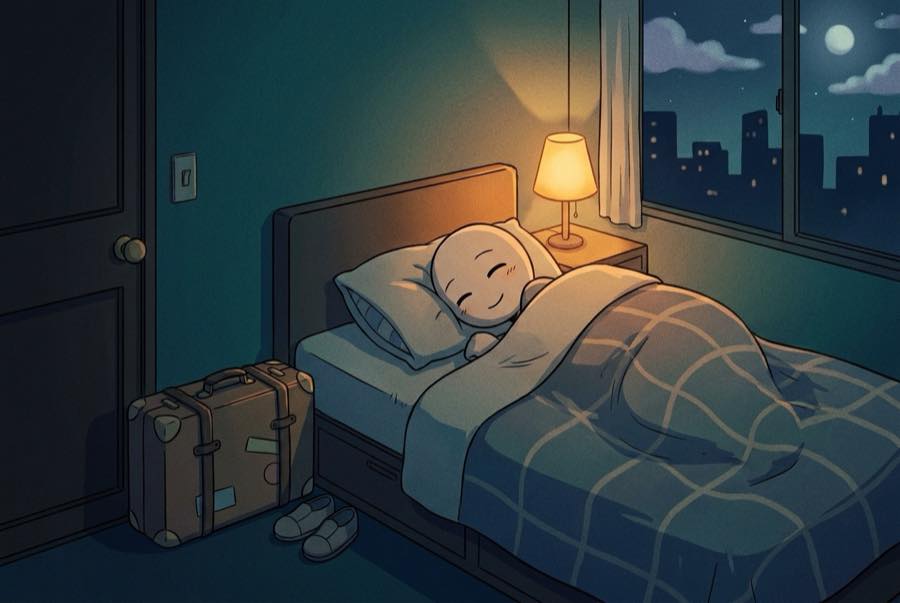
The suitcase is packed by the door, the alarm is set for a flight that leaves before sunrise, and the ceiling has become the most interesting thing in the room. Or the call came at eleven — the offer, the yes, the news worth telling everyone — and now the house is quiet and the celebration has nowhere to go. Christmas Eve does this to children and nobody warns them it keeps working at thirty-five. If you're looking up how to sleep when you're excited, the good news is that nothing has gone wrong with you. Something nice happened, your body responded the way it responds to things that matter, and now the two of you disagree about bedtime.
Excitement is arousal wearing a friendly face
Worry and anticipation feel completely different from the inside, and yet they tend to produce a strangely similar night. Fast thoughts. A warm chest. The urge to check the time, or the tickets, or the message thread one more time. Whatever gets a body ready for something big doesn't seem to sort that something into good and bad first — it just switches on, and switching off again takes a while.
Which means the usual advice aimed at anxious nights is a poor fit here. You are not going to reason your way out of being happy, and you shouldn't want to. Talking yourself down from good news is a miserable trade for forty extra minutes of sleep. The aim tonight isn't to shrink the feeling. It's to let it burn at a lower flame — to give it a place to go before you lie down, so that lying down isn't the first quiet moment it has had all evening.
That's the whole method, and everything below is a version of it.
Give the excitement somewhere to go before bed
The reason excitement gets loud in bed is that bed is often the first place with no distractions in it. Handle it earlier, while you're still up and moving.
Tell it once, out loud or on paper. Call the person who'll be most pleased for you, or write the news down in a few sentences — what happened, what it means, what you want to do about it. Excitement that has been expressed sits quieter than excitement that's still waiting for its turn to speak. Anything you're saving to tell people tomorrow, write down that you're saving it, so your mind stops rehearsing the delivery.
Make the list, then close it. Trip eve is mostly logistics dressed up as anticipation. Passport, charger, the thing you always forget, the time you'll leave. Put it all on one page, physically lay out what you can, and let the page hold it instead of your memory. Half of what feels like excitement at midnight is a to-do item that hasn't been written down.
Move a little, early enough. A walk around the block, tidying the kitchen, anything that lets restlessness spend itself in your legs rather than your head. Do it a couple of hours before bed rather than right before — the point is to come down from it, not to still be coming down when the lights go out.
Stop the input. Booking pages, group chats, the photos, the map of where you're going, the message you keep rereading. Every look is a small refill. Set a time in the evening when the topic closes for the night — not because it doesn't matter, but because it will still be entirely true in the morning.
Keep the room boring. Cool, dark, phone face down and out of reach, no bright screen for the last stretch. If tomorrow is a genuinely high-stakes day rather than a fun one, the sibling problem — pressure instead of anticipation — is covered in how to sleep before a big day.
How to sleep when you're excited and it's already late
Sometimes the news arrives at 11pm and there is no earlier to work with. Then the job is smaller: stop trying to fall asleep, and start letting the pace drop.
Take the pressure off the clock first. Turn the phone away so you can't count backwards from the alarm; no good has ever come of that particular sum. One alarm, set, trusted, out of sight.
Then lower the bar for what tonight has to be. Tomorrow's excitement will carry you further than a tired body would predict — that is rather the nature of the days we get excited about, and almost nobody looks back on a trip or a first morning and remembers it as spoiled by six hours instead of eight. Deciding in advance that a shorter night is acceptable removes the one thing that reliably makes it worse, which is minding.
And if you're still lying there wide awake and irritated with yourself, get up for a bit — with one strict condition attached, which is that you do not go back to the topic while you're up. A fifteen-minute reread of the itinerary undoes the entire exercise. Doing the leaving-and-returning part properly is covered in how to fall back asleep.
Let something slower set the pace
A quiet room leaves your attention with nothing to do but replay the good thing on a loop, and a replayed good thing tends to get more vivid each time round rather than less. Sound gives that attention something undemanding to rest on instead — dull on purpose, which is the point of it rather than a shortcoming, and the reasoning is in why rain sounds help sleep.
Waves beat rain on a wound-up evening, and the difference is tempo. Slow surf has a pace built into it — long, unhurried, arriving and withdrawing — noticeably slower than a buzzing head, and it is genuinely difficult to keep running at full speed alongside something that leisurely. Ocean Waves for Sleep — Slow and Steady is chosen at that tempo: long, even surf, no gulls, no sudden crashes, nothing that arrives as an event, held to the checks in what makes a rain sound work. Let it repeat through the night so it doesn't leave you in silence at 2am, and set the level so your alarm still cuts straight through it — on a night before an early flight, that matters more than usual.
If the excitement is a flight and several time zones, the sound helps with the unfamiliar room at the far end but not with the clock — that part is light and timing, and it's in how to sleep with jet lag. If waves turn out not to be your family of sound, the others are in the guide library.
Press play and let the tide take the evening down a gear: Ocean Waves for Sleep — Slow and Steady.
This article is for general information and isn't medical advice. If sleep problems persist, talk to your doctor.