One thin night almost never ruins the day that follows it. That is the honest verdict, and it belongs at the top of the page, because the reason people look up how to sleep before a big day is usually not that they aren't tired — it's that tomorrow has climbed into bed with them. The interview. The wedding. The 6am flight. The presentation you've rehearsed four times. You've done the preparation, and now the final item on the list is to fall unconscious on command, which happens to be the one task that gets harder the harder you try.
So tonight's work isn't sleeping better. It's getting tomorrow out of the bed.
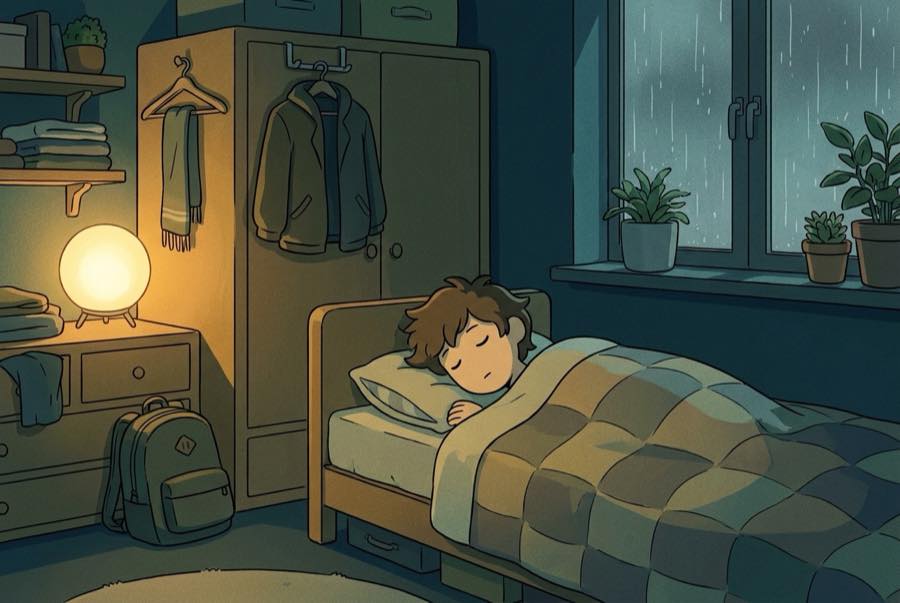
The rehearsal that won't switch off
What's keeping you awake is almost certainly a performance running in your head. You open the door and say the first line. You shake the hand, find the row, find the seat, find the microphone. Then the version where the projector fails, or the traffic is worse than you planned for, or the one question you can't answer arrives from the back of the room. The reel restarts and plays again with a small edit.
Rehearsal feels productive at 11pm. It almost never is. By this hour you already know what you know, and your mind isn't improving the performance — it's confirming that the performance exists, over and over, the way you'd pat your pocket for keys you can already feel through the fabric. That confirming is what keeps you alert, and alert is the entire problem.
Two things quiet a loop like that, and neither of them is effort. The first is proving to the part of you doing the checking that the day is genuinely handled — physically, in the room, so there is something to point at other than memory. The second is letting the reel run instead of arguing with it. When you catch yourself mid-scene, you don't have to shut it down. Noticing "there it goes again" and turning your attention to something duller works far better than a wrestling match, because arguing with a thought is a way of keeping it on stage.
A second loop can start on a night like this — counting how many hours are left before the alarm, then recounting twenty minutes later with a smaller number. That one has a page of its own: how to sleep when you have to wake up early covers the clock math, the fear of not hearing the alarm, and why going to bed two hours early tends to backfire.
How to sleep before a big day: put the morning in the room
Do this before you brush your teeth, not after you're already lying down. It takes ten minutes, and it is the part of tonight that reliably shortens the reel, because it gives the checking something real to check.
Lay the morning out physically. Clothes over the chair, shoes by the door, bag packed and zipped, documents and keys in one place you'll see on the way out. Anything your mind might go looking for at 2am should be visible from the hallway instead.
Decide the timings once, in writing. Leave at 7:15. Park in the garage on the north side. Coffee after security, not before. A decision written down stops being a decision and becomes a fact, and facts don't wake you up.
Write the loose thoughts down too. A question you want to ask, a name you keep losing, a worry with no action attached — same piece of paper. You're not solving any of it. You're parking it somewhere that isn't your memory.
Give the first ten minutes of the day away. Decide now what happens between the alarm going off and the door closing behind you: the shower, the breakfast you always eat, the bag that is already by the door. A morning that requires no decisions is a morning your mind can stop pre-living tonight.
Set one alarm you trust, plus one backup only if that is what stops you checking the clock, and then treat waking up as handled and out of your hands.
Keep the rest of the evening ordinary while you're at it. Tonight is a poor night to try a new supplement, a new pillow, a new breathing technique you found at 10pm, or a much later and larger meal than usual. Familiar is the whole point — you want the run-up to bed to be so unremarkable that it doesn't register as one more thing you're doing about tomorrow. If tomorrow's big day is an exam, the specific problem of switching from studying to sleeping is in how to sleep before an exam.
Tomorrow will bring its own energy
Here is something worth knowing before midnight, when it stops being obvious on its own: the day does a great deal of the work itself. Big mornings arrive with their own momentum. People get through interviews, weddings, flights, first days and difficult conversations on nights they would have called a disaster while they were living through them, and they are not running on the sleep alone — the occasion supplies its share, and it starts supplying it the moment you're in the day rather than waiting for it.
Which is also why the weight you're putting on the next four hours is misplaced. Tonight is not the thing that decides tomorrow. If that pressure is a regular visitor rather than a one-off, the fuller argument is in how to stop worrying about not sleeping.
Give the evening something steady to hold
Anxious evenings have a texture: quiet room, loud head, every small sound in the building arriving with unnecessary importance. Sound helps for a plain reason — a rehearsing mind needs somewhere else to put its attention, and an unchanging noise is about the least interesting thing you can offer it. The longer explanation is in why rain sounds help sleep.
The reason we'd point you at this particular playlist tonight is that nothing in it ever happens: no thunder, no swelling, no moment where the weather turns and your attention snaps back to the room and then straight on to tomorrow. Rain for Anxious Evenings is the softest thing we curate, even and unhurried the whole way through. Start it while you're laying the clothes out rather than at lights out, so it belongs to the evening instead of being one more thing you're doing to try to sleep. Leave it running rather than on a timer — silence arriving at 2am is its own small event on a night like this — and keep it under the alarm, quiet enough that the morning still gets through. Every track is checked against what makes a rain sound work. If rain isn't your sound, the other families are in the guide library.
The playlist won't make tomorrow smaller. It just makes the waiting easier, which on a night like this is the useful thing.
If it's 1am and you're still awake
Don't turn it into a standoff with something important on the other side of it. Get up, keep the lights low, and spend ten or fifteen minutes on something dull that has nothing to do with tomorrow, then go back — how to fall back asleep has the reasoning and the detail.
Be kind to yourself about a thin night
Nobody says this to you the night before something that matters, so: being awake is not a failure of preparation, and it is not evidence that you're the wrong person for tomorrow. Wanting it is precisely why you're awake. People who don't care sleep beautifully the night before an interview they don't need.
So if you end up watching a good part of the night go by, don't stack a second layer of stress on top by treating it as the first thing that has gone wrong. Eat something in the morning. Don't triple your usual coffee. Build in ten extra minutes so nothing has to be rushed and you arrive without a sprint behind you. Whatever tomorrow asks, it will be asking someone who prepared for it — and the preparing was the part that was ever under your control. You already did that part.
The short version
Lay the morning out and put the timings in writing before you brush your teeth. Set one alarm you trust, and a backup only if that is what stops you checking the clock. Keep tonight ordinary, with no experiments the night before something that matters. Let the rehearsal run instead of fighting it, and give your attention a steady sound to sit on instead. If you're still awake and irritated, get up briefly in low light and come back. Then in the morning, take the extra ten minutes so nothing has to be rushed, and let the day pull you along rather than bracing against it.
This article is for general information and isn't medical advice. If sleep problems persist, talk to your doctor.