A car is a small sealed box with seats designed for sitting upright at speed. Nothing about it was built for a night's rest, which is why sleeping in one takes a little planning instead of just lying back and hoping. The reasons people end up there are ordinary enough: a long drive that ran out of daylight, a shift that ends too far from home, a motel that costs more than the trip is worth, a ferry queue at 2am, a move between two addresses. If you're figuring out how to sleep in a car tonight, the honest order of business is safety first — a few non-negotiables that take five minutes — and then comfort, which is mostly about making the space flatter, darker, and quieter than it wants to be.
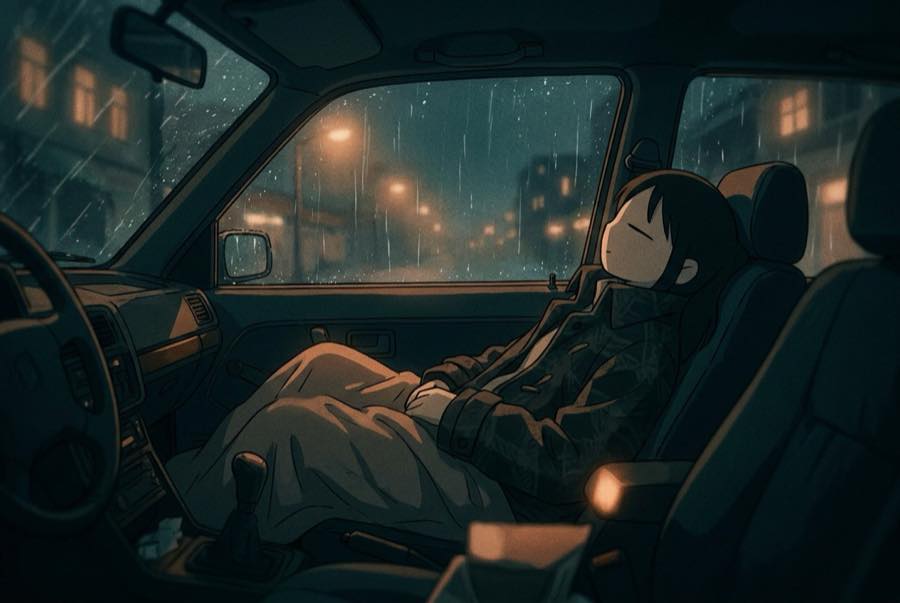
How to sleep in a car safely, plainly
Never run the engine to stay warm. This is the one rule with no exceptions. Exhaust contains carbon monoxide, it has no smell, and it can seep into a stationary cabin — the risk climbs when the car is in a garage, boxed in by walls, or has snow, mud, or leaves packed near the tailpipe. People have died doing this while feeling nothing worse than sleepy. The same goes for any fuel-burning heater or stove inside a closed car. Warmth comes from blankets and clothing, not from combustion.
Crack the windows. Two small gaps on opposite sides, an inch is plenty. Sealed up, a cabin gets stuffy and the glass fogs solid by morning from your own breath. If insects or weather are a problem, a strip of mesh or a slightly opened sunroof does the same job. Air moving through the car is the difference between waking up clammy and waking up merely stiff.
Park somewhere legal, level, and lit. Signed rest areas, service stations, and lots where overnight parking is explicitly allowed are worth the detour. Rules vary by town and country, so read the signs rather than assume. Never sleep on a hard shoulder or in a lay-by right against fast traffic — that's the genuinely dangerous option, not the frugal one. Level matters more than you'd expect: a slight slope will slide you toward the door all night.
Lock the doors, keep the keys where your hand falls, and put bags out of sight. Being able to sit up and drive away without hunting for anything is worth more than any comfort tweak. Tell someone where you've stopped, if there's someone to tell.
One more thing that catches people out: in many places, being in a parked car with the keys accessible can legally count as being in charge of the vehicle, even asleep in the back. If you've been drinking, look up how that works where you are before you decide the car is the safe choice.
Making the shape of the car work
Flatter beats padded. A reclined front seat with lumbar support wound all the way out is usually better than a back seat you have to curl into, unless the back seats fold and you can stretch out properly. If you're across the rear bench, the footwell gap is the enemy — fill it with a bag, a folded coat, or a cushion so your hips aren't bridging a hole.
Support your neck deliberately, because a head that keeps nodding forward will wake you every twenty minutes no matter how warm you are — the upright-sleeping details are worth borrowing wholesale from how to sleep on a plane.
Dress for a colder night than the forecast promises. Cars shed heat fast once the engine cools, and the metal around you goes cold long before the air does. Layers, dry socks, a hat, and something insulating underneath you rather than only on top — the surface you lie on pulls warmth out of you, which is the same lesson that decides whether a night outdoors works or fails in how to sleep while camping. Loosen your belt, take your shoes off, and deal with the bathroom question before you settle rather than at 3am in a dark lot.
Then handle the light. Streetlights, security floods, and headlights sweeping across the ceiling will keep pulling you back up. Reflective window shades, a towel wedged in the door frame, or a plain eye mask all work. Dark first, comfortable second.
Quieting a parking lot
A car sits in the middle of whatever is happening outside it, and the cabin is small, hard, and reflective, so every sound arrives with edges on it. The steady stuff — distant highway hiss, wind, rain on the roof — usually fades into the background on its own. It's the sudden ones that pull you up: a door slamming two rows over, a refrigerated truck cycling on, someone's alarm chirping.
A cabin is small enough that a low, continuous sound reaches all of it at once, which takes the edge off what the glass and plastic do to every noise arriving from outside; the longer explanation is in why rain sounds help sleep.
For a car we'd reach for Gentle Rain — No Thunder, No Surprises. A parked car is a place where part of you is half-listening for anything unusual all night, so the last thing you want in your ears is a recording that rumbles or swells and hands that instinct something new to check — this one has every rumble and swell already cut, and it is curated to loop without a seam so nothing lurches while you're under. What we listen for before a track goes in is set out in what makes a rain sound work.
Two car-specific notes on that. Leave it looping rather than on a timer, so the cabin never drops back into bare silence somewhere around 3am. Keep the volume genuinely low — lower than you'd use at home — because you want to stay aware of what's happening around the vehicle, and low volume is where masking works best anyway. And watch your battery: a phone playing all night on a dying charge is how you wake up with no alarm and no map. Charge before you stop, or bring a power bank.
The short version
Park legal, level, and lit. Windows cracked on both sides. Engine off all night, no exceptions, and nothing burning inside the car. Doors locked, keys in reach, bags out of sight. Recline as flat as the car allows, fill the footwell gap, brace your neck, insulate underneath you, and cover the windows. Bathroom before bed, phone charged, alarm set with a little margin. If you stopped because you were too tired to drive, don't set off again until you're properly awake — a slow start beats the alternative. If you want more on sound families and what suits which situation, it's all in the guide library.
This article is for general information and isn't medical advice. If sleep problems persist, talk to your doctor.