Wind never arrives at one volume. It comes as a long pull across the roof, then a shove at the window hard enough to move the glass in its frame, then a stretch of near-quiet that lasts just long enough for a body to start letting go — and then the next one. That shape is the whole problem, and it's why the usual advice fails on a windy night. Anyone looking for how to sleep when the wind is loud has often already tried covering it with something soft and found that gentle rain vanishes under the peaks and leaves the room silent in the gaps. There are two useful moves here, and they go in this order: take away the noises the wind is making inside your house, then raise what's left so the gusts stop standing out.
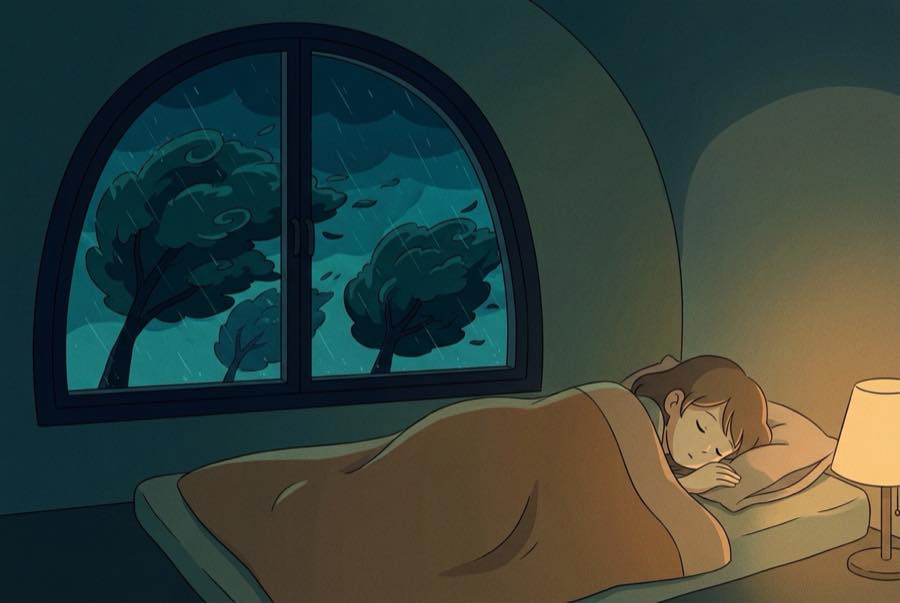
Wind is peaks, not a drone
A fan, a highway, a hard rain — those sit at roughly one level, and most people stop noticing them within a few minutes. Wind does the opposite: it builds, hits, drops away and comes back on no schedule, so an unpredictable peak keeps landing in a quiet room and leaving you braced for the next, which is the same startle-and-bracing loop set out in full in how to sleep during a storm. Raising the room's noise floor is what takes the contrast out of it, and the mechanism is explained properly in why rain sounds help sleep.
The part that belongs to wind specifically is where the peaks are actually coming from, and it is usually not the sky. The wind itself is mostly a low rush across the roof, and a low rush is close to the easiest thing there is to sleep through. What wakes people is the house and the yard answering it — a latch tapping, a vent flap slapping, a downspout knocking the wall, a gate on a worn catch, a bin lid lifting and dropping back. Those are sharp, close, and man-made, and unlike the weather every one of them is something you can go and stop before dark. That is the real work of a windy night, and it is worth doing properly rather than fixing one obvious thing and hoping.
Fix the rattles before you fix the sound
Do this while there's still light, and be a little ruthless. A single loose object can own an entire night.
Latch every window properly. A window on a catch, closed but not locked, will buzz and tap all night; turning the lock pulls the sash tight against the seal. Same for balcony and patio doors.
Chase the whistle. Whistling means air is being forced through a small gap — a trickle vent, a keyhole, the bottom of an ill-fitting door. Close interior doors along the draft path, and put a rolled towel at the base of the worst one.
Pad the loose sash. If a window still moves in its frame, a folded index card wedged at the rattle point or a strip of self-adhesive foam along the gap usually kills it. Both cost almost nothing and come out cleanly, which matters if you rent.
Tie up cords and lift the blinds. Blind cords against a frame, a slat swinging in a vented window, a curtain ring sliding on a pole — these are the noises people spend an hour trying to identify in the dark.
Wedge the interior doors. Pressure changes slam them, and a door slamming at 3am is the single worst sound in this whole article. Hook them open or shut them fully.
Walk the outside once, before dark
This is the half people skip, and it's the half that decides the night. Almost everything that bangs at 2am on a windy night is something that was sitting outside at 6pm, visible, and easy to deal with while you were still dressed and could still see.
Go around the whole building once rather than looking out of one window. Bins first — lids down and latched if they latch, and the bins themselves pushed against a wall or a fence rather than standing free, because an empty wheelie bin in an open spot will travel and will hit something on the way. Garden furniture goes flat or stacked and pushed under cover; a chair on its back can't catch the wind the way an upright one can, and a table with a light top is worth bringing in entirely. The parasol comes down, not just closed — a closed umbrella still works as a sail, and the base is rarely as heavy as it looks. Gates get latched or tied, because a swinging gate knocking its post is one of the most carrying sounds there is, and it repeats on every gust for hours.
Then the loose small stuff, which is what actually makes the noise: empty plant pots, a watering can, a bamboo screen leaning on a fence, a folded parasol cover, a hose reel handle, a bike propped against a wall, a ladder lying on brackets, a tarpaulin with one corner free. Anything leaning gets laid down. Anything hollow and light comes in or goes under something heavy. Take the wind chimes in — they're charming in a breeze and unbearable in a gale, and nobody ever regrets a night without them. Check the shed and the garage door are properly shut rather than resting closed, and if there's a trampoline or a light cover or a folded gazebo, deal with it now instead of at midnight in a robe.
Be honest about the limits while you're out there. Anything that needs a ladder, a roof, or a reach above your head does not get done tonight. Loose flashing, a gutter section, a slipped tile, a rattling extractor vent on the third floor — you can hear those and you cannot safely fix them in the dark with the wind up. Note them in your phone for daylight and let that be the end of it. Writing it down isn't admin, it's the thing that stops you lying in bed rehearsing the same problem every time it makes a sound.
How to sleep when the wind is loud and the room is as quiet as it gets
Once the house has stopped adding to it, the remaining job is filling in. This is the one night where the delicate options don't work: soft rain sits below the gusts, so you get calm sound and then a peak straight through it, over and over. You want something with body — dense and continuous enough that a gust reads as a swell inside it rather than as a separate event.
That's the argument for Heavy Rain — Full Downpour on a night like this: thick, drumming rain with real weight to it, so a gust has to be bigger than the rain before it registers as an event — and against a full downpour, most of them aren't. The tracks are cut to run into each other rather than stop, so leave it on repeat and clear any sleep timer before you get under the covers. The wind doesn't stop at 1am, so the thing covering it shouldn't either.
Two things to get right. First, don't chase the gusts with the volume. If you turn it up every time the wind rises, you end up with a loud room and the same problem; the aim is to soften contrast, not to win. Pick a level while you're still standing up and then leave the phone alone. Second, keep it low enough that your alarm, a child, or a knock at the door still gets through. If dense rain is your default sound in general, the longer version is in heavy rain sounds for sleeping.
If the wind worries you rather than just wakes you
For some people a loud night isn't an annoyance, it's a low, constant unease — every gust an implied question about the roof. If that's you, handle it in the evening instead of in bed. Check the official forecast or warnings once, do whatever it tells you to do while you're still dressed — move the car off the tree side, put a charged lamp by the bed, bring the loose things in — and then close the app. Checking five more times horizontally will not change the weather, and it moves you from sleepy to alert in about a minute.
Set your sound before you get under the covers so you have nothing to reach for later, and put the phone across the room if the temptation is real. If storms in particular put you on edge, the way to handle the startle of the peaks is covered in how to sleep during a storm.
When a gust wakes you anyway
Some will. Stay flat, keep your eyes closed, and don't check the window — standing up at a dark pane guarantees another twenty minutes awake and never once tells you anything useful. Don't check the time either, and don't start calculating what's left. Let the rain come back into focus and let the next gust arrive without being met.
If you're properly awake and staying that way, how to fall back asleep covers what to do with the rest of the night better than lying there listening for the roof does.
The short version
Lock the windows rather than latching them, wedge the doors, pad the one sash that rattles, and walk the outside before dark putting down anything that can move. Note what you can't fix, so you stop rehearsing it. Then start dense rain on repeat with the timer off, at a level low enough to hear your alarm and high enough that a gust arrives inside it rather than through it. If a gust wakes you, stay flat and leave the window alone. Other sound families, for nights when the weather isn't the problem, are in the guide library.
This article is for general information and isn't medical advice. If sleep problems persist, talk to your doctor.