It's late. You've tried quiet, and quiet isn't working. What you want is weather — a storm somewhere out there, low and rolling, while you're warm in here. If that's your sound, here's the whole method up front: distant thunder over steady rain, nothing sharp, nothing close, set to repeat until morning.
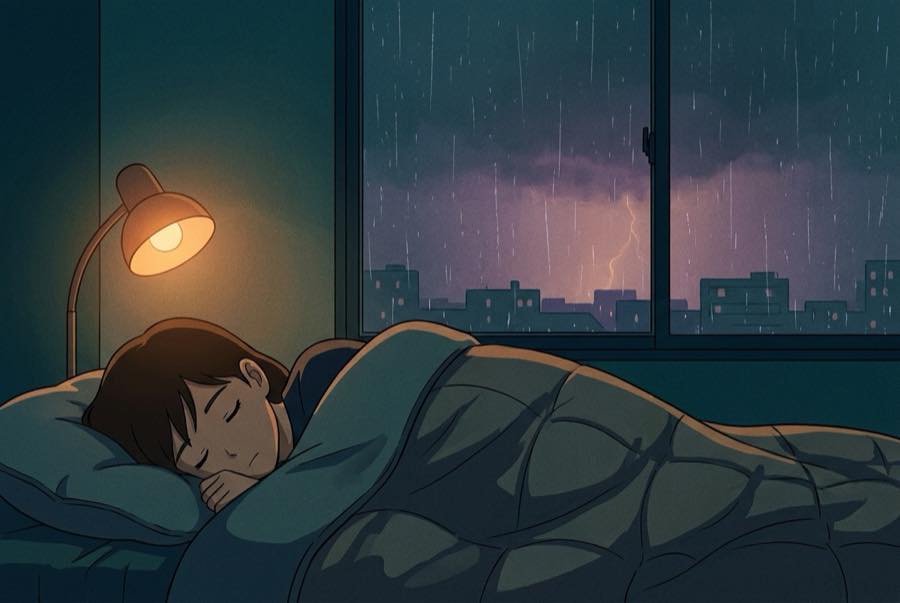
Play Thunderstorm Nights — a deep pool of distant thunder over steady rain. Every storm in it stays far away. No close cracks, no sudden claps, nothing built to make you flinch.
Before lights out: turn repeat on, since the playlist needs to start over to carry you to morning. Set the volume now, low — the storm should sit behind the room, not in it. Then put the phone down, face down, out of reach.
The rest of this page is why storm audio works for some sleepers, the one rule that decides whether it's sleepable, and — honestly — who shouldn't use it at all.
Why rumble comforts some sleepers
Plenty of people fall asleep fine to plain rain. But for some, rain alone feels thin — all surface, no floor. What's missing is the low end.
Distant thunder fills that in. Rolled out over miles of air, a thunderclap loses its sharp edges and arrives as a long, low swell — more felt than heard. Under a steady bed of rain, that rumble gives the sound weight. The room feels held rather than merely covered.
There's a plainer mechanism underneath the coziness. Like rain, a storm recording is a masking sound: it raises the sound floor of your bedroom so the door down the hall, the car outside, the pipe ticking in the wall register as smaller events against it. The research on continuous noise and sleep is genuinely mixed, but a systematic review by Riedy and colleagues in Sleep Medicine Reviews (2021) found its clearest value in exactly this: covering up a disruptive environment. (The full mechanics — masking, spectrum, the bedtime-cue effect — are in why rain sounds help sleep.) Low-frequency rumble happens to be good at the low-pitched intrusions — traffic, a neighbor's bass, a distant train — that lighter rain textures barely touch.
And there's the association. A storm outside is one of the few sounds that makes staying in bed feel like the correct decision. Nothing to do, nowhere to be, weather handling the night for you. That framing does real work when your head won't switch off.
We see this preference constantly in curation: when storm audio is done right, a lot of sleepers choose it over everything else. Distant rumble is no niche taste — it just rarely gets made correctly.
The one rule: two valleys away, never overhead
Done right is the catch. Most thunderstorm recordings are made to be dramatic — close strikes, cracking peaks, the storm arriving on top of you. Great cinema. Terrible sleep.
Your auditory system stays on duty after you close your eyes, and what it reacts to is contrast — a sudden loud thing against a steady quiet thing. A sharp thunderclap at 2am is precisely that: a spike engineered by nature to get your attention. It will find you in your lightest sleep stage and pull you straight out. One close crack undoes an hour of good rain.
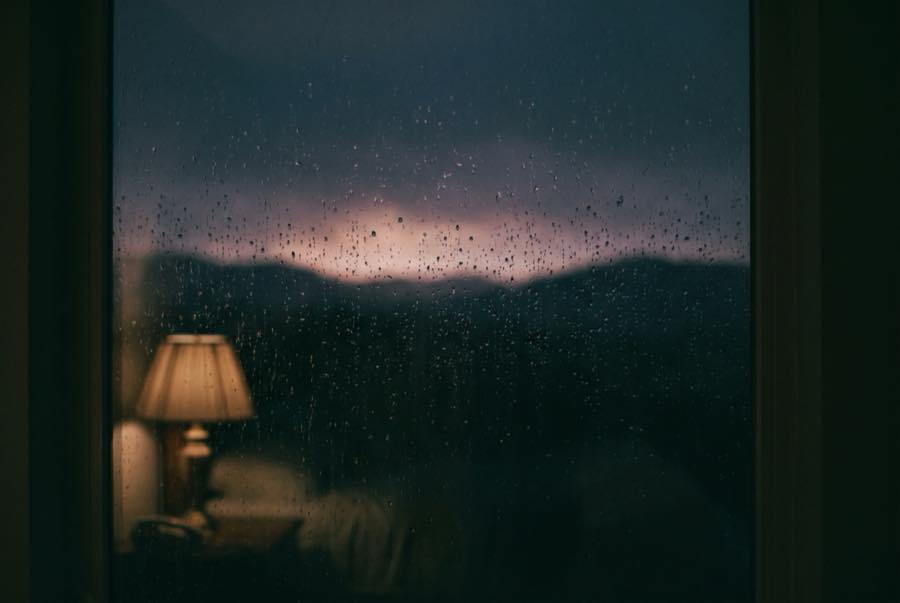
So the rule that makes storm audio sleepable is simple: distant rumble only. The thunder should sound two valleys away, never overhead. Low, long, unhurried — a slow roll that rises and fades under the rain without ever breaking its surface. If you can point at the moment the thunder "hits," it's too close for sleep.
This is the entire curation standard behind Thunderstorm Nights. We listen through every track before it earns a place, and anything with a sharp attack, a close strike, or a clap that jumps above the rain bed is out — however beautiful the recording. What's left is a playlist where the storm never moves closer: steady rain in front, thunder far behind it, the same distance in its last minute as in its first. Set it to repeat and the storm stays out there all night. There's more about who the playlist is for on its own page.
If you want the deeper mechanics of the rain layer itself — why steady beats dramatic, why fades wake you, what makes a recording loop cleanly — that's covered in our rain sounds guide.
When thunderstorm sounds are the wrong choice
We'd rather you sleep than stream, so here's the honest part.
If you startle easily, skip thunder entirely. Even distant rumble is a dynamic sound — it swells and recedes — and for some sleepers every swell is a small question mark. If you notice yourself listening for the thunder instead of drifting past it, this isn't your sound. Steady rain with no thunder at all will serve you better.
If a child is sleeping nearby, or sharing the sound, be careful. Kids who are frightened of storms don't get less frightened because the storm is well curated. A storm playlist in a room with a storm-scared child is a bad trade; plain rain or soft noise is the kinder pick.
If you need to hear something in the night — a baby, an alarm, a knock — remember that masking cuts both ways, and low rumble is especially good at swallowing low, quiet sounds. Keep the volume genuinely low, or choose silence.
If storms carry bad memories for you, no amount of distance in the mix fixes that. The right sleep sound is one your body doesn't argue with. There are calmer families to try in our sleep sounds library.
If sleep itself is broken — most nights awake, or exhausted no matter how long you're down — that's beyond any playlist. Persistent insomnia or suspected sleep apnea belongs with your doctor. A storm can make a bedroom feel safer; it isn't treatment.
Tonight, then
Distant rumble over steady rain, low volume, repeat on, phone down. Let the storm stay two valleys away and do the night's work for you.
Play Thunderstorm Nights — every storm in it kept at a distance. Follow it so it's one tap away the next time you want weather instead of quiet.
Roll over. Listen to the storm outside.
This article is for general information and isn't medical advice. If sleep problems persist, talk to your doctor.