"How much more should I go over tonight?" is usually the question that keeps people up the night before an exam, and it's the wrong one. The better question — how to sleep before an exam when your head is still flipping through cards — has a shorter answer than you'd expect. Stop earlier than feels responsible. Give your attention something plain to do for the last stretch of the evening. Keep the room sounding the way your desk sounded. None of that takes discipline you won't have at 11pm; most of it is one decision, made in the evening while you can still think clearly.
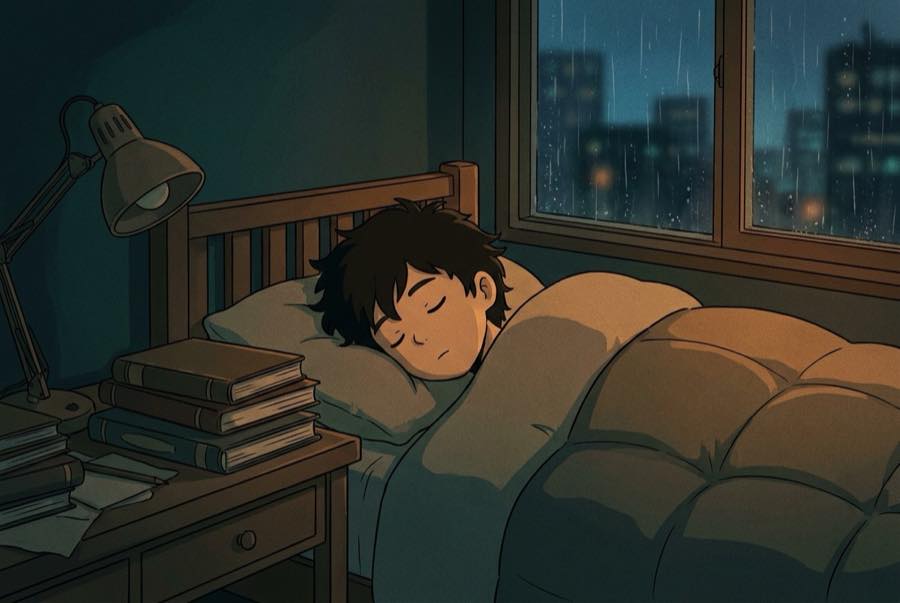
Set a cramming cutoff, earlier than feels right
The last hour of studying is almost always the most expensive one. It's the hour where new material goes in badly, where you stumble onto a topic you hadn't looked at, and where the small panic that follows books itself a room in your night. Whatever you pick up between eleven and midnight, you tend to pay for twice: once in the sleep you didn't get, and once in how blurred the morning feels.
So choose a cutoff and fix it early in the evening, as a real clock time, decided while you're calm rather than negotiated while you're anxious. An hour before bed is a sensible default. Ninety minutes is better if you're the sort who spins. When the time comes, close the books mid-topic if that's where you are. There's no version of tonight where you finish everything, so "finished" is a poor condition to make sleep wait for.
One concession makes the cutoff survivable: keep a scrap of paper beside you for the "wait, what about..." thoughts. Anything that surfaces after the cutoff gets written down and looked at in the morning, not now. The list itself barely matters. What matters is that your head stops rehearsing the things it's afraid of forgetting once it can see them held somewhere outside itself.
How to sleep before an exam when the material keeps replaying
Even with a clean cutoff, the material keeps arriving. A definition. A formula you half remember. The section you meant to get to. That's ordinary, and it isn't a signal to get back up and check — checking once tends to become checking until one in the morning, and the version of the topic you find at that hour rarely sticks anyway.
Instead of arguing with the replay, give it competition. The last half hour works best when it's mildly occupying and completely unrelated: a shower, tidying the desk you'll come back to tomorrow, a few pages of a novel, a slow walk around the block if the street is calm. Keep the light low from the cutoff onward, and get the phone off the bed — group chats the night before an exam are a compression chamber, and everyone in them is more anxious than they sound.
It's also worth saying the reassuring thing plainly, because at midnight it stops being obvious: one thin night is uncomfortable, not decisive. People sit exams on imperfect sleep constantly and do fine — tomorrow may feel duller around the edges than you would like, and you will still be able to read a question, recall the method and write the answer. Believing that also takes weight off the next hour, which is the longer argument in how to stop worrying about not sleeping. If tomorrow is heavier than a single paper, how to sleep before a big day takes the same problem from a wider angle.
Keep the same sound from desk to pillow
Here's the piece worth setting up before you're tired: don't change the soundtrack at the cutoff. If you studied to steady rain, keep steady rain running while you wind down and after the light goes out. A sound your evening already contains doesn't announce itself, and it quietly marks the boundary between working and stopping without requiring you to feel finished.
There's a practical half to this too. A silent room at midnight is a room where every noise has an edge — a housemate's door, a car outside, someone else still awake and typing, which the night before an exam arrives with a free thought attached about who is still up revising. A sound that has been running since the desk gives those noises nothing to interrupt; the longer version of why that works is in why rain sounds help you sleep.
What makes this playlist right for the handoff is that it was chosen to be ignorable in both rooms. Rain Sounds for Studying and Reading is a deep pool of plain, featureless rain with no thunder and nothing that shifts halfway through, so it holds up as background against a textbook and then doesn't become an event against a pillow. Let it run on a loop rather than a timer, so it is still there if you surface at three. The checks we curate against are in what makes a rain sound work.
Two adjustments when you move from the desk to the bed. Turn it down a notch — study volume sits slightly above sleep volume, and what covered a noisy library is louder than you want against a pillow. And keep it quiet enough that your alarm still wins in the morning, which on exam night is not a small detail. If rain isn't your sound, the other families are in the guide library; the differences between studying and sleeping with it are covered in rain sounds for studying.
If you're still lying there
Give it a fair while, then stop trying. A bed you lie in while silently testing yourself on chapter headings is a bed that starts to mean revision, which is the last association you want the night before a paper — so get up, keep the light low, do something dull elsewhere, and come back when you feel heavy. The reasoning is in how to fall back asleep.
And turn the clock away. The math — six hours, now five and a half — does nothing except add pressure to a night that already has plenty. Set one alarm you trust, plus one backup only if that is what stops you checking the clock, then put the phone face down and out of reach and leave the arithmetic alone.
The practical version
Pick a cutoff time now and write it down. Keep a scrap of paper for after-cutoff thoughts. Lay out clothes, ID, pens, and anything the exam room requires tonight, so the morning is a route rather than a search. Set one alarm you trust, and a backup only if that is what stops you checking the clock. Keep the last half hour dim, unrelated, and phone-free. Leave the same steady rain running from the desk through lights out, a notch quieter than you studied to, looping rather than timed. If sleep hasn't come after a fair stretch, get up briefly rather than fighting it. Then let tomorrow be tomorrow's problem, which — one way or another — it's going to be regardless.
This article is for general information and isn't medical advice. If sleep problems persist, talk to your doctor.