Nothing cancels caffeine once it's in you. Not water, not a cold shower, not lying very still and willing it out of your system — the only thing that clears it is time, and time will take exactly as long as it takes. That is the honest verdict, and it's worth having up front, because the hour people spend looking up how to sleep after drinking coffee too late is usually an hour spent hunting for an off switch that doesn't exist. What you can change is the rest of the night: how much of the wait you spend tense and negotiating, and how much of it you spend resting, which is a genuinely different experience even when sleep is slow to arrive.
What the coffee is actually doing up there
Sleep Foundation guidance puts caffeine's half-life at around five to six hours in a typical adult, which is why a four o'clock cup can still be doing quiet work at midnight. That number moves a great deal between people — genetics, age, whether you drink it daily, and various medications all get named as factors — so the friend who sleeps fine after an espresso with dessert and you, undone by a mid-afternoon flat white, can both be telling the truth about their own bodies.
The usual explanation is that caffeine muffles the signal that tells you how tired you are. The tiredness underneath doesn't go anywhere; you just can't feel it clearly for a while. That's a useful thing to know at half past eleven, because it means you are not broken and you're not permanently awake. You're a person whose drowsiness is temporarily hard to hear. It comes back through. If the sensation you're stuck with is the specific one of being exhausted and wired at the same time, that state gets a longer look in why can't I sleep even when tired.
It's also worth knowing what doesn't move the needle, so you don't spend the night trying. Drinking a lot of water doesn't flush it out — it mostly gets you up at 3am. A cold shower, a snack, a walk around the block: these can change how alert you feel from minute to minute, but none of them shorten the chemistry. And using a drink to knock yourself out tends to be a bad trade: the same Sleep Foundation guidance describes alcohol as fragmenting the later half of the night even when it speeds up the start of it. There's no shortcut here worth the effort of trying.
How to sleep after drinking coffee too late: stop fighting the clock
The caffeine is a nuisance. The fight with it is what actually costs you the night.
Stop doing the arithmetic. Five and a half hours until the alarm, five and a quarter, five. Every time you run that sum you hand yourself a fresh reason to be tense, and tension is the one variable here you have real influence over. Turn the clock away. Put the phone face down across the room, or at least out of arm's reach, so checking it takes a decision rather than a reflex.
Lower the bar for what counts as a good night. Lying warm and still in the dark with your eyes closed is not nothing. It's not sleep, and we won't pretend it is, but it's rest, and it's a far better use of the next ninety minutes than sitting up scrolling in blue light while you wait to feel sleepy. Bodies handle one shortened night better than 2am tends to believe.
If you've been lying there a long while getting more annoyed, get up — but get up differently than you would on an ordinary bad night. Most sleepless nights are a loop of thinking, and leaving the bed is a way of breaking it. Tonight there's no loop to break. You're simply early, waiting on chemistry that hasn't finished, so the job out of bed is to add nothing. Don't answer anything, don't tidy at speed, don't stand in a bright kitchen. One dim lamp, something undemanding on paper, no clock in view, and back to bed when your eyes get heavy rather than when the hour finally looks acceptable. It also stops the bed from becoming the place where you lie awake being frustrated, which is a habit worth not building. For the nights that aren't chemical, the wider version of this move is in how to fall back asleep.
Do the wind-down anyway, even late. It's tempting to skip the whole routine on the grounds that it clearly isn't going to work tonight. Do it regardless — dim lights, warm shower, the same order you always use. The sequence still tells your body what time it is, and it gives you something to do besides wait. There's a fuller version of that in how to relax before bed.
Make the waiting easy on yourself
Set the room up as if you fully expect to sleep, because at some point you will. Cool, dark, phone out of reach, alarm already set with a little margin so you're not guarding it. Then give your attention something soft to rest on that isn't your own commentary about being awake.
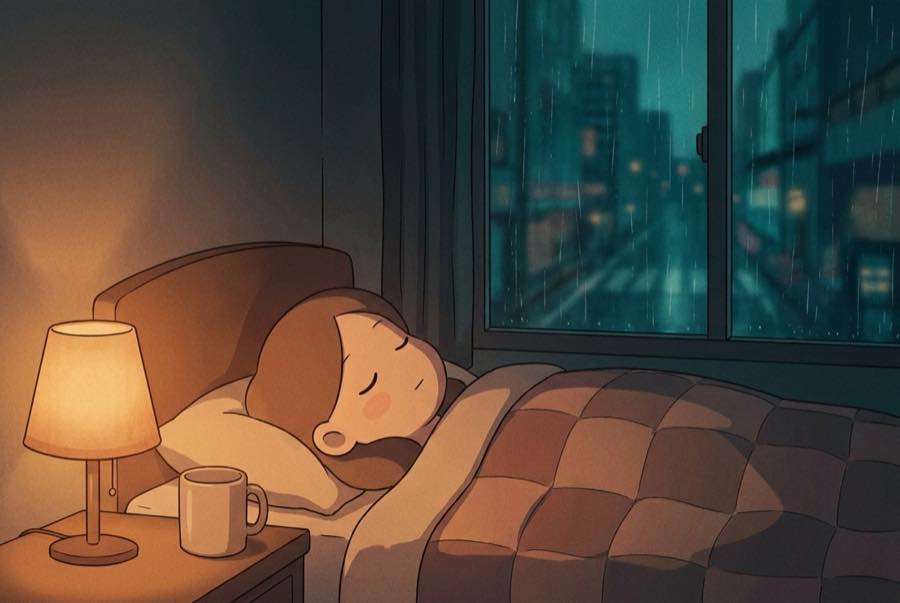
This is the one place a sound genuinely earns its keep on a night like this. It won't touch the caffeine, and anyone telling you otherwise is selling something. What it does is give an over-alert head one plain thing to follow. Caffeine makes your attention greedy — it goes hunting for material, and at half past midnight the only material in the room is the clock, the arithmetic, and your own running commentary about being awake. Rain is duller than all three, and it doesn't finish. That's the entire trick.
For this we'd put on Rain on the Roof — All Night Sleep, on the specific grounds that a caffeine night is a long one and you may well surface again at four. The recordings run at full level to the end rather than fading out, so set the playlist to repeat and switch off any sleep timer before you put the phone down — then it's still going when you come back up, and the room hasn't changed while you were away. Volume low enough that the alarm still lands over the top of it. If rain isn't your sound, there are other families in the guide library; the only requirement is that it stays steady and that you never have to touch it again.
Then fix tomorrow, not tonight
Once the night is behind you, the fix is a cutoff, and it's the only part of this you actually control. The same guidance suggests keeping caffeine well away from bedtime — several hours at minimum — and the practical way to use that is to count backward from when you want to be asleep and draw a line on the day. Two in the afternoon is a common landing spot. If you're on the sensitive end, noon may serve you better.
A few things quietly break people's cutoffs. Tea, cola, energy drinks, pre-workout mixes, and dark chocolate all carry caffeine; some cold and headache tablets list it on the box. Decaf usually contains a small amount rather than none. And a very large iced coffee is often more than the cup it replaced, even earlier in the day.
Then test your own line rather than trusting a general number. Hold the same cutoff for a week and notice how long you take to fall asleep. If it's better, keep it. If it isn't, move the line earlier by two hours and try another week. Front-load the day instead: the same amount of coffee, all of it before your line, tends to work better than spacing it out and paying for the last cup at midnight.
This article is for general information and isn't medical advice. If sleep problems persist, talk to your doctor.