It's late, you're tired, and your mind is still running the day — the email you didn't answer, the thing you said at 3pm, tomorrow's list. You don't need a new lifestyle tonight. You need the next 30–45 minutes to go gently, so that by the time the lights go out, your body has somewhere soft to land.
That's what this page is: not a sleep-hygiene lecture, not a routine for morning people. A short sequence you can actually do, starting now, in whatever state you're in.

Start by dimming what you can dim
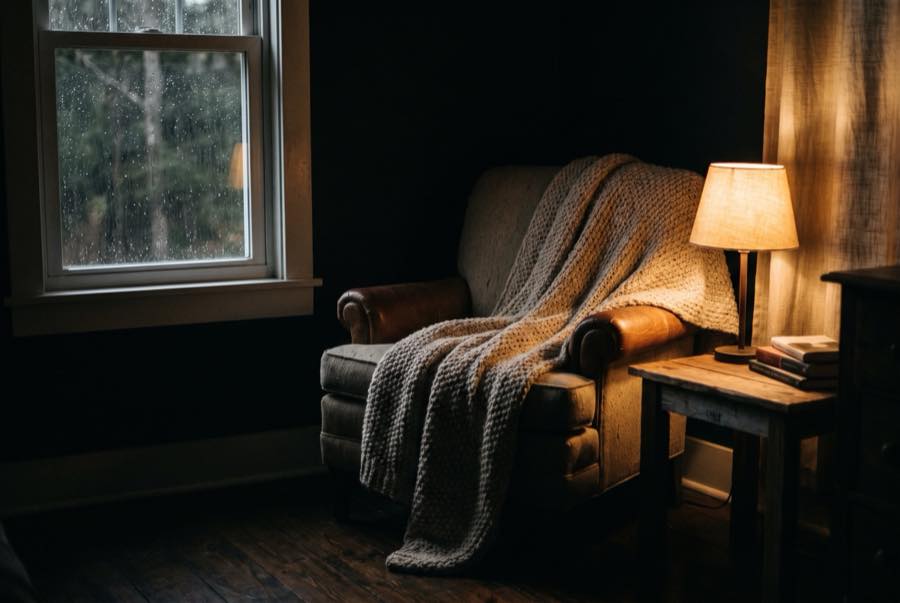
Relaxing begins with the room, because the room is easier to change than your thoughts. Turn off the overhead light and leave one small lamp on. Screen brightness down. If the kitchen light is glaring down the hall, close the door.
Bright light in the evening tells your body it's still daytime — the Sleep Foundation notes that light exposure late in the evening can delay melatonin, the hormone that helps make you sleepy. You don't need to sit in the dark. You just need the room to stop shouting "afternoon" at a nervous system that's trying to clock out.
One dimmer room. That's the whole first step, and it takes under a minute.
Put the day somewhere
Here is the part most wind-down advice skips, and it matters more than any breathing pattern: your head keeps rehearsing tomorrow because it's afraid you'll forget it. So don't argue with it — write it down. Take any scrap of paper, or the notes app if that's what's within reach, and write the three things that actually need to happen tomorrow. Not ten. Three. Add anything that's circling — the call you're dreading, the thing you keep almost forgetting — and then put the list where you'll see it in the morning. The NHS's Every Mind Matters sleep guidance recommends exactly this: writing a to-do list for the next day as part of winding down, so the planning happens on paper instead of on the pillow. Once it's written, your mind doesn't have to hold it, and most of the 1am rehearsing is just your mind holding things.
Slow the body — pick one thing, not five
Your thoughts follow your body more than the other way around. So give your body one clear signal that the day is over. Pick a single one of these — whichever sounds least like effort tonight:
A warm shower. Not a production. Five or ten minutes of warm water, then out into a cooler room. The cooling-off afterward is widely recommended in sleep-hygiene guidance as a natural wind-down cue.
Gentle stretching. On the floor or on the bed. Neck, shoulders, lower back — the places the day lives. Slow, no goals, stop when it feels like enough.
Slow breathing. In through the nose, out a little longer than in. No counting apps, no precise ratios to get right. Just noticeably slower than you were breathing a minute ago, for a few minutes.
One is enough. Choosing all three turns relaxing into another task, and you have had enough tasks today.
Trade the feed for a steady sound
Now the hard swap, and the one that changes the most: the phone stops being a window and becomes a speaker.
Scrolling feels like rest, but it isn't — every headline, message, and video asks something of you, and your mind answers each one. Steady rain asks nothing. It just carries on, the same in minute forty as in minute one, and your attention can finally stand down.
So make the trade: open Rain on the Roof — All Night Sleep — a deep pool of steady rain, no fades, nothing that swells or startles. Set it to repeat so it runs until morning. Set the volume now, low enough that you could talk over it in a whisper. Then the phone goes face-down, out of reach, and its work for the night is done.
If you want the longer story of why rain works and how to pick a good recording, that's in our guide to rain sounds for sleeping. And if your mind isn't just busy but racing — worry, not workload — the rain sounds for anxiety at night guide meets that directly. For tonight, the playlist is the whole answer.
Let being awake be okay
One last thing, because it's the trap that catches the most people: don't try hard to fall asleep. Sleep is one of the few things that retreats when chased — checking the clock, calculating hours left, ordering yourself to drift off, all of it keeps the effort switch on, and effort is the opposite of the state you're after.
So lower the bar. Lying in a dim room, warm, breathing slowly, with rain running — that is already rest, and rest already counts. Your body is recovering even before sleep arrives. Let being awake be an acceptable place to be for a while, and sleep tends to wander in on its own, precisely because nothing is demanding it.
And honestly: if most nights look like lying awake for hours, or you're exhausted no matter how long you sleep, that's more than a wind-down can fix. Persistent insomnia — or anxiety that follows you to bed night after night — is something to raise with your doctor. This routine can make the edges of a hard day softer; it isn't treatment, and we won't pretend otherwise.
Tonight, then
Dim one room. Write three things down. Warm shower, a stretch, or slow breathing — one, not all. Rain on, repeat on, volume low, phone face-down. And let awake be okay.
Play Rain on the Roof — All Night Sleep — a deep pool of steady rain, set to repeat until morning. Follow it so the next hard night starts one tap from quiet.
One gentle step at a time. Goodnight.
This article is for general information and isn't medical advice. If sleep problems or anxiety persist, talk to your doctor.