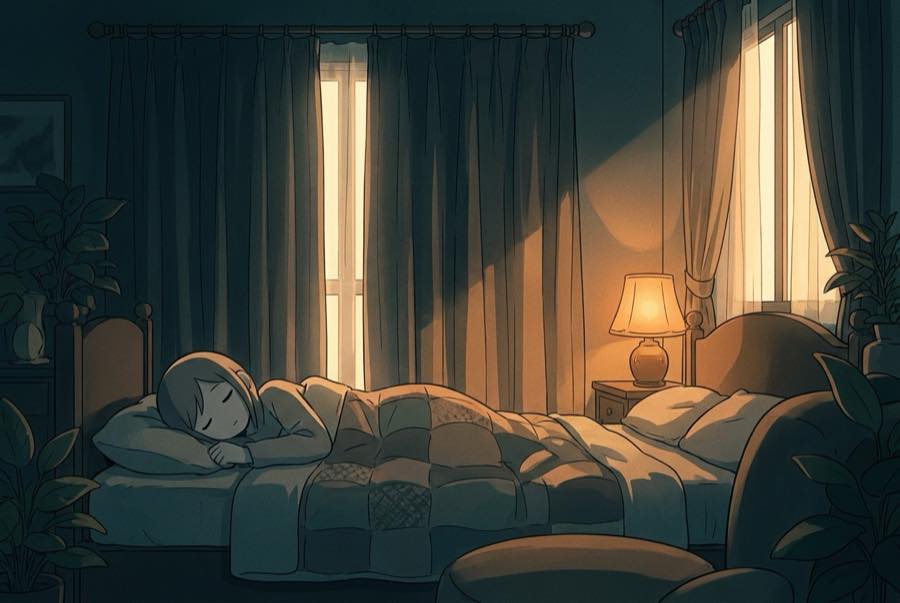
Daytime sleep runs against the grain of everything around it. The sun is up, the street is working, and the body clock that should be winding down has already started its morning climb. That is the honest starting point for anyone asking how to sleep after a night shift: you are not doing it badly, you are doing something harder than ordinary sleeping, and it asks for a room set up on purpose rather than good intentions. Most of what helps is physical — light, noise, temperature, timing — and most of it you arrange once, then reuse every shift week for years.
Why daytime sleep is harder than it should be
Three things push at you at the same time, and it helps to name them separately.
The first is light. Daylight is the strongest signal your body has for deciding whether it is daytime, and a bedroom that leaks even a bright rim around the curtain keeps making that argument all morning. The second is your internal clock, which after a night awake is usually somewhere between the tail of the night and the start of a normal day — sleepy, but not on the schedule you want. The third is the world's volume. At 2am a building is nearly silent. At 9am it is a workplace: bins, vans, a drill two gardens over, a delivery driver leaning on your buzzer.
None of these is willpower's problem to solve. The morning after a shift is exactly when you have the least willpower available anyway. So the answer is a room that does the work for you.
How to sleep after a night shift: fix the room first
Darkness is the biggest single lever. Blackout curtains or a blind mounted outside the window frame will beat any thin liner, and if that is not an option, an eye mask does most of the same job for a fraction of the cost. Cover the small glowing points too — the charger, the standby dot, the router. A dark room is not a nice-to-have for a day sleeper; it is the whole foundation, and it is worth the money and the awkward afternoon of installing it. If your room simply cannot be made dark, the workarounds are laid out in how to sleep in a bright room.
Handle the light on your way home too. Bright morning light on the walk or drive back is telling your body to start the day just as you are trying to end it. Sunglasses on the way home, and low light once you are inside, keep the message consistent. Save the daylight for when you get up — that is when you actually want it working on you.
Cool the room down. Bedrooms warm up through the day, which means the temperature curve is working against you exactly when you are trying to sleep deepest. Set the room cooler than feels necessary at 8am, and shade the window from the outside if you can.
Kill the interruptions you can predict. Phone on silent, not vibrate. A note on the door for deliveries, and where possible a delivery box or a neighbor who will take parcels. If people in your life keep calling at noon out of habit, tell them plainly which hours are your night — most people will simply adjust once they understand it is not a nap.
The daytime noise problem
Daytime noise is not just louder than night noise, it is more eventful. Silence broken by a slammed van door is what pulls you out of sleep; a room with a steady sound floor gives those spikes less to cut through — the mechanics of that are in why rain sounds help sleep. It is also a narrow, realistic thing to ask of sound. It is not going to make you sleepy at 8am; it is going to stop a reversing van from being the loudest event of your morning, which is a smaller claim and a more useful one.
For a day sleeper that argues for something dense rather than delicate. A gentle drizzle sits too low to cover a reversing beeper; a full downpour has enough body to swallow it. That is the reason we reach for Heavy Rain — Full Downpour on shift weeks — thick, unbroken rain with nothing in it that suddenly gets quiet. A gap in the sound at 10am is a gap the whole street walks straight into, which is why we listen to every hand-off before a track goes in; the rest of that checklist is in what makes a rain sound work. Leave it looping, put the phone face down, and it will still be going when the alarm arrives.
Volume is worth one minute of attention before you lie down. Loud enough that the street loses its edges, quiet enough that your alarm and your front door still reach you. Set it once, at the start, rather than reaching for the phone at 11am. If heavy rain turns out to be too much weather for you, the other families are in the guide library.
The wind-down still applies at 8am
The instinct after a shift is to go straight from the car to the mattress, and it rarely works. You have spent eight hours being alert on purpose, sometimes on caffeine, often on adrenaline. That does not switch off at the door. Give it twenty or thirty minutes of the same sequence every time: eat something small rather than a full meal, shower if a shower helps you, low light, no bright screens, then bed. The sequence matters more than the contents — a repeated order of small cues is what teaches a body that this particular morning is a night.
A few things worth trying, with the honesty that they are habits rather than guarantees. Stop caffeine well before the end of the shift rather than at the end of it, since the last cup is usually the one still working at noon. Keep the drive home boring and dim rather than a burst of loud music and sunlight. And if you get home wired despite all of it, sit somewhere low-lit for a little while instead of lying in bed waiting for the switch to flip.
Split sleep, and the days off
Not everyone gets one solid block, and that is fine. Plenty of shift workers do better with a long sleep straight after the shift and a shorter one before the next, or the reverse — main sleep in the late afternoon, closer to the shift. Both patterns are legitimate. Pick one and repeat it, because the repetition is doing at least as much work as the timing.
Days off are the genuinely hard part. Flipping fully to a daytime schedule for two days and back again is the closest thing to jet lag you can arrange without a plane. Many sleepers find the softer version works better: keep one anchor — a consistent wake time on at least part of your off stretch — instead of swinging the whole clock twice. The mechanics of moving a schedule gradually, and how long it actually takes, are in how to fix your sleep schedule.
When tiredness needs more than a dark room
There is a line worth knowing. If you are protecting your sleep well — dark room, quiet room, consistent timing, enough hours — and you are still exhausted, falling asleep when you do not intend to, or feeling low in a way that is not lifting, that is not a discipline problem and it is not something a playlist reaches. Shift work is demanding on the body in ways doctors take seriously, and there are real assessments and adjustments available. Bring it to your doctor, and bring your actual shift pattern with you; it changes the conversation.
The short version
Make the room properly dark, cool it before you get home, and cover the standby lights. Wear sunglasses on the way back, and keep the lights low once you are inside. Silence the phone, head off the deliveries, and tell the people who call at noon which hours are your night. Give yourself twenty minutes of the same wind-down sequence in the same order, every single time, even at 8am. Then set a dense, unbroken sound at a volume you chose deliberately, and leave it running until the alarm.
This article is for general information and isn't medical advice. If sleep problems persist, talk to your doctor.