Why are you wider awake at midnight than you were before you trained? Everyone who lifts at nine, runs after work, or plays in an evening league ends up asking it eventually — tired legs, heavy shoulders, and a head that is completely switched on. The honest answer to how to sleep after a late workout is that nothing has gone wrong. Your body is still running the program you gave it an hour ago, and that program takes a while to shut itself down. You can't skip the shutdown. You can shorten it, and you can stop accidentally extending it.
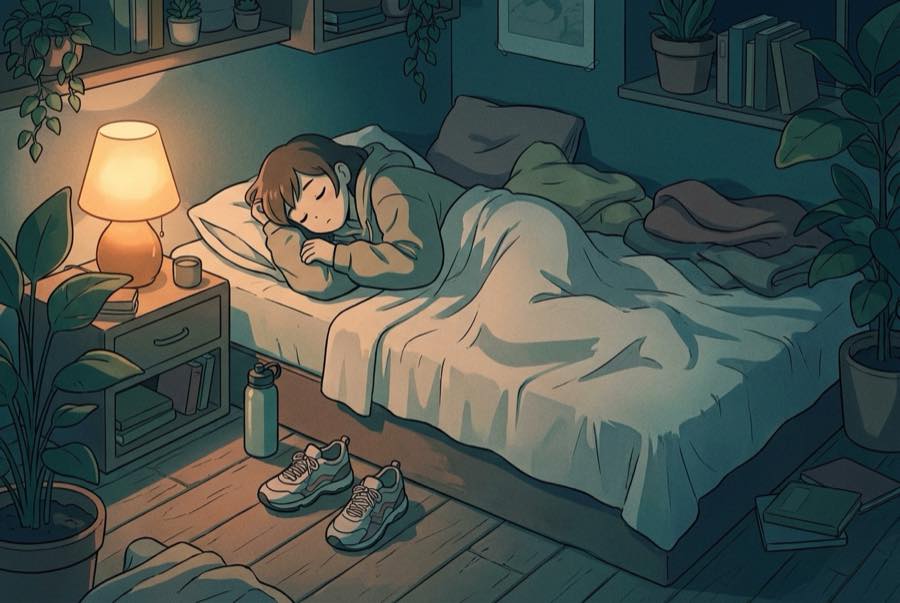
The wired hour is normal
Hard effort tends to leave you switched on for a while after the last set. Warmer than usual, breathing settled but not quite quiet, and alert in a way that has nothing to do with how tired your muscles are. That gap — exhausted body, awake head — is the thing that makes late training feel like it broke your night. It usually hasn't. It has just moved your wind-down an hour later than you planned for.
There's a second layer, and it's the one people underestimate. After a good session your mind has material: the set that finally moved, the split you didn't hit, tomorrow's plan, the app you opened to log it all. Training is interesting, and interesting is not sleepy. So there are really two things to bring down before lights out — the heat and the alertness — and they respond to different tactics.
Worth naming early: if your session runs on a pre-workout or a strong coffee, that's often the real culprit, not the exercise. Caffeine taken at seven in the evening is still doing its job at eleven. If your late nights started when your pre-workout did, try training without it for a week before blaming the barbell.
How to sleep after a late workout: cool down on purpose
The five to ten minutes at the end of a session are the ones everybody skips, and they're the ones that pay you back at bedtime. Don't stop dead. Walk, spin easy, do something that lets your breathing slow down while you're still in the room where you trained. Coming down gradually is a lot easier than coming down flat on your back in the dark.
Then keep the descent going on the way home. This is where most late-workout nights get quietly ruined: you go from the gym straight into a bright kitchen, a bright phone, and forty minutes of admin, and every one of those is a signal to stay up. Keep the lights lower than you normally would once you're through the door. Whatever you were going to reply to can be replied to tomorrow.
Food and shower, and the order they go in
Eat first, shower second. It's a small thing that makes the rest of the evening line up better.
Food. You're likely hungry, and going to bed genuinely hungry is its own kind of awake. Eat something reasonable and eat it soon after you finish, so there's time between the last bite and lights out. A very large or very heavy meal right before bed tends to sit badly and keep people up; that's worth avoiding, but so is grimly refusing to eat because it's late. Drink enough to replace what you sweated, then taper off in the last hour so you're not making the trip to the bathroom at two.
Shower. Save it for closer to bed. A warm shower and then a cool bedroom is a well-worn wind-down sequence, and doing it last means you get into bed already on the way down rather than heating yourself back up after you'd settled. Keep the bathroom light as low as it goes if it has a dimmer, and don't bring the phone in with you.
If you stretch, foam roll, or do any kind of mobility work in the evening, that fits nicely after the shower — slow, quiet, floor-level, low light. Not a second workout. The test is simple: if it raises your heart rate, it belongs earlier.
How late is actually too late
Honestly, it depends on the person, and you'll learn more from two weeks of paying attention than from any general rule. Some people finish at ten and sleep fine. Others need a couple of hours between the last rep and lights out, and know it. If you have any flexibility in your schedule, moving the session thirty to sixty minutes earlier is the highest-leverage change available, and it costs nothing.
If you don't have that flexibility — shift work, kids asleep by eight, the only court time you could book — then late is simply when you train, and the fix lives in the hour afterward rather than in the session itself. Skipping training to protect a bedtime you weren't reliably hitting anyway is usually a bad trade.
One more honest note: the night after a hard session sometimes just runs shorter. What tends to happen next is that you read the short night as proof that training wrecked your sleep, and then lie there resenting it — and that resentment costs more of the night than the session did.
The room, the heat, and something to listen to
You'll get into bed warmer than usual, so set the room up for that before you're lying in it. Cooler than feels necessary, lighter covers than you'd normally reach for, one foot out if that's your thing. If heat is a recurring problem rather than a post-training one, there's more in how to sleep on hot nights.
Then give the alert half of you something undemanding to hold. After training, the job the sound is doing is mostly occupation: it takes over the channel your brain was using to rerun the session, the set that finally moved, the split you missed, tomorrow's plan. There's a quieter physical argument for it as well, laid out in why rain sounds help sleep.
Moving water is the right family for this, because a river is busy without ever being eventful — plenty for a switched-on head to listen to, nothing in it to react to, which is the exact combination the wired hour needs. Forest, River and Night Nature puts river current, night woods and soft weather into that shape, all of it held to the standard in what makes a rain sound work so nothing jolts you back up just as you're going under. Start it while you shower rather than at lights out, leave it going, and keep it quiet — you'll get into bed warmer and more alert than usual, and turning the volume up to compensate tends to backfire. If a river isn't your sound, the other families are in the guide library.
For the rest of the wind-down — the last half hour, in the same order every night — the full version is in how to relax before bed. It works exactly the same after training; it just starts later.
The short version
Finish with five to ten easy minutes instead of stopping dead. Keep the lights low from the door onward and leave the admin for tomorrow. Eat something sensible soon after you finish, taper the water in the last hour, and take the warm shower last so you get into bed already cooling. Set the room cooler than usual and the covers lighter. Log the session, close the app, and put the phone across the room. Start the sound before lights out rather than after, at a low volume, on repeat. If the wired hour keeps costing you sleep, move the session earlier before you change anything else — and if it's caffeine driving the evening, that's the first thing to test.
This article is for general information and isn't medical advice. If sleep problems persist, talk to your doctor.