It's late, you're in bed, and your head won't switch off. You don't need to fix anything tonight — you just need something calm to hand the night over to. Here is the short version: put on steady rain — no thunder, no fades, no track that suddenly gets louder at 2am — set it to repeat, and let it run until morning.
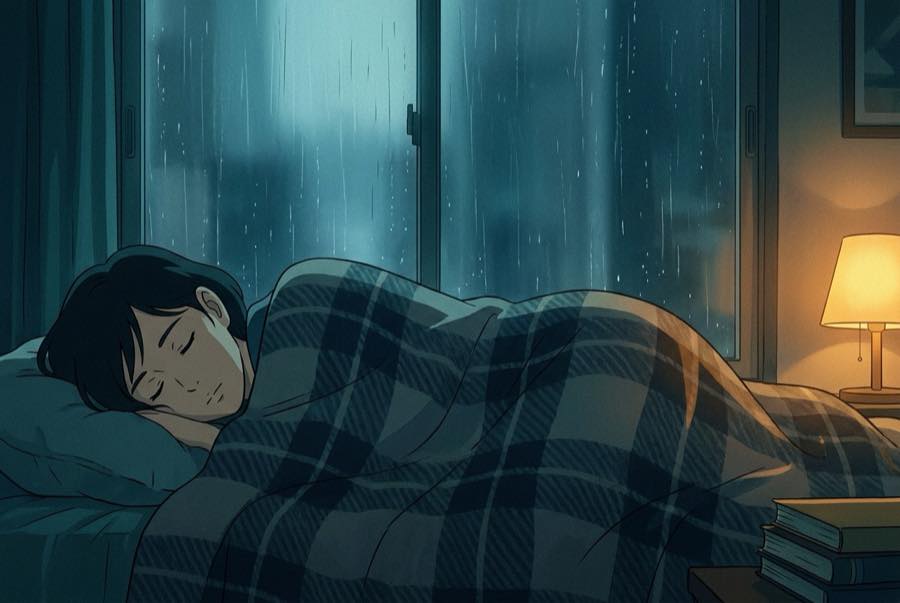
That's what this playlist is built for.
Play Rain on the Roof — All Night Sleep — a deep pool of hand-curated steady rain, long enough to lose yourself in. No sudden changes, no jump-scares, nothing that pulls you back to the surface once you start drifting.
Two things to set before lights out. First, enable repeat on the playlist — even the deepest pool of steady rain carries you to morning only if it starts over instead of stopping mid-night. Second, set the volume now, about the level of a soft shower heard through a wall, so you're not reaching for a bright screen in the dark. And we didn't guess our way to this curation: we listen through every recording before it earns a place, and the ones that hold a whole night are always the steady, low, unhurried ones.
The rest of this page is the longer answer: why rain works, how to pick a good recording, and when rain honestly isn't the right sound for you.
Why steady rain helps you fall asleep
Rain doesn't knock you out. What it does is simpler and more useful: it masks the sounds that wake you up.
Your brain keeps listening after you close your eyes. A door down the hall, a car outside, the fridge clicking on — each one is a small spike of contrast against silence, and contrast is what your auditory system reacts to. Steady rain raises the floor. Against a constant wash of sound, that door-slam is a smaller spike. It's less likely to register, and less likely to pull you out of light sleep.
Rain is particularly good at this because of its texture. It's broadband — energy spread across many frequencies at once, weighted toward the low end — which is close to what researchers call pink noise. It covers a wide range of intrusions without sounding harsh the way pure white noise can.
The evidence here is genuinely mixed, and we'd rather tell you that than oversell it. A systematic review by Riedy and colleagues in Sleep Medicine Reviews (2021) looked at continuous noise as a sleep aid and found the strongest case for exactly this masking effect — noise helps most when it's covering up a disruptive environment, less when your bedroom is already silent. The Sleep Foundation's guidance on noise and sleep points the same direction: a consistent, unchanging sound can help some sleepers fall asleep faster and stay asleep, especially in noisy surroundings.
So the honest claim is this: rain sounds are a masking tool, not a sedative. If noise — outside or inside your own head — is part of what keeps you up, steady rain is one of the most pleasant masks there is.
What to look for in a rain sound
Not every rain recording is a sleep recording. Before a track earns a place in the playlist, we check three things: steady (the same in minute forty as in minute one — every swell is a small event, and events wake you), no fades (a fade-out leaves a pocket of silence, and silence is contrast), and loopable (gapless handoffs and repeat on, so the rain never appears to stop). The full breakdown of the three criteria — and how to pick by sleeper type — is in the best rain sounds for sleeping.

This is the whole reason the playlist is hand-curated rather than auto-generated: every track in it passed those checks, ending at full level and sequenced to hand off cleanly. Set Rain on the Roof — All Night Sleep to repeat and it holds a steady room of rain until your alarm — there's more about how it's put together on the playlist's page.
Rain vs thunder vs ocean
Different water, different night. Here's how the three big sleep sounds compare — including where each one goes wrong.
| Rain | Thunder | Ocean | |
|---|---|---|---|
| Feel | Steady, close, roof-and-window cozy | Deep, distant, stormy-night drama | Slow, wide, rhythmic push and pull |
| Best for | Falling asleep and staying asleep; masking a noisy room | Listeners who find low rumble comforting and rain alone too thin | People who relax to rhythm; daytime rest and unwinding |
| Watch out | Recordings with fades or shifting intensity defeat the purpose | Sharp, close thunderclaps can startle you awake — distant rumble only | Wave crashes are peaks and gaps; irregular sets can register as events |
For what it's worth, the storm recordings that can hold a whole night all work the same way: the thunder stays distant, two valleys away, never overhead. Rumble is fine. Cracks are not. If thunder is your sound, start with the thunderstorm sounds guide.
When rain is the wrong choice
We'd rather you sleep than stream, so here's the honest section.
If your bedroom is already quiet, added sound may do nothing for you — and for some people any noise, however gentle, is one more thing to notice. Try a few nights with rain and a few without. Keep whichever wins.
If you need to hear something in the night — a baby, an alarm, a door — masking cuts both ways. Keep the volume low, about the level of a soft shower heard through a wall, or skip it.
If you associate rain with bad weather or bad memories, no amount of curation fixes that. Wind, deeper rumble, or plain pink noise may sit better — the right sleep sound is the one your body doesn't argue with, and there are more families to try in our full sleep sounds library.
If sleep itself is the problem — you're lying awake most nights, or you're exhausted no matter how long you sleep — that's beyond what any sound can address. Persistent insomnia and suspected sleep apnea are things to raise with your doctor. Rain can make a bedroom more sleepable; it isn't treatment, and we won't pretend otherwise.
Tonight, then
Steady rain, low volume, on repeat, all night, no fades. That's the whole method.
Play Rain on the Roof — All Night Sleep — hand-curated steady rain, sequenced to hand off cleanly; set it to repeat and it runs until morning. Follow it so it's one tap away the next time your head won't switch off.
Press play. Lights out.
This article is for general information and isn't medical advice. If sleep problems persist, talk to your doctor.