It's late. The lights are off, the house is quiet, and your mind is anything but. Maybe it's replaying today, maybe it's rehearsing tomorrow, maybe it's just loud in a way you can't name. You don't have to solve any of that tonight. This page is about one small, gentle thing you can do right now: give your ears something steady to listen to.
One thing to say plainly, before anything else: rain sounds do not treat anxiety. They are not therapy, not medicine, and not a substitute for either. What they can be is a kinder backdrop for a hard night — and sometimes that's genuinely worth having. We'll be honest about the difference the whole way through.
What's happening when the room feels too quiet
An anxious mind at night is doing something very normal: it's scanning. It's alert, looking for anything that might need attention. And a silent bedroom, oddly, gives it more to work with — silence turns the room into a listening room. Every small sound stands out sharply against nothing: the floor creaking, a car passing, your own heartbeat in the pillow. Every thought stands out the same way, because there's nothing else on.
So the quiet you hoped would help can end up amplifying exactly the things you were trying to get away from. Each little noise is a spike of contrast, and contrast is what an alert mind reacts to.
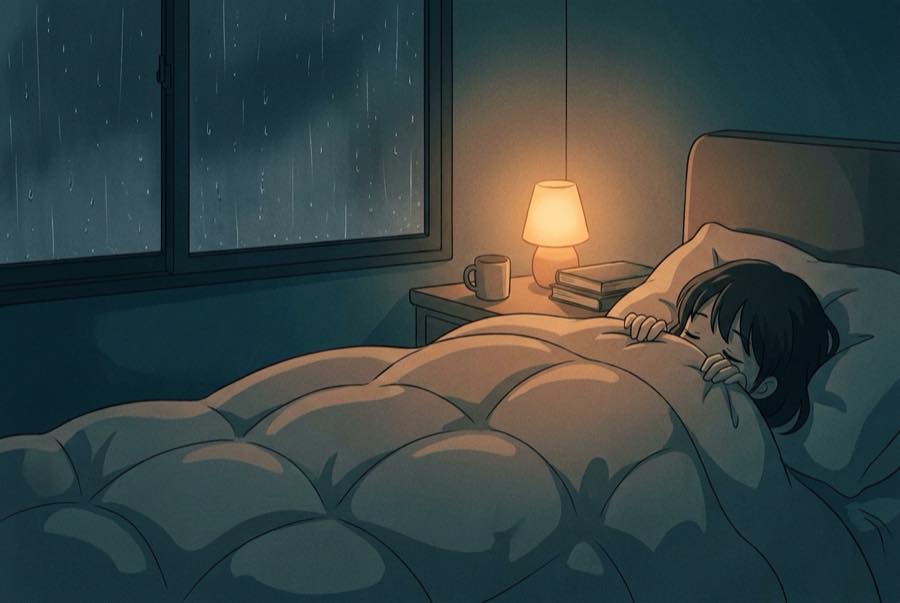
What steady rain can honestly do — and what it can't
Steady rain does two modest, real things.
It gives your attention somewhere calm to rest. A scanning mind wants something to monitor. Rain is a safe thing to monitor: constant, familiar, and going nowhere. Instead of circling through thoughts or straining at the silence, your attention has one soft, predictable place to settle. Not forced, not effortful — just there, whenever your mind drifts back to it.
It smooths out the small spikes. A constant wash of sound raises the floor of the room, so the creak and the car door become smaller events against it. This masking effect is the best-supported thing about sleep sounds — the evidence overall is mixed, but a systematic review by Riedy and colleagues in Sleep Medicine Reviews (2021) found that continuous noise helps most when it's covering up a disruptive environment, and the Sleep Foundation's guidance on noise and sleep points the same way — a consistent, unchanging sound can help some sleepers, especially where the surroundings are noisy.
It can become a cue. Used most nights, the sound of rain starting can come to mean "the day is over now." That familiarity is quietly useful on the anxious nights, because it's one part of bedtime that feels normal.
And what rain cannot do: it cannot switch off anxious thoughts, and it cannot make you sleep. If your mind keeps racing over the rain, that's not you failing at a relaxation technique — it's just an honest sign the sound can only carry so much. Rain lowers the volume of the room. It doesn't argue with your thoughts, and it was never going to.
How to use it on an anxious night
Volume lower than you think. The rain should sit under your thoughts, not compete with them. Aim low — quiet enough that you could ignore it, present enough that the room is never silent. Loud rain becomes one more thing to monitor.
Repeat on, phone face down. Set the playlist to repeat before lights out, then put the phone down and leave it down. The whole point is that nothing needs your attention again until morning. Rain on the Roof — All Night Sleep is built for exactly this — a deep pool of steady rain with no fades and no sudden changes, so once it starts, nothing in the sound will surprise you.
Let your breath slow down with it. No technique required, no counting. Just let your exhale be a little longer than your inhale, at whatever pace feels easy, and let the rain be the thing you listen to while you do it. Many people find a long, unhurried exhale settling; if it doesn't feel that way tonight, drop it and just listen. If you want a fuller wind-down for the hour before bed, we've written one: how to relax before bed.
Give it time without watching the clock. Falling asleep isn't a task you can perform. The rain is on, the lights are off, your only job is to lie there. That's enough.
If rain feels wrong tonight
Some nights, no sound feels right — or rain specifically carries the wrong weight. That's fine. Try something more grounded instead: notice the weight of the blanket, the temperature of the air on your face, the points where your body meets the mattress. Slow, physical, wordless things. Or try a different sound family entirely — low wind, or plain pink noise — from our full library. The right sound is the one your body doesn't argue with, and on some nights that's silence. Nothing on this page is homework.
When it's time for real help
This is the most important section on the page.
If anxiety is regularly stealing your sleep — if most nights involve a racing mind, if you feel panic in the night, or if you've started to dread going to bed — that is beyond what any sound can address, and it deserves better help than a playlist. Talk to a doctor or a therapist. Night anxiety is common, it's treatable, and asking about it is an ordinary, sensible thing to do — not an admission that something is wrong with you.
And if you are in real distress right now — if you feel unsafe, or the night feels unbearable — please contact your local emergency services or a crisis line in your country. They exist for exactly this, at exactly this hour.
Rain can make a hard night softer. People can make it better. Use both in their right places.
Tonight, then
Rain on low, repeat on, phone down, lights off. Let your exhale run a little longer than your inhale. Let the rain be the one thing in the room that's completely predictable.
Play Rain on the Roof — All Night Sleep — steady rain, no fades, no surprises, set to repeat until morning. Press play. Put the phone down. The rest of the night can just be rain.
This article is for general information and isn't medical advice. Rain sounds don't treat anxiety or any other condition. If anxiety is persistently affecting your sleep, talk to a doctor or therapist.