Short and early is most of the answer. A nap of around twenty minutes, taken in the early afternoon, rarely costs a normal sleeper anything at bedtime — and it can hand back the second half of a day that was slipping away. What wrecks a night is the other kind of nap: the long one, the late one, the accidental hour on the sofa that starts as resting your eyes at six in the evening and ends in the dark with the whole night pushed sideways. So how to nap without ruining your sleep comes down to two decisions, and you make both of them before you lie down: how long, and how late. The rest is comfort and a little planning.
Why some naps cost you the night and others don't
The plain-language version, and it's worth holding loosely, is that the drive to sleep builds through the day. Sleep at two in the afternoon spends a little of it. Sleep at seven in the evening spends a lot, and spends it right before you need it most. That's the difference between a nap that leaves your night intact and one that leaves you lying there at midnight, wide awake and annoyed at your own afternoon.
Depth matters too, and the common explanation goes like this: a brief nap tends to stay near the surface, so you come back up easily, while a long one takes you deeper, and being pulled out of deep sleep is what is usually blamed for that thick, disoriented feeling afterward — the one that makes people swear off naps entirely. Whatever the exact mechanism, neither problem is a character flaw. Both are timing.
The length: keep it short, or don't nap at all
Ten to twenty minutes is the sweet spot for most people. Long enough to blunt the worst of the afternoon, short enough that you surface easily and your night doesn't notice. Twenty to thirty is still fine if you're genuinely short on sleep.
The awkward zone, as a rough heuristic we use rather than a precise boundary, is the middle — call it forty-five minutes to an hour and a quarter. Naps that land there seem to be both deep enough to leave you groggy on the way out and expensive enough to show up at bedtime. If you find yourself there often, it's almost always because no alarm was set.
So set the alarm before your head is anywhere near a pillow. Add a few minutes for the falling-asleep part, then trust it. Deciding how long to nap while already drowsy is how twenty minutes becomes ninety. Sleep Foundation guidance lands in the same neighborhood: keep daytime naps brief and keep them early.
The timing: find your personal cutoff
Most people get a natural dip in the early afternoon, somewhere in the stretch after lunch. That dip is the window. The rough way we place it, which is a starting point and not a formula: aim for somewhere around the middle of the gap between when you woke up and when you plan to be in bed, then adjust by how your nights go.
Then set a hard cutoff and treat it as fixed. If you go to bed around eleven, napping after about three in the afternoon starts borrowing directly from the night. If your bedtime is earlier, move the cutoff earlier with it. Past that line, the honest choice is to stay upright and go to bed a little sooner instead — a slightly earlier night beats a six o'clock nap every time.
There's one exception worth naming: if your schedule is genuinely upside down, shift work or otherwise, nap rules bend around a different anchor. That's a bigger project, and it's covered in how to fix your sleep schedule.
Position: make it slightly harder to sink
This is the part people skip, and it does more work than it should. Where you nap quietly decides how deep you go.
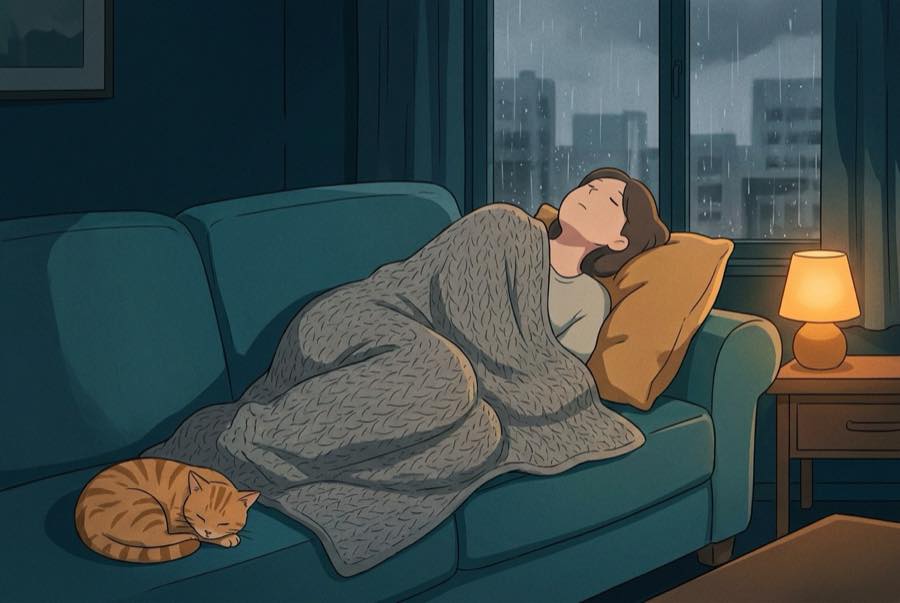
Flat in bed, under the duvet, curtains drawn — that isn't a nap, that's going to sleep, and your body will treat it that way. For a short daytime rest, aim for comfortable but not committed: reclined rather than flat, on top of the covers rather than under them, a blanket instead of the full bedding, shoes on if you're the type who'll otherwise sleep for two hours. A sofa, an armchair, a reclined car seat in a quiet parking spot — all of them help you stay near the surface.
There's a second reason to keep naps out of the bed if your nights are already shaky. You want the bed to mean one thing. If you're someone who genuinely can't drop off during the day at all, then take the comfort you need, but keep the alarm non-negotiable.
How to nap without ruining your sleep after a bad night
The temptation after a rough night is to repay the whole debt at lunchtime. Resist that. A long recovery nap tends to hand you a second bad night, and then you're two nights in.
Take the short one instead, keep it early, and let tonight do the real repair work — ideally with your usual wake time held steady in the morning rather than slept through. The version worth avoiding is two poor nights in a row, with the second one caused entirely by an afternoon that ran long.
The after-nap fog, and how to shorten it
Grogginess on waking is normal, it has a name — sleep inertia — and for a short nap it usually clears within ten or twenty minutes. The mistake is judging the nap in the first two of them. Almost everyone feels worse immediately after waking and better shortly after.
What tends to speed it up is simple: light, water, and movement. Get to the brightest window you have, or step outside for a minute. Drink something. Do a small physical task rather than sitting back down with your phone. If coffee is part of your afternoon anyway, having it just before the nap is an old trick worth trying, since it tends to arrive around the time you're getting up.
Keeping the room quiet enough to nap in
Naps happen during the loudest hours of the day, which is the practical problem with them. Deliveries, neighbors, traffic, someone else's meeting through a wall. A steady sound means the courier at the door is one thing happening among several rather than the only thing happening — that's the whole mechanism, explained properly in why rain sounds help sleep.
For daytime rest we reach for the softest register we curate, Gentle Rain — No Thunder, No Surprises, and softness is the point: you are trying to stay near the surface for twenty minutes, so the last thing you want is something so enveloping that it takes you down as far as a night would. Soft, even rain with nothing that swells or cracks, sequenced to hand off cleanly. Have it playing on repeat and let your alarm end the nap, never the playlist running out. If you want the fuller version of that setup — timer versus repeat, volume, how to wake out of rain gently — it's all in rain sounds for napping, along with the other sound families in the guide library.
When the naps are telling you something
A nap is a patch, and patches are fine. But if you need one every single day just to stay functional, or you're sleeping a full night and still crashing hard every afternoon, that's worth raising with your doctor at your next appointment — persistent daytime sleepiness has causes worth ruling out, and no amount of nap technique addresses them.
The short version
Set the alarm before you lie down: twenty minutes, early afternoon, before your cutoff. Nap reclined and on top of the covers rather than under them. When the alarm goes off, get up, get to a window, and drink something instead of deciding how you feel. And if it's already past your cutoff, skip the nap and move tonight's bedtime forward by half an hour instead.
This article is for general information and isn't medical advice. If sleep problems persist, talk to your doctor.