Your eyes are open, the room is dark, and without even looking you know roughly what the clock says. Waking up at 3am — or 2:47, or 3:20, somewhere in that same stretch of night — has a way of feeling personal, like your body has an appointment it never told you about. It doesn't. This is one of the most ordinary things a sleeping brain does, and this page is about the why of it: why you surface at all, why it clusters in the small hours, and why 3am feels so much heavier than the same wake would at any other time. Seen clearly, the 3am wake shrinks back to its real size — a surfacing, not a sentence.
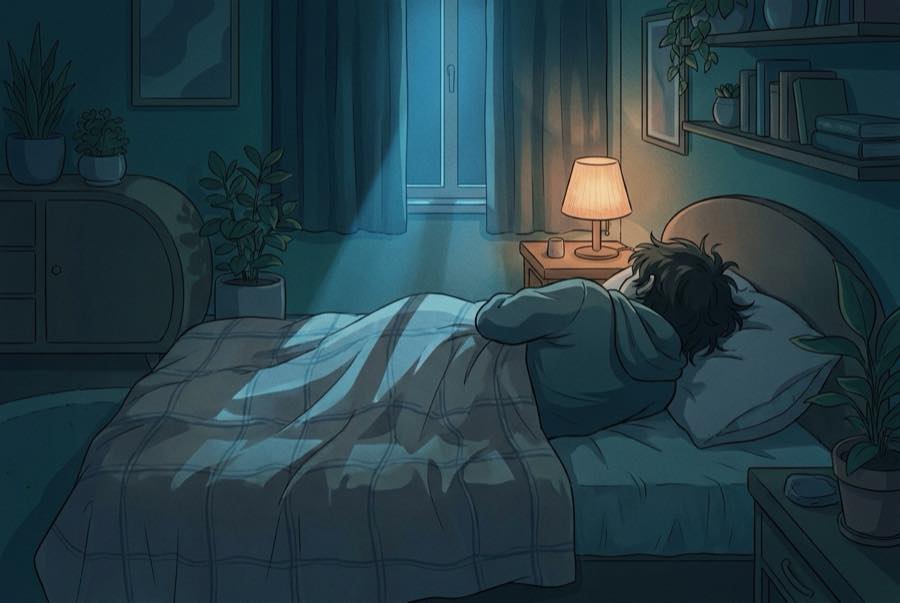
Why waking up at 3am is so common
Sleep isn't one long dive. It runs in cycles, roughly every hour and a half, and between cycles you surface — briefly, and usually without remembering it. Sleep Foundation guidance describes these short awakenings as a normal part of the night, not a malfunction. The catch is that the later cycles of the night carry more light sleep, so by the small hours you're surfacing closer to full waking. Most nights you drift straight back under. Some nights, something meets you at the surface — a sound, a warm room, a thought that was waiting — and suddenly you're awake enough to know it.
Why the same hour, night after night? Nobody can promise you a tidy answer, and we won't invent one. Part of it is simple arithmetic: if you fall asleep around the same time each night, your lighter stretches land around the same time too. Part of it is attention — once 3am becomes "the time I wake up," your mind starts treating that surfacing as an event worth checking on, which is exactly the promotion it didn't need.
The important reframe: the waking itself was never the problem. Everyone surfaces. The problem is what happens next — the clock-check, the mental math about how much night is left, the quiet frustration that warms you up instead of down. And what happens next is shaped by something particular about this hour.
What makes 3am feel worse than it is
Listen to what 3am actually sounds like: almost nothing. The traffic has thinned to the occasional car. The house has finished ticking and settling. Nobody is texting you, nothing needs answering, and the people you love are unreachable in their own sleep. In daylight, a worry has to compete for your attention with a hundred other things. At 3am it has the whole floor, and a thought with no competition swells to fill the room.
The quiet cuts the other way, too. Against near-silence, the few sounds that do happen — a pipe, a radiator, a door somewhere down the street — arrive like events, each one a small tug on a lightly sleeping brain and a fresh distraction for a woken one.
Then there's the arithmetic of the hour itself. At 3am you're too far from bedtime to feel like the night is young and too close to morning to stop caring, so every thought about the time becomes a countdown. And there's the loneliness of it — the sense of being the only person awake anywhere, which makes an ordinary worry feel like something you're facing by yourself. None of this means your 3am thoughts are true. It means they're playing to an empty room with the volume up.
This is exactly where steady sound earns its place. It fills the silence so the small noises stop spiking against it — continuous sound smooths over the little changes that tug at light sleepers, and the full explanation of that effect lives in why rain sounds help you sleep. Just as usefully, it gives your thoughts some competition. Rain on the Roof — All Night Sleep is even, unhurried rain, built to loop without a seam — set it to repeat at bedtime, keep the volume low, and it holds the room until morning instead of ending somewhere in the dark. Every track is chosen against the handful of checks that matter in the middle of the night; what those checks are, and why they matter, is covered in what makes a rain sound work.
What to do about it
The way back down is mostly a matter of not doing things — not checking the clock, not turning on a light, not trying to force sleep — and it deserves a slower walkthrough than a list of bullets. The full method lives in how to fall back asleep; that page is built for exactly the moment you're in. If tonight is the wider-awake version — heart going, thoughts sprinting, clearly up rather than half-surfaced — can't sleep at night covers that night instead, and there are more steady sounds to try across our sleep sounds library.
When 3am stops being ordinary
An occasional middle-of-night wake is normal. But if you're waking most nights and lying awake for long stretches, if it's been going on for weeks, or if you wake gasping or your partner notices pauses in your breathing, that's worth a conversation with your doctor. Rain can make the middle of the night a kinder place to be — it can't treat insomnia or sleep apnea, and we'd rather say that plainly than sell you otherwise.
Back down, gently
You woke up. That's all that happened — the night isn't ruined, and there's more of it left than 3am wants you to believe. The house is quiet, the rain is steady, and your body knows the route down. It's done this every night of your life.
This article is for general information and isn't medical advice. If sleep problems persist, talk to your doctor.