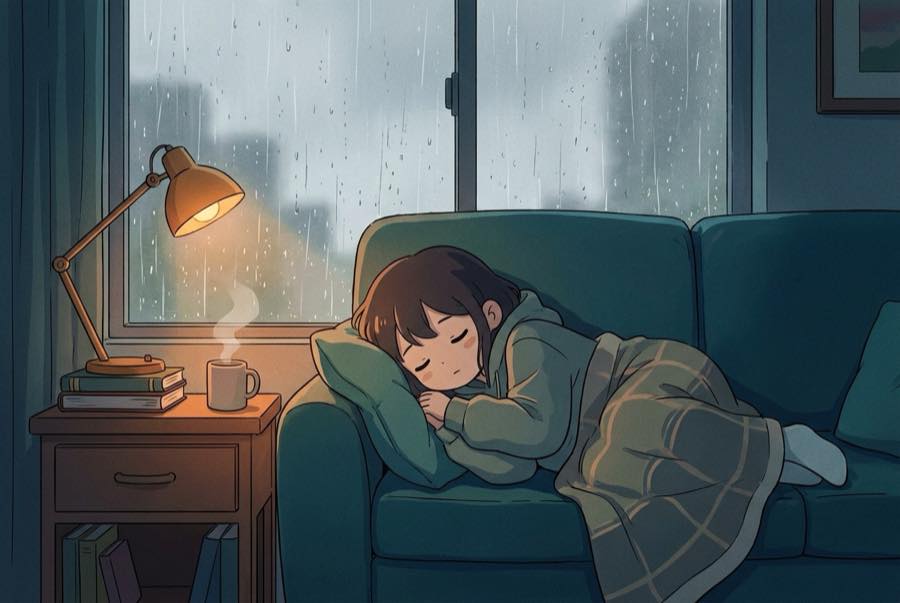
Why does rain make you sleepy at two in the afternoon, on a day you slept perfectly well? It's a strange, specific kind of tired — not the drained feeling of a bad night, but a warm, heavy, pleasant pull toward the nearest horizontal surface, arriving right as the sky goes grey and the first drops hit the window. Nothing is wrong with you. A rainy afternoon changes three things at once — the light, the temperature of the day, and the sound of the world — and each of them nudges you gently toward rest.
Why does rain make you sleepy? Start with the light
The biggest change on a rainy day is one you barely register: it got dark. Thick cloud can knock the outdoor light down enormously compared with clear midday sun, and indoors — under lamps that were designed to be adequate, not bright — you may be spending the whole afternoon in something closer to evening light than daylight.
Light is the main signal your body clock reads. Sleep Foundation guidance is consistent on this point: bright light, especially earlier in the day, pushes you toward alertness, and dim light lets drowsiness in. A grey Tuesday quietly hands your body evening-flavored information for hours, and your body responds the way it always does to evening: it starts winding down.
That alone explains most of the rainy-day slump. It also explains why the pull is worst if you spend the day indoors, away from windows, and why stepping outside for a few minutes — even into the rain, under a hood — often shakes it off better than another coffee does.
The shelter feeling
The second thing rain does is give you a good excuse. Watching weather from inside a dry, warm room is one of the most reliably comforting experiences there is, and it lands somewhere below thinking: you are in here, it is out there, and for the moment nothing is expected of you. Plans get canceled. The garden waits. The walk you were dreading becomes reasonable to skip.
Sleep doesn't arrive when you're braced. It arrives when your body decides it's safe to stop paying attention, and rain on the roof is about as clear a "you are covered, stay put" signal as a house can produce. Whether you call that instinct or association, the effect is easy to notice in yourself: the same grey light through an office window on a workday you can't escape feels like sludge, while the same light on a free Saturday feels like permission.
Warmth compounds it. Rainy days pull people toward blankets, hot drinks, and thicker socks, and a warm, still body in a dim room is a body already halfway into a nap.
The sound is doing something too — just less than people think
Rain also makes a very particular noise: dense, random, unchanging, with no melody to follow and nothing to anticipate. There's a real mechanism there — steady sound raises the sound floor of a room so that small interruptions stand out less, which is the whole story of why rain sounds help sleep at night.
In the daytime, though, the sound is probably doing something simpler. It gives your attention a place to rest. Most of what's around you during the day asks something of you — voices, notifications, the tick of a task list — and rain asks nothing back. Attention with nothing to grip drifts, and drifting is the doorway.
We'd rather be honest about the ranking: on a rainy afternoon, the light is doing the heavy lifting, the shelter feeling is doing more than you'd guess, and the sound is a lovely third.
What we won't tell you it is
Search this question and you'll be told, confidently, that barometric pressure drops make you drowsy, or that rain fills the air with negative ions, or that the oxygen in the room changes. Those explanations are repeated everywhere, usually without a source worth following, and we can't point to solid evidence for any of them. So we won't state them as fact.
You don't actually need them. Dim light for six hours, a warm room, an unhurried afternoon, and a soft wall of sound is a full explanation on its own — and unlike the pressure theory, every part of it is something you can adjust.
What to do with rainy-day sleepiness
You have two honest options, and the mistake is not choosing between them.
Take the nap properly. If the afternoon is yours, this is a gift, not a failure of discipline. Set an alarm before you lie down, keep it short, and don't let it run so late that tonight pays for it — the full setup, including what to play and why a nap wants a softer rain than a night does, is in rain sounds for napping.
Or wake yourself up on purpose. If you have to stay upright, treat it as a light problem first. Get to the brightest window in the building, or step outside for five minutes; turn on more lamps than feels normal. Then move — a lap of the stairs beats a second cup of coffee at 4pm, and it doesn't follow you to bed. Eat something real if you skipped lunch. And be careful with the couch: the accidental 6pm doze on a rainy evening is the single easiest way to turn a cozy day into a 1am ceiling-staring session.
The one thing not to do is drift in between — half-working, half-dozing, lights off, for three hours. That's the version that leaves you groggy and behind.
Borrowing the feeling on purpose
Here's the useful part of all this. The rainy-afternoon pull is a mood your body already knows how to answer, which makes it worth keeping on a shelf. When the night is dry and loud and you're wide awake in it, you can put the sound half of that day back into the room: Rain on the Roof — All Night Sleep — a deep pool of steady rain with nothing in it that swells or cuts out underneath you. The recordings hand over at full level rather than fading, so set repeat and check that no sleep timer is running. The whole point is a dry bedroom that sounds like a wet afternoon for as long as you need it to, and a timer switching the weather off at midnight undoes the trick entirely.
Give it the rest of the setting and it works better: lights low well before bed, a warm room, and the same rain every night so it starts to mean something. Rain can't make a night restful on its own, and it won't do a thing about the reasons you're awake — but as a way to tell a dry, wide-awake bedroom that it's a rainy Sunday, it's hard to beat. Other sounds do the same job for other people; they're all in the guide library.
Grey sky, warm room, rain on the roof — borrow it tonight.
This article is for general information and isn't medical advice. If sleep problems persist, talk to your doctor.