Your bedroom is fine. It's just that it's your bedroom — the same ceiling you stared at last night, the same unfinished day sitting in the corner. Some nights the hardest part of falling asleep is that you're still here. That's what rainforest sounds for sleep are quietly good at: they don't just cover the noise of your street, they move you. Warm rain on broad leaves, a canopy breathing above you, night insects far off in the dark. Somewhere else, all night.
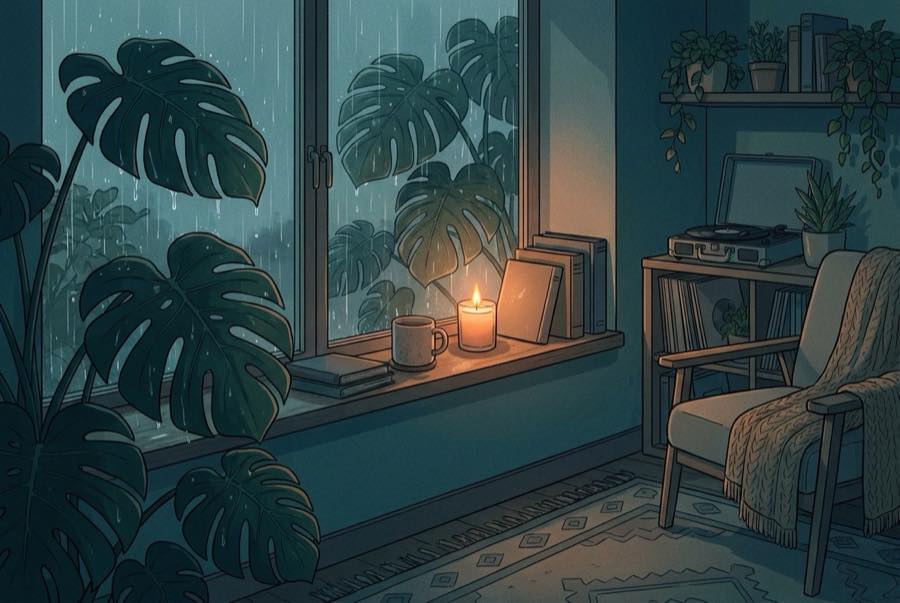
Play Tropical Rain and Rainforest Nights — hand-curated warm rain and rainforest night, sequenced to hand off cleanly. Set it to repeat before lights out, so the forest starts over instead of stopping while you sleep.
Keep the volume low — low enough that you could talk over it without raising your voice — and put the phone face down. The rest of this page is the longer answer: why a rainforest feels different from plain rain, how we chose these recordings, and when this isn't your sound.
Why rainforest sounds for sleep feel different from plain rain
Plain rain is weather. A rainforest is a place.
That's the real distinction, and it matters more than it sounds. When you put on a straightforward rain recording, your brain hears rain on your own window — the sound lands in the room you're already in. A rainforest recording lands somewhere else entirely. The rain is warmer and softer, filtered through layer after layer of leaves before it reaches you. Underneath it there's depth: the low hum of insects, the occasional far-off drip from the canopy, the sense of a vast green space breathing in the dark. Your imagination has somewhere to go, and it goes there instead of circling back to tomorrow's list.
Many sleepers find that this kind of gentle mental relocation is exactly what they need on the nights when the problem isn't noise but presence — the mind refusing to leave the day behind. A place-sound gives it a destination. You're not lying in your room trying to sleep; you're lying somewhere under a canopy where it's been raining for hours and will keep raining long after you've stopped listening.
There's an ordinary masking benefit here too: steady, broadband sound raises the floor beneath the door-slams and car noises that would otherwise spike against silence — the full explanation of how that works lives in why rain sounds help sleep. But masking is only half of what a rainforest does. The other half is the journey.
The canopy problem: what we listen for
Here's the honest difficulty with rainforest recordings, and the reason we curate them by hand: a real rainforest is not a polite place. Real jungle audio is full of events — a bird shrieking directly overhead, a branch cracking, a monkey deciding that 3am is the moment. Wonderful on a documentary. Terrible in a bedroom, because every sudden call is a small alarm, and your sleeping brain treats it like one.
So before a track earns a place in Tropical Rain and Rainforest Nights, we listen through the whole thing and hold it to the same steady, no-fade, loopable bar as everything we curate — what makes a rain sound work unpacks those checks — plus one that's specific to this playlist: nothing close, nothing sharp. The rain stays even from the first minute to the last, the insect bed hums along without swelling, and whatever wildlife remains is distant, low, and part of the texture rather than a character in it.
The result is a rainforest the way you remember it from the best kind of dream: dense, warm, alive, and completely uninterested in waking you.
Making the place-effect work for you
A few small things help the somewhere-else feeling settle in.
Same forest every night. The place-effect gets stronger with repetition. If the rainforest becomes your nightly destination, pressing play starts to work like a boarding call — your body learns that this sound means the day is over.
Repeat on, always. No playlist runs as long as the night. Set it to repeat so the rain carries through instead of ending somewhere in the dark.
Speaker over headphones, if you can. A rainforest wants to fill the room, not sit inside your ears. A phone on the nightstand at low volume is enough to turn the whole bedroom into the space under the canopy.
If the jungle isn't your place
The right sleep sound is the one your body doesn't argue with, and warm tropical rain isn't everyone's home. If you relax more to a cooler, quieter kind of green — leaves, a stream, a night with no insects — a temperate forest may sit better; start with forest sounds for sleeping. If you're still choosing between rain, forest, ocean, and night, the umbrella guide to nature sounds for sleeping walks through them by feel, and the rest of the sleep sounds library is there when you want to wander.
Tonight's forecast, somewhere warm
Rain over the canopy, steady until morning. Play Tropical Rain and Rainforest Nights, set to repeat — turn the volume low, and let the room you're in matter a little less. Somewhere far away it's already raining. You're allowed to fall asleep there.
This article is for general information and isn't medical advice. If sleep problems persist, talk to your doctor.