You're in bed, still wired, and the sound you're reaching for is the sea. Not surf-competition waves, not a storm against the rocks — the slow, patient version, water arriving and leaving on its own schedule, the way it sounded the last time you slept really well somewhere near a coast. Ocean sounds for sleeping can bring some of that into your bedroom, but only if the recording is the right kind of ocean. The short version: choose slow, regular waves with no big crashes, keep the volume low, set the playlist to repeat, and let the shoreline run until morning.
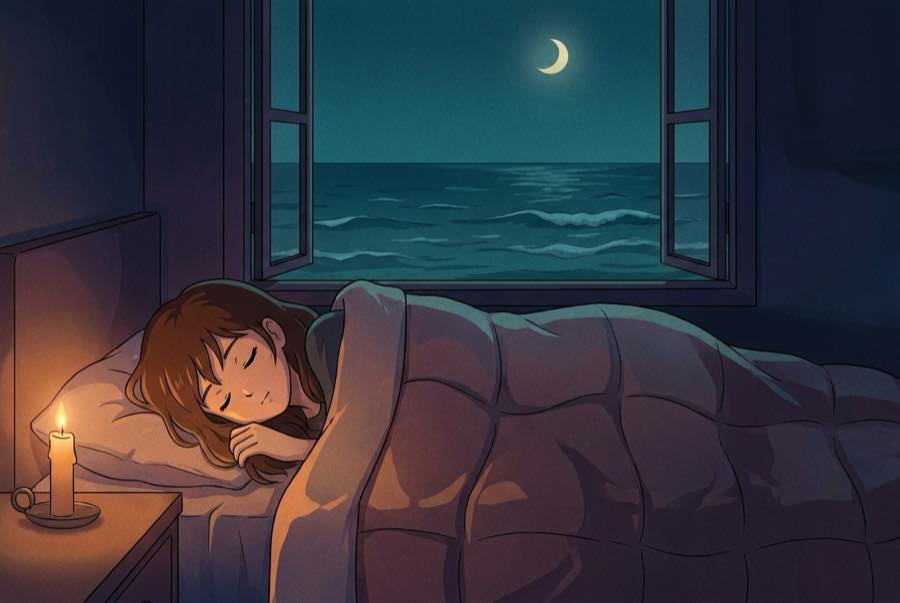
That is exactly the ocean we curated.
Play Ocean Waves for Sleep — Slow and Steady — a deep pool of slow, regular surf, hand-picked and sequenced to hand off cleanly. Set it to repeat so the tide keeps coming in until your alarm, instead of stopping somewhere in the small hours.
The rest of this page is the longer answer: why slow waves settle some sleepers so well, why other ocean recordings do the opposite, and how to tell the difference before you commit a night to one.
Why slow, regular waves settle some sleepers
The sea has something rain doesn't: rhythm. A wave builds, arrives, and withdraws, and then the next one does the same. When the interval is long and even, your ear learns the pattern within a minute or two. Nothing about the next wave is news. Many sleepers find that this kind of predictable, unhurried cycle gives a busy mind something to rest on — a little like being rocked, but in sound. Your attention rises and falls with the water instead of circling your own thoughts.
There's a plainer layer underneath the rhythm, too: a continuous wash of water raises the sound floor of your room, so the door down the hall and the car outside stand out less — the full explanation of how that masking works lives in why rain sounds help sleep, and it applies to the ocean just the same.
So the honest claim is modest. Ocean sound isn't a sedative, and it won't suit everyone. But if you're someone who relaxes to rhythm — who finds a perfectly even hiss slightly dead, and a slow shoreline alive in the right way — the sea is one of the most natural sounds to hand a night to.
The wave-crash caveat
Here is where most ocean recordings fail, and it matters enough to be blunt about it.
A big wave crash is loud, then gone. What follows is a stretch of near-silence while the next set builds. To a waking listener on a beach towel, that's atmosphere. To a sleeper, each crash is a spike and each gap is a hole — and your auditory system reacts to exactly that kind of contrast. A recording full of irregular sets, where one wave booms and the next three whisper, isn't a steady sound at all. It's a series of small events, arriving on no schedule, all night long — and each one is a fresh invitation to surface.
This is why "ocean sounds" is a genuinely risky search at midnight. Two recordings with the same name can behave like different sounds entirely: one a slow, even shoreline that holds you under, the other a surf break that taps you on the shoulder every ninety seconds. If you've tried ocean sound before and found yourself surfacing through the night without knowing why, the recording — not the ocean — was probably the problem.
How to choose ocean sounds for sleeping
Whether you use our playlist or build your own, the test is the same, and it's the one we apply before any track earns a place: slow and regular beats big and dramatic, and every recording has to hold its pattern from first wave to last, end without a fade, and loop without a seam — the full reasoning behind those checks lives in what makes a rain sound work.
Ocean Waves for Sleep — Slow and Steady is sequenced so the last track hands back to the first, but the repeat switch is yours to flip: the shoreline reaches morning only if it starts over instead of stopping, so set repeat on before lights out.
One more setting worth doing now rather than at 2am: volume. Low is the goal — waves you'd have to half-listen for, not waves that fill the room. Set it before you put the phone down so you're not reaching for a bright screen in the dark.
Is the ocean your sound, or is rain?
They solve the same problem differently. Rain is texture without rhythm — an even, close, roof-and-window wash that many people find easier to ignore completely. Ocean is rhythm first — a slow pulse some sleepers sink into and others find themselves quietly counting. Neither is better; they suit different heads, and the only reliable way to know yours is to give each a couple of nights. We've written up the differences properly in ocean sounds vs rain sounds if you want the comparison before you choose.
And if what draws you to the sea is less the acoustics than the memory — a particular coast, a particular holiday, sleeping with the window open somewhere warm — that pull is real and worth using. There's a gentler, more familiar take on it in falling asleep by the sea, and plenty of other sound families to wander through in the full guide library if the ocean turns out not to be your answer.
Tonight
Slow waves, low volume, repeat on, nothing dramatic. That's the whole setup.
Play Ocean Waves for Sleep — Slow and Steady — set it to repeat, put the phone face-down, and let the tide keep its own time until morning.
This article is for general information and isn't medical advice. If sleep problems persist, talk to your doctor.