Maybe you've already given the usual suggestions a fair try. Rain felt like listening to weather. Ocean waves kept arriving, one after another, like small events you couldn't ignore. And plain white noise was just that — noise. So you're still awake, looking for something that helps without asking you to picture a forest or a storm. That's exactly what ambient sounds for sleeping are: soft tonal beds — long, warm, sustained tones with no melody to follow, no scenery, no story. Sound that behaves less like a place and more like a dimmer switch for the room.
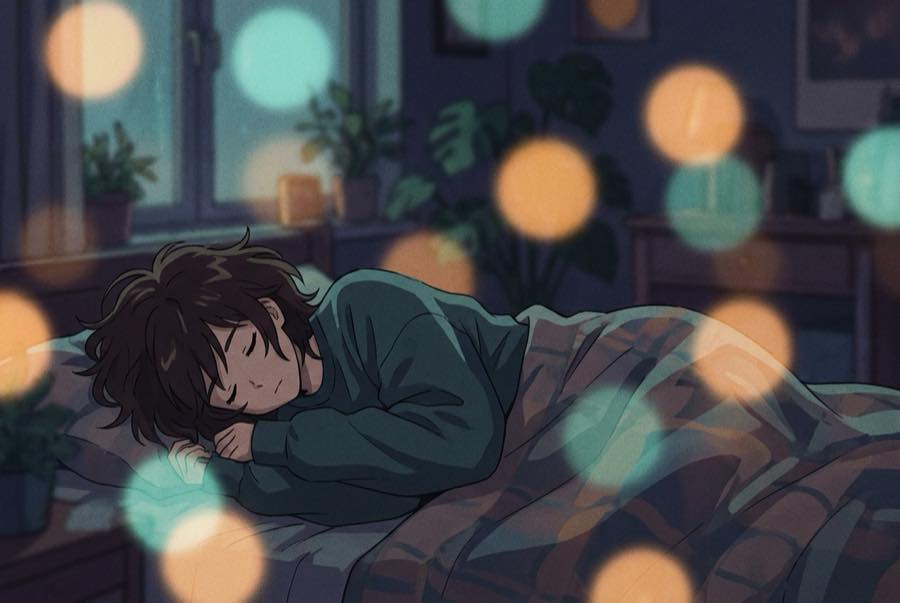
One honest note before anything else: we're still building a true ambient shelf, and we don't link playlists that don't exist yet. Until it's real, the closest things we curate are Fan Sounds for Sleep — Steady Hum — steady, placeless, carrying no scene at all — and, if a whisper of the natural world is fine, Gentle Rain — No Thunder, No Surprises. Set either to repeat and it holds the same low, even floor until morning.
Below is the longer answer: why ambient suits some sleepers better than nature sound, what makes an ambient track safe to fall asleep to, and how to set it up so it actually carries a whole night.
Why ambient sounds for sleeping work when nature sounds don't
Nature recordings come with pictures attached. Rain is a roof and a window. Waves are a shoreline. For many people that imagery is the comfort. But for some sleepers, a picture is one more thing to attend to — the mind names the sound, places it, follows it. If that's you, the recording isn't failing. It's just doing something you don't need at midnight.
Ambient removes the pictures. A tonal bed doesn't sound like anywhere. It's closer to warmth than to weather: a low, slowly breathing layer of sound with nothing in it to identify or track. There's nothing to listen to, which is precisely the point — it gives your attention permission to stand down.
Part of what it does is the same thing any good sleep sound does: it raises the sound floor so that small noises — a door, a pipe, a car outside — stand out less, and the full explanation of that masking effect lives in why rain sounds help sleep. But ambient adds something quieter on top. Many sleepers find that a soft, unchanging tone gives a busy mind somewhere gentle to rest — an anchor that asks nothing back. Thoughts still come; they just have something neutral to dissolve into.
What makes an ambient track sleep-safe
Here's the honest catch: most ambient music was never written for sleep. It was written for listening. It has swells that bloom, chords that change, melodies that surface, arcs that build toward something. Beautiful at 9pm. At 1am, every one of those moments is a small demand for attention — and a chord that finally resolves can wake you as surely as a slammed door, because your brain was quietly waiting for it.
So before a track earns a place in this playlist, we listen through it the whole way and hold it to the same bar as everything we curate — steady with no swells or builds, no fade-outs, a clean handoff so the bed of sound never appears to stop — and the full reasoning behind those checks lives in what makes a rain sound work.
For ambient we add a fourth, unofficial check: nothing that resolves. No melody to hum along with, no progression pulling toward a destination, no moment the music is "getting to." A sleep-safe ambient track holds its ground — warm, low, and unhurried — so there's never a payoff for staying awake, and that's the standard we hold every candidate to while the shelf is being built.
Setting it up for a full night
Three small things before lights out, all done in under a minute.
Put the playlist on repeat. This is the one that matters. The playlist is a compact set built to loop; on repeat it starts over seamlessly instead of leaving you in sudden silence at 2am. Repeat is the mechanism — no playlist should have to be ten hours long, it just has to loop cleanly.
Set the volume low, now. Lower than you'd choose for listening — just above the natural quiet of your room. If you can comfortably ignore it, it's right. Setting it before you lie down means you won't be reaching for a bright screen in the dark later.
Prefer a speaker if you can. A tonal bed works best as room-warmth, not as a headline in your ears. Headphones are fine for travel or a shared bed; if you use them, go even quieter.
Then put the phone face down. That's the whole ritual.
If ambient isn't landing
None of this is worth anything unless it actually puts you under, so a few honest notes.
Some sleepers need a little texture — pure tone feels too empty, like a room with nothing in it. If that's you, the gentle middle ground is worth a try: crickets, low night air, the world ticking over quietly. Start with night sounds for sleep.
If you're not sure what your sound even is, don't guess your way through a dozen playlists at midnight. The walkthrough in what to listen to when you can't sleep sorts the options by sleeper type in a couple of minutes, and the full library of sleep sound guides is there when you want to explore.
And if your bedroom is already quiet and your nights are already fine, added sound may genuinely do nothing for you. Try a few nights with the playlist and a few without, and keep whichever wins — there's no dogma here.
The last thing you turn on
A warm, steady bed of tone. Volume low. Repeat on. Nothing to follow, nothing to wait for.
Play Fan Sounds for Sleep — Steady Hum — the most ambient thing we make tonight: set it to repeat so the hum holds until morning. And when our true ambient playlist is ready, this page will be the first place it appears.
Let the room go warm and dim, and let the sound do the staying awake for you.
This article is for general information and isn't medical advice. If sleep problems persist, talk to your doctor.