Congestion almost always feels worse lying down than it did standing in the kitchen an hour earlier. That isn't the cold suddenly getting worse at bedtime; it's what a horizontal position does to a nose that was already struggling. So the useful answer to how to sleep with a blocked nose isn't a cure. It's a short list of adjustments to how you lie, what the air in the room is like, and what to do once you give up and breathe through your mouth. None of them unblock anything. All of them make the night smaller and less annoying.
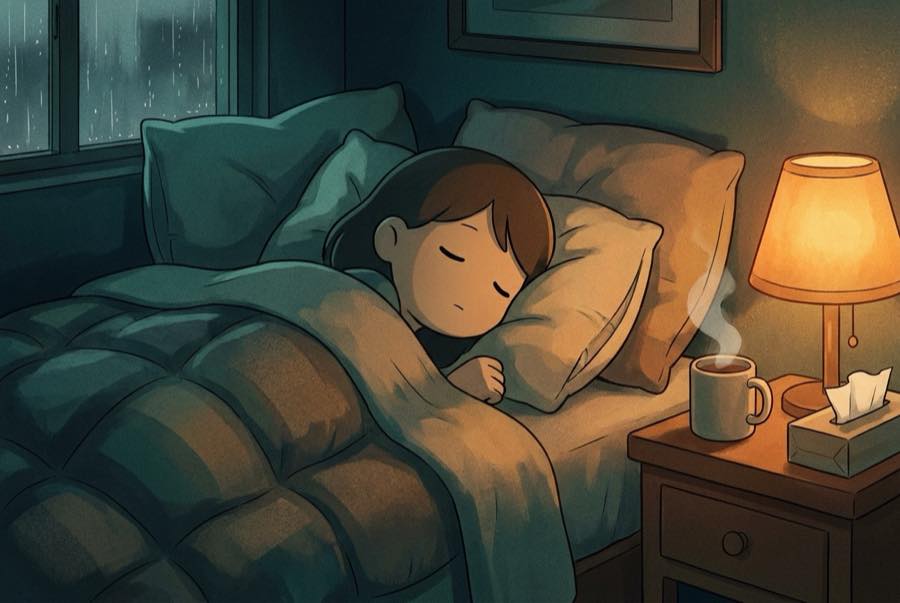
One thing up front, so you know what this page is and isn't: there are no remedies here. What to put in your nose or your body is a question for a pharmacist or a doctor, not for a sleep-playlist site. What's left is still most of the night — position, air, and the long awake stretch in between.
Why it gets worse the moment your head goes down
The usual explanation is unglamorous: lying flat, more blood sits in the tissue lining the nose, the lining swells a little further, and there's less room left to breathe through. Anyone who has stood up at 2am and felt a nostril open within a minute has already run the experiment.
There's a second thing worth knowing, mostly because it stops the night feeling like a personal vendetta. The nose is commonly described as working in a slow rotation, favoring one side for a while and then the other. On an ordinary day you'd never notice. With both sides already narrowed, the handover is loud — the nostril that was working fine at midnight is the blocked one at three, and you wake up convinced something has changed. Nothing has. It's just the swap, happening in a nose that had no margin to spare.
Both facts point the same way. You can't argue with the swelling tonight, but you can change the angle you meet it at, and you can stop the room making it worse.
How to sleep with a blocked nose: raise the whole upper half
Propping up genuinely helps, and most people do it wrong. Stacking two or three pillows under your head bends your neck forward and pushes your chin toward your chest, which narrows the airway you were trying to open and hands you a stiff neck as a bonus.
What you want is a gentle, continuous slope that starts at your hips, not a hinge at your neck. A few ways to get one, in order of how little effort they take:
Put something under the mattress, not on top of it. A folded blanket or a couple of cushions slid beneath the mattress at the head end lifts the whole thing evenly, and it stays put when you move.
Raise the head end of the bed itself. A few inches of books or wooden blocks under the two head-end legs is the version that survives a whole night of turning over. It's also the version you can leave in place all week, which matters if the cold is going to outlast your patience.
Use a wedge pillow if you own one. That's exactly what it's for. Lie on it from the shoulder blades up rather than perching your head at the top.
Or take the armchair. A night half-upright in a chair with a blanket is not a failure. On the worst night of a bad cold, it's frequently the sleep you actually get, and sleep you get beats a principled night of staring at the ceiling from a flat bed.
Damp air is easier than dry air
A dry room is the quiet villain of a congested night, and central heating is very good at making one. Dry air tends to leave a raw nose and a scratchy throat feeling worse, and it punishes mouth breathing especially hard.
You don't need equipment. A bowl of water on or beside the radiator does more than it looks like it should. A damp towel over the back of a chair works. Drying laundry in the bedroom overnight is unglamorous and effective. If you own a humidifier, use it, and use it clean — a neglected tank is not something you want to be breathing all night.
Don't overshoot, though. A clammy, warm room is its own kind of sleepless, and warm rooms fight sleep regardless of what your nose is doing. Aim for cool air that isn't parched. If cool tips over into cold and you end up shivering instead of sleeping, the fixes for that are in how to sleep when you're cold — warm feet, warm bed, cool air is the combination worth landing on.
Pick a side, and expect to change it
Flat on your back is generally the least helpful position for a blocked nose, and it's the one most likely to have you breathing through your mouth by morning. Side sleeping, with the head end raised, is a better starting point.
Which side depends on the night. Lying on one side, the lower nostril often blocks up more than the upper one, so many sleepers find it easier with the worse nostril facing the ceiling. Then, an hour or two later, the rotation does its thing and the arrangement is backwards. Turning over is the fix, and it's worth knowing in advance that you'll probably do it two or three times. Half the misery of a congested night is the feeling that something is going wrong. Very little is going wrong. It's just a nose taking turns.
The mouth-breathing hours
At some point you may stop negotiating and breathe through your mouth, and then you wake at four with a throat like sandpaper, dry lips and a tongue stuck to the roof of your mouth. That wake-up is preventable in the small ways, even if the breathing isn't.
Put water within reach before you turn the light off, so a dry mouth costs you a sip rather than a trip to the kitchen and a full return to alertness. Leave a lip balm on the nightstand for the same reason. The damp room helps here more than anywhere else. And no, we're not going to tell you to tape your mouth shut — that's exactly the sort of advice a site like this has no business giving.
Something to listen to that isn't your own breathing
There's a particular misery to a congested night that has nothing to do with the nose itself. In a silent room you can hear every single one of your own breaths — the whistle, the catch, the swallow, the effort. Attention lands on it and refuses to move, and a person listening closely to themselves breathe is not a person drifting off.
A steady sound gives your attention somewhere else to go, and covers the small interruptions without pretending to treat anything; the longer version of that is in why rain sounds help sleep. It will not touch your sinuses, and anything claiming otherwise is selling you something.
Dense sound works better than sparse sound on a congested night, for the plain reason that your own breathing is loud and a thin trickle of rain leaves it plenty of room. A wall of water with leaves and insects behind it does not. Tropical Rain and Rainforest Nights is the densest shelf we keep — heavy warm rain and night forest, the sound of air that already holds moisture, which is at least a pleasant coincidence on a night spent chasing humidity around the bedroom. Everything in it holds its level rather than thinning out, on the checks in what makes a rain sound work. Have it loop rather than run to an end, so it isn't stopping at the moment you finally go under, and keep it under your alarm.
If dense rain feels like too much when your head is already full, take the quieter shelf instead — gentle rain sounds for sleeping is softer company and asks less of you. Other families, if neither is yours, are in the guide library.
When it's worth asking someone qualified
A nose that blocks up with a cold and clears when the cold does is an ordinary bad week. Some things aren't that, and they're worth a short conversation with your doctor rather than another night of improvising: congestion that hangs on for weeks after everything else has cleared, one side that stays blocked no matter which way you lie, facial pain or fever alongside it, blood, or a nose that's blocked most nights of the year rather than this one week. The same goes if you're mouth-breathing through the night as a matter of routine, snoring heavily, or waking with a gasp. Those get looked at properly, and the answers are often more straightforward than people expect.
The short version
Raise the head end of the whole bed rather than stacking pillows under your neck, and take the armchair if the bed won't cooperate. Keep the room cool but not dry — a bowl of water near the radiator is the cheapest version. Sleep on your side with the more blocked nostril facing up, and plan on turning over once or twice when it swaps. Leave water and a lip balm within arm's reach so a dry mouth doesn't cost you the rest of the night. Start the sound before lights out rather than after the frustration arrives, quiet enough that you'd still hear your alarm. And lower the bar for tonight: a congested night is a shallow night for most people, it usually ends when the cold does, and expecting less of it is what stops the frustration from doing the rest of the damage.
This article is for general information and isn't medical advice. If sleep problems persist, talk to your doctor.