A cold room and a cold body are two different problems, and only the second one reliably keeps you awake. Bedrooms are meant to run a little cool — that part is working as intended. What isn't working is lying under a heap of blankets with feet that never warm up, shoulders held tight against the air, and a bed that seems to be taking heat rather than giving any back. So the useful answer to how to sleep when you're cold has less to do with turning the thermostat up than with where the warmth sits: at your edges, underneath you as much as over you, and in the bed before you climb into it.
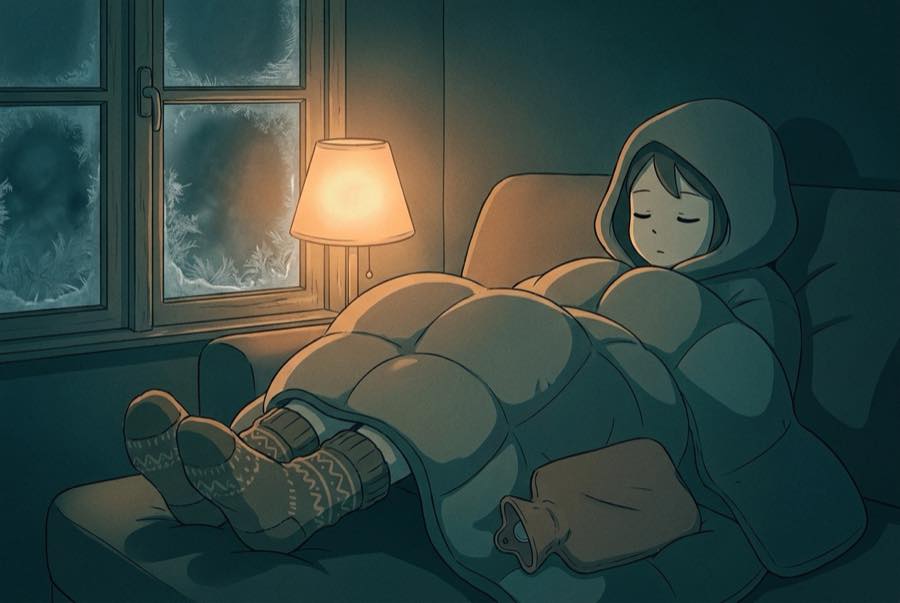
A cool room helps you. A cold body doesn't.
These get confused constantly, and the confusion is why so many people lie awake in a room they've been told is the right temperature. General guidance from places like the Sleep Foundation puts a comfortable bedroom somewhere on the cool side of room temperature, and that advice is sound — cool air makes it easier for your body to shed the small amount of heat it lets go of as you drift off.
But shedding heat is something a warm body does. The usual explanation is that it happens mostly at the hands and feet, where blood runs closest to the surface and warmth leaves most easily, and that extremities which are already cold hold onto what little heat they have instead — so the process stalls. Whatever the mechanism turns out to be in detail, the state is one most people recognize when they describe being too cold to sleep: not freezing, exactly, just stuck at a low simmer, tired and unable to tip over the edge.
Which means the goal isn't a hot room. It's a cool room and a warm you. Almost everything below is one version of that.
How to sleep when you're cold: warm the edges first
Start where the cold actually lives. If your feet are cold, nothing else you do will land.
Dry socks, put on warm. Wool or thick cotton, and ideally a pair that hasn't been on your feet all day — socks hold more damp than they feel like they do, and damp is what makes them cold at 2am. If you can, keep them under the covers for a few minutes first so you're not pulling cold fabric onto cold skin.
Something warm at the foot of the bed. A hot water bottle or a microwavable wheat bag placed down by your feet twenty minutes before you get in does more than an extra blanket on top. Heat rises through the bedding; heat added at your shoulders never travels down.
A warm shower or bath, then a cool-ish room. This pairing is squarely inside Sleep Foundation guidance, which points at a warm bath in the evening and a cool bedroom to sleep in. The usual explanation for why the two work together is that warm water draws blood toward the surface and stepping out into cooler air then lets that heat go. Do it half an hour before bed rather than right at lights-out.
Cover the head and neck if the room is genuinely cold. A thin beanie in a freezing bedroom is unglamorous and extremely effective. So is a scarf loose around the neck, or a hood.
Something warm to drink, in a small amount. Not enough to send you to the bathroom at 4am. The warmth is real but brief, so treat it as part of the wind-down rather than the plan.
One thing to skip: alcohol as a warmer. The warm flush is commonly described as blood being moved outward, which is close to the opposite of holding heat through the night, and it makes for a broken second half regardless.
Build the bed from the bottom up
Most cold-bed misery is an insulation problem, not a blanket-count problem. Whatever is under you gets compressed flat by your own weight, so it insulates far less than the same material draped over you. If your bed is cold from below — over a garage, on a ground floor, against an exterior wall, on a slatted frame with air moving under it — piling on another duvet won't fix it.
Fix the underside first. A wool mattress topper, a folded blanket under the fitted sheet, or a fleece mattress pad changes a cold bed more than anything you add on top. Then layer above you in thin, separate pieces rather than one thick one: a sheet, a blanket, a duvet, a quilt. Layers trap air between them, and separate layers let you shed one at 3am when you overshoot, which is the other half of sleeping well in winter.
Two more small things worth doing once. Pull the bed a few inches off a cold exterior wall if you can. And find the draft — the gap under the door, the window that doesn't quite seat, the letterbox in the hall. A moving thread of cold air on your face will keep you awake at a temperature you'd otherwise sleep through happily.
If you use an electric blanket, follow its instructions on overnight use; many are designed to warm the bed and then be switched off. And never use a fuel-burning heater in a closed bedroom to get through a cold night — insulation and layers are the answer there, never combustion in a small space.
Warm the bed before you're in it
This is the single highest-return habit on this page, and it costs nothing. Cold sheets pull heat off you for the first fifteen or twenty minutes, exactly when you're trying to fall asleep. Waiting it out with your body doing the warming is the slow way to do it.
So warm the bed while you're still doing something else. Hot water bottle in twenty minutes before, electric blanket on while you shower, or simply the duvet folded over itself so the pocket you'll climb into is already holding heat. Get in warm, and the cold hour just doesn't happen.
Cozy is doing more work than it gets credit for
Being warm in bed while the weather is not is one of the oldest good feelings there is, and it isn't only sentimental — feeling sheltered lowers the amount of low-grade alertness you carry into the dark. Cold has an edge of vigilance to it. Warmth and shelter take that edge off.
Sound is part of how that lands. A steady rain overhead, heard from a bed you've made warm, tells your ears that the weather is outside and you are not. It also smooths over the small noises a cold house makes — the ticks and settles of a building contracting in the night — which is the whole of the masking story here; the longer version lives in why rain sounds help sleep.
For cold nights the pick is Rain on the Roof — All Night Sleep, because rain heard from directly overhead is the texture that most reliably reads as being under something rather than out in it — which is the whole feeling you're trying to build here. The tracks are cut to hand straight over to each other, so set it to repeat and turn the sleep timer off; the coldest stretch tends to come right before dawn, and that's a poor moment for the room to fall silent. Keep the level low, since this one is working on the part of you that is already comfortable. If you want the specific bright metallic patter that reads most like shelter, that's rain on a tin roof — and when the season turns and the problem inverts, how to sleep on hot nights is the other side of the same coin. Other families are in the full guide library.
To be plain about it: the recording adds no heat. Warm your feet first. The sound is for the part of you that's still listening once your body has settled.
Tonight, in order
Hot water bottle into the bed twenty minutes early. Dry socks, and a hat if the room is really cold. Something insulating under you, thin layers over you. Find the draft and block it. Then get in warm, before the sheets have a chance to take anything from you.
Warm feet, a warm bed, and Rain on the Roof — All Night Sleep running overhead on repeat with the timer off — let the cold stay outside where it belongs.
This article is for general information and isn't medical advice. If sleep problems persist, talk to your doctor.