Is there a way to fall asleep next to a television without starting an argument about it? That is the real question underneath most searches for how to sleep when your partner watches TV in bed, and it deserves a straight answer. You are tired. They are two episodes from the end of something. The room has been asked to do two incompatible jobs at the same time, and neither of you is being unreasonable about it — one of you is winding down the way you have wound down for years, and the other has to be up in six hours.
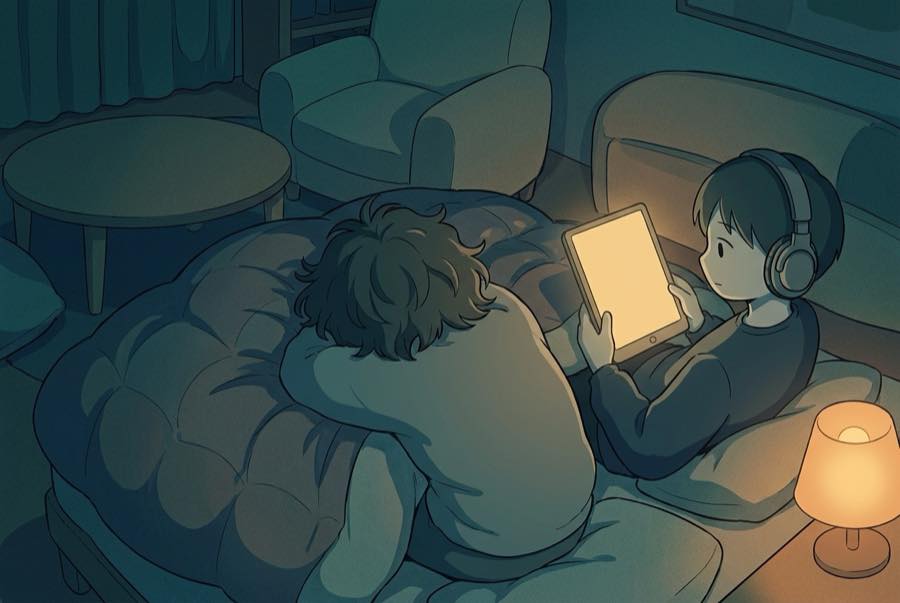
So this page comes in two halves. The first is the conversation, because most of the fix lives there and no amount of equipment replaces it. The second is what to do about the part of the problem that a conversation cannot reach.
Start with the negotiation, not the earplugs
It is tempting to skip straight to gear. Resist that for one evening. A quiet setup that you built resentfully at midnight is a worse outcome than a slightly awkward five-minute talk on a Saturday afternoon.
Have it outside the bedroom, in daylight, when neither of you is tired. That timing matters more than the wording. The same sentence lands completely differently late at night with your head under a pillow.
Bring a specific ask rather than a grievance. "The TV keeps me awake" invites a defense. "Could we make the volume drop and the subtitles go on after eleven?" invites a yes. Specific, small, and time-bound is what gets agreed to and, more importantly, what gets remembered next Tuesday.
A few asks that tend to work, in rough order of how easy they are to say yes to:
Headphones after your bedtime. This is the single biggest change available, and for most couples it is the whole solution. Wireless headphones with subtitles on turn a shared problem into a private one, and the watching partner usually finds they prefer it — better sound, no need to keep nudging the volume down.
A stop time, not a stop. Nobody wants to be told their evening is cancelled. An agreed hour — the current episode, then off — protects your night without taking theirs away.
Screen brightness down and night mode on. Costs the watcher almost nothing and takes real weight off your side of the bed.
No autoplay. The next episode starting itself is how a reasonable ending time becomes the small hours for both of you.
And be honest about your half of the trade. If your alarm is early and theirs is not, you are asking for the room to run on your schedule, which is a real ask. Offer something back — the weekend is theirs, or the TV stays in the bedroom rather than getting exiled, or you take the noise-canceling headphones and they keep the speakers. The couples who solve this tend to be the ones who treat it as a scheduling problem rather than a character flaw. If you are working out a shared setup more broadly — two sleepers, one room, different tastes — sleep sounds for couples goes into the volume negotiation properly.
How to sleep when your partner watches TV in bed anyway
Negotiations get you most of the way, not all of it. Maybe they are a shift worker whose evening genuinely starts late. Maybe headphones give them a headache. Maybe you got a compromise and you can still hear a tinny leak of dialogue from the other pillow. This is the part sound can help with.
The trouble is not really loudness. It is speech. A steady drone slides into the background of a room within minutes, and a conversation never quite does — your attention keeps going back to it to find out what happens next, which is exactly what television is designed to make it do. That is why turning the volume down often disappoints: quiet dialogue can be more compelling than loud dialogue, because now you are straining.
So the goal is not silence. It is to give the room a fuller sound than the television, one with no story in it. A steady sound works by lifting the floor of the room so the peaks have less contrast to cut through — the longer explanation is in why rain sounds help sleep.
For this specific job we reach for weight. Light, gentle rain leaves gaps between drops, and dialogue slips straight into the gaps. What you want is a downpour: Heavy Rain — Full Downpour — dense, close and continuous, with no thunder cracks to jolt you at the wrong moment, which is the one thing a television will never accidentally do to you and a storm recording will. The recordings are cut so one runs into the next without a gap; set repeat before you lie down, and turn off any sleep timer (here is what we listen for).
Three practical notes on using it next to a TV:
Change the sound before you change the dial. The instinct is to climb over the television, and it does not work: a louder room is a worse room, and the dialogue is still legible. Reach for density instead. Rain with no air in it does at a low level what thin rain cannot manage at any level. What you are aiming for is the point where the words stop resolving into words — that is a result, not a volume target, and denser sound usually gets you there without the dial moving much at all. Set the level while the show is running, before lights out, and then leave it there; fiddling in the small hours wakes you more thoroughly than the television does.
Placement before volume, too. Our default everywhere else is a speaker across the room, where distance softens the sound for free. A television is the exception, because it is a specific noise arriving from a specific direction — so a small speaker on your nightstand, on your side, aimed roughly at your pillow. Meeting a directional noise from your own side buys you more cover per notch of volume than anything on the far wall can, and it keeps your fix from becoming their problem. Run it at the lowest level that keeps the dialogue unintelligible.
Or wear it. If the room simply cannot be shared, sleep headphones put the rain closer to your ears than the TV will ever get. Prefer something wireless and sleep-shaped over the everyday earbuds you already own, keep the level genuinely low, and make sure you can still hear an alarm, a child, or a door — headphones or a speaker for sleep covers the choice and the cable question properly.
If earplugs are more your thing, they work here too, though they work better as a pair with sound than alone: plugs take the edge off the level, rain fills what is left. That combination is the same one that does the heavy lifting in how to sleep with a snoring partner, for much the same reason.
The glow is a separate problem
Sound and light need separate solutions, and people usually solve only one. Even a muted television lights the whole room, and it does not light it steadily — it flickers, brightens on a cut, and darkens again. That flicker reaches you through closed eyelids.
An eye mask is the fastest fix in this entire article. It is cheap, it works immediately, and it does not require anyone else to change anything. A flat contoured one is worth the few extra dollars if a strap across your eyes bothers you.
Beyond that: ask for the brightness slider, not just night mode. Most televisions ship far brighter than a dark bedroom needs, and pulling the backlight down is invisible to the person watching after a couple of minutes of adjustment. Turning to face away helps a little. A bit of physical distance between the screen and your pillow helps more. And general guidance from the Sleep Foundation on screens and evening light points in the same plain direction — dimmer and earlier is the lever worth pulling.
When the answer is the TV moving out
It is worth saying: some couples eventually take the television out of the bedroom, and are glad they did. If the arrangement is costing one of you real sleep several nights a week, and the workarounds keep half-failing, that is not a small thing to keep absorbing quietly. A bedroom is not a compromise you have to lose.
Equally, if a temporary decamp to the couch or the spare room is what gets you through a hard week, take it without turning it into a verdict on the relationship. Sleeping in separate rooms sometimes is a logistics decision, not a signal. Plenty of couples do it and are perfectly fine.
What does not work is silent endurance — lying there tallying up the minutes and saying nothing. Resentment is much worse for a night's sleep than a television is.
Tonight, though: eye mask on, level set before lights out, and Heavy Rain — Full Downpour on your nightstand — chosen for this room because it is the one texture in the library with no gaps in it for dialogue to climb into. Repeat on, sleep timer off, their episode finishing on their side. More sounds to try are in the guide library.
This article is for general information and isn't medical advice. If sleep problems persist, talk to your doctor.