How are you supposed to sleep when your body is still standing in the argument? That is the real question, and it deserves an honest answer instead of a calming platitude: you probably will not talk yourself out of the anger tonight, and you do not have to. Almost nothing that helps when you are searching how to sleep when angry involves resolving anything. It involves bringing your body down out of a fight it is no longer having, and giving your head something to hold besides the replay.
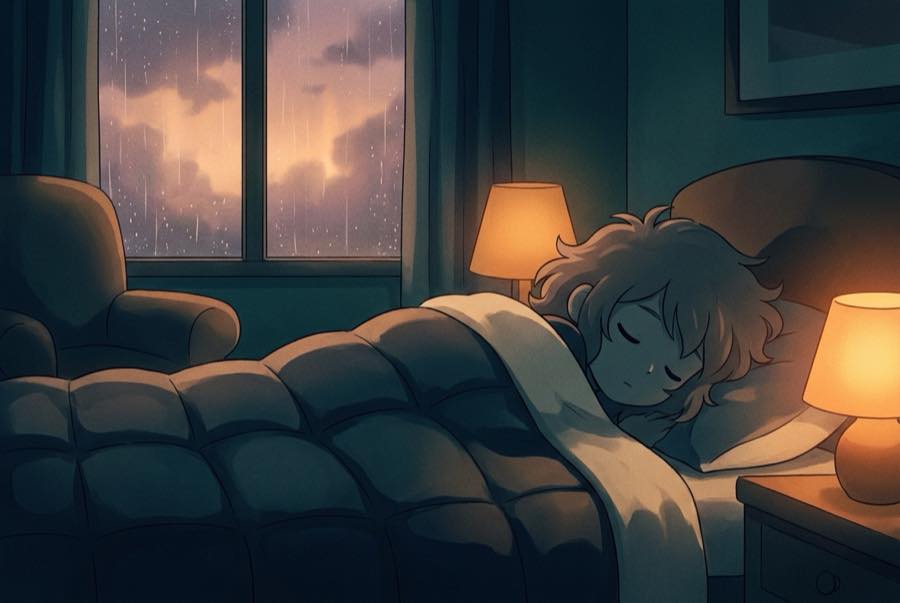
Anger is a body state before it is a thought
Notice where it actually sits. The jaw, usually. The hands. A chest that feels a size too small, a pulse you can hear on the pillow, skin that runs hot under a duvet that was fine an hour ago. People often describe the same set of things, and it explains why lying still feels impossible — anger is an activating state, and activation is the opposite of the drifting-off you are trying to do. Your body has been handed energy for a confrontation and then asked to lie down in the dark with it.
This is why the usual advice to "just let it go" lands so badly at midnight. Letting go is a thought-level instruction given to a problem that is currently living in your shoulders. Start lower down.
Why "don't go to bed angry" often is not practical
It is well-meant advice, and on a good evening it works. But it assumes two people with the energy to resolve something well, and by 11:30pm that is rarely who is available. Tired arguing is worse arguing. It repeats, it escalates, it reaches for things that were settled months ago. Staying up to finish it can leave you further apart at 1am than you were at 11.
The version that actually works is not going to bed pretending everything is fine — it is going to bed with the thing named and postponed out loud. "I'm not dropping this. I just can't do it well right now. Tomorrow, after coffee." Said to the other person, or written on a note to yourself if they are already asleep or a hundred miles away. An unfinished argument stays open and keeps demanding attention. A scheduled one is easier to set down, because some part of you stops guarding it.
How to sleep when angry: cool the body first
Work from the outside in. None of this requires a good mood.
Cool down, literally. Anger runs warm, and a warm body tends to make settling harder. Cold water on the wrists and the back of the neck, a cooler room, a foot out from under the covers. A lukewarm shower does more than it sounds like it should — partly the temperature, partly the fact that it is a hard stop between the evening and the night.
Move the charge out. Ten minutes of something physical gives the energy somewhere to go: a brisk walk around the block, a few flights of stairs, a hard tidy of the kitchen. Brisk, not maximal — going flat out this late tends to wind you up rather than wear you out, which defeats the point. It does not need to be graceful and it does not need to hurt. It needs to move.
Unclench on purpose. Lying down, go through it in order — jaw loose, tongue off the roof of the mouth, shoulders down, hands open on the sheet. Then breathe out longer than you breathe in, a handful of times. It will not feel like it is working. Do it anyway; the body tends to follow the posture it is put in.
Put the phone across the room. Rereading the messages is the single most reliable way to restart the whole thing at full volume. Nothing you type after midnight reads the way you meant it to in the morning.
Give the replay loop an exit
Then there is the argument itself, running on a loop, getting sharper each time. You are not really thinking at this point — you are rehearsing, writing better lines for a scene that is over.
Two things help. The first is writing it down: the whole unfair, uncharitable version, the reply you would never send, on paper or in a note nobody sees. It gets the loop out of the queue by giving it somewhere to be. The second is a deadline. "I will deal with this at eight." Anger is often trying to make sure it is not forgotten; a specific time is a promise it can accept.
If you have been lying there a long while and getting angrier at the ceiling, get up — by that point the bed has become one more thing to be furious with, and that is not an argument you can win from inside it. Sleep Foundation guidance points the same way, and the full version of leaving and coming back is in how to fall back asleep.
If the heat is closer to pressure than to fury, how to sleep when stressed is the closer fit. And if the anger came from a screen rather than a person, how to sleep after watching the news covers that particular residue.
Let a bigger storm have the room
Silence is a bad room for an angry person. It leaves the whole space to the replay, and it turns every ordinary household noise — the fridge, a car door, the breathing of the person beside you — into one more thing to be annoyed by. Sound gives all of that somewhere to go, and why rain sounds help sleep sets out the reasoning if you want it.
But when you are angry, sound is doing something else too. Big weather is honest company for a big feeling. Something enormous is going on out there, it has nothing to do with you, and it will keep going whether or not you win the argument. That perspective is hard to talk yourself into and easy to just lie in.
A big storm is the one sound that meets an angry evening at its own size instead of asking it to be smaller — full downpour, thunder working away somewhere behind it, weather with no opinion about who was right. Heavy Thunderstorm for Deep Sleep is that, and it is assembled to roll rather than crack, against the checks in what makes a rain sound work. Let it run unbroken through the night, then turn it down until the thunder sounds distant rather than overhead: you want it holding the room, not performing in it. If thunder feels like more jolt than comfort tonight, the gentler families are in our sleep guides.
If someone else is in the bed
Sharing a bed with the person you are angry at is its own particular quiet. You do not owe them a conversation at midnight, but you do both have to sleep. Headphones let you have your storm without imposing it, a second duvet ends the silent tug-of-war before it starts, and the couch is a fair choice on a specific night rather than a verdict on anything. Tomorrow is when the talking goes better anyway.
One more honest note: if the anger is not really about tonight — if it has been sitting on your chest for months and taking your sleep with it — that is worth saying out loud to someone, and your doctor is a reasonable place to start.
Tonight is just tonight
Cool down, put the argument on tomorrow's calendar, and let Heavy Thunderstorm for Deep Sleep take the room while you stop holding the rope.
This article is for general information and isn't medical advice. If sleep problems persist, talk to your doctor.