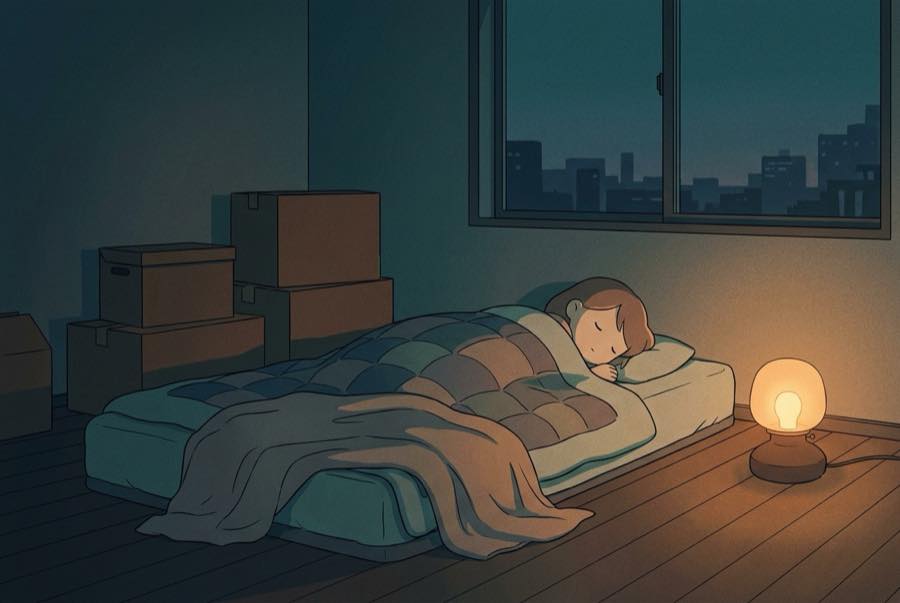
Boxes line one wall. The bed is in roughly the right place, made with sheets that came out of a box marked BEDROOM, and at 1am the house makes a sound nobody in it has heard before — a pipe ticking as it cools, a floorboard letting go somewhere down the hall. Moving is exhausting in a way that ought to guarantee sleep, and yet the first nights in a new home are often the thinnest ones of the whole year. If you're wondering how to sleep in a new house when the house itself keeps interrupting, the honest answer is reassuring: nothing is wrong with you, this settles on its own, and a handful of small decisions make the waiting much easier.
Why a new home wakes you up
In an unfamiliar room, part of the brain tends to stay a little more on watch — the effect that gets described as the first-night effect, and the same reason a strange bed on the road sleeps badly. A new house is that, stretched. There isn't one unfamiliar room, there are several, plus a street, a heating system, a fridge, a set of neighbors, and a whole building settling at temperatures it has settled at for years without you.
The mechanism is less mysterious than it feels at 3am. Unknown sounds get filed. A noise your body already recognizes — your old fridge, your old radiator — gets waved through without waking you. A noise it has never heard before gets checked, and checking is a small awakening whether or not you remember it in the morning. In a new place, almost everything is unfiled. That's why you can be flattened with tiredness and still surface six times before dawn.
The useful part: filing happens quickly. Most of what wakes you this week is ordinary by next month, not because the house got quieter but because your body stopped treating it as news.
How to sleep in a new house: finish the bedroom first
The single best move on moving day is to stop unpacking the kitchen and finish one room instead. The bedroom takes an hour, and it buys back every night that follows.
Make the bed with sheets from the old place. Unwashed, if that doesn't bother you. Familiar smell and familiar texture are two fewer new signals in a room full of them.
Solve darkness temporarily. New curtains rarely arrive on time. A blanket clipped over the rail, a blackout panel taped to the frame, or a sleep mask from the bag you actually packed will do for weeks. Then hunt the small lights: the router, the smoke alarm, the boiler panel, the charger with the bright blue eye. New houses come with a fresh constellation of these, and each one is something to notice in the dark.
Walk the route to the bathroom with the lights off. Once, before bed, deliberately. The 3am trip through an unfamiliar layout wakes you far more thoroughly than the noise that started it, and a shin against an unpacked box will finish the night.
Put your phone, water, and lamp where they lived before. The room is new; the reach doesn't have to be. Small anchors like this cost nothing and give your body something it recognizes without thinking.
Expect the temperature to be wrong. A heating or cooling system you've never lived with rarely lands right on night one. Set it cooler than feels necessary in the evening and adjust across the week rather than at midnight.
Name the noises while it's still light
The night is a bad time to investigate a sound. The evening is a good one.
Walk the house once with the lights on and listen on purpose. That tick is the pipes cooling. That hum is the fridge cycling. That thump at eleven is the neighbor's door, and it will happen every night at about eleven. Sounds you can name stop being questions, and questions are what pull you back up out of sleep.
While you're at it, fix the fixable. Tighten the vent cover that rattles. Move the stack of boxes leaning against the wardrobe so it stops shifting at 2am. Put a felt pad under the door that clicks in the draft. Ten minutes of this in daylight removes more nighttime interruptions than any amount of determination in the dark.
Some things won't be fixable — a road, thin floors above you, a building that creaks as it cools. Those are the ones to cover rather than solve.
Bring one sound with you
Your old bedroom had a soundtrack, even if you never thought of it that way, and it's the one thing you couldn't pack. A half-furnished house is unusually quiet and unusually echoey at the same time, which is precisely the kind of room a new creak sounds enormous in; a steady sound played low fills that quiet in before the creak gets there — the longer version of that is in why rain sounds help sleep.
In a new house it does a second job that matters more. Play the same thing every night and it becomes portable: the one part of your bedroom that moved with you intact. Rain on a roof is the easy choice here because it's shelter you can hear — a sound that says the walls are doing their work, whichever walls they happen to be: Rain on the Roof — All Night Sleep, steady roof rain sequenced to hand off cleanly. Leave it looping through the night rather than on a timer, and pick a volume that still lets a knock at the door reach you. What we throw out before a track goes in is listed in what makes a rain sound work.
Start it on night one, before the house has had a chance to teach you which sounds to listen for. That's easier than retraining later.
Rebuild the routine before you unpack the rest
The move breaks every habit you had, and the last half hour before bed is usually the first casualty. Boxes are still open, there's one more thing to do, and suddenly it's midnight with the lights blazing.
Pick three cues and put them back immediately, in the same order, however chaotic the rest of the house is: shower, lamps instead of overheads, phone face down, sound on. The sequence tells your body the day is finished even when the day clearly isn't. If you want the full method for making that stick over the coming weeks, it's in how to build a bedtime routine.
The tactics for any strange room apply here too — set up early, cover the lights, keep one familiar thing — and those are collected in how to sleep in a hotel, which is the same problem with a shorter stay.
What to expect, honestly
The first night is usually the worst. The second is often better. Many sleepers find a new place feels normal somewhere in the first couple of weeks, though a genuinely noisy street or a bright window can take longer and needs its own fix — sound masks and comforts, it doesn't turn a floodlit room dark or make a truck disappear.
Be gentle with the timeline. You're tired from lifting furniture, your usual meals and hours are scrambled, and none of that resolves by trying harder at bedtime. Do the small setup, name the noises, keep the sequence, and let the house become ordinary. If sleep stays broken well after the boxes are gone, that's worth raising with your doctor rather than waiting out. More sleep guides are in the guide library if you want them.
Tonight, in a house that doesn't know you yet, press play on Rain on the Roof — All Night Sleep and let the roof do the talking.
This article is for general information and isn't medical advice. If sleep problems persist, talk to your doctor.