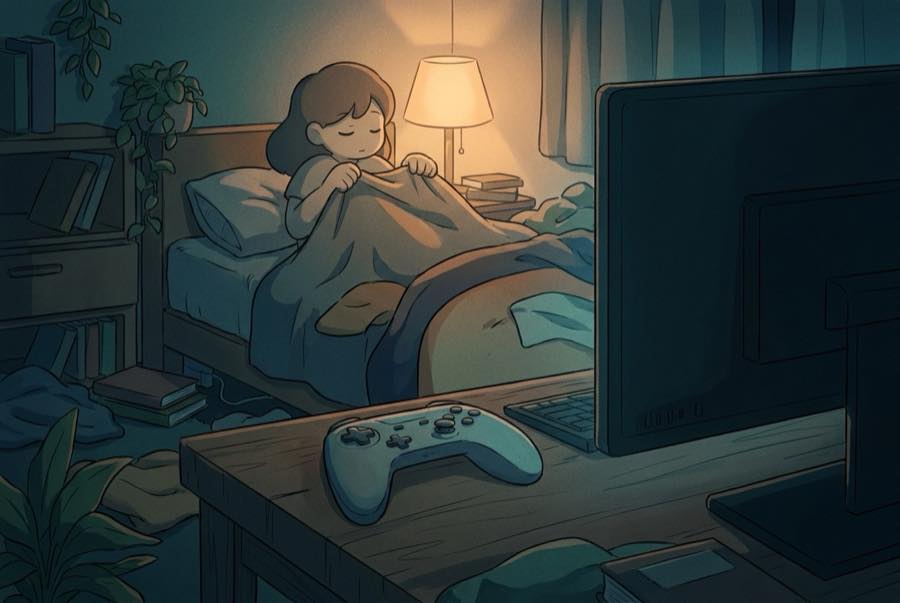
Twenty minutes after shutting everything down, you're still running the fight back. Still hearing the callouts, still a little wired in the arms, still — annoyingly — awake. That gap is the actual subject of how to sleep after gaming, and it's the part almost nobody accounts for: the session ends when you stop playing, but the state you were in to play well has a tail on it, and the tail is longer than the walk from the chair to the bed. Nothing is wrong with you. You spent the evening being deliberately alert, on purpose, and doing it well. The fix isn't discipline at 1am. It's a cool-down lap between the game and the pillow, and it's shorter than you'd think.
Why the game doesn't end when the screen does
Competitive play asks for the exact opposite of what sleep asks for: fast attention, quick decisions, stakes that matter to you in the moment. Whether it's ranked, a raid, or a run you'd been chasing all week, your body has spent that time in a state it can't drop the second the monitor goes dark. Most players describe the same tail — hands still tense, heart still a bit quick, the mind replaying the round it lost rather than the ten it won.
There's a second thing at work, and it's the one people underestimate. Games are unfinished by design. There's always a next queue, a next attempt, a rank one rung up. Unfinished things follow you to bed more stubbornly than finished ones, which is why a session that ends on a loss so often turns into another hour, and why the hour after that is even harder to leave.
So the goal isn't to stop feeling alert on command. It's to give the tail somewhere to run out that isn't your mattress.
How to sleep after gaming: run a cool-down lap
Twenty to thirty minutes. Same shape every time. Athletes don't sprint and then lie down, and this is the same principle applied to a desk.
Decide the last match before you start playing. Not "one more after this one" — an actual number or an actual clock time, picked while you're still fresh and reasonable. A loss should not be allowed to set your bedtime. The single most useful rule most players adopt is: the last game is the last game, win or lose. If you only take one thing from this page, take that one.
Stand up and change the room. Push the chair in. Open a window for a minute. Get a glass of water. It sounds too small to count, but leaving the physical spot where you were competing is what tells your body the activity is actually over, and staying in the chair scrolling clips afterward keeps you exactly where the alertness lives.
Let your hands do something dull. Rinse the mug, tidy the desk, put tomorrow's clothes out, shower if a shower helps you. Boring, physical, no score attached. This is the part of the lap that does the most work and gets skipped the most often.
Don't hold the debrief in bed. If there's something you genuinely want to think about — a build, a strategy, a message you owe someone — write one line about it on paper and let tomorrow have it. Reviewing the session under the covers is just playing without the controller.
Keep the ending calm rather than sharp. Going straight from a tense final round to lights-out is a hard landing. So is switching to something equally stimulating, which is usually where the phone comes in. There's a longer, unhurried version of this whole wind-down in how to relax before bed.
Light is doing more of the damage than the game
A gaming setup is one of the brightest, closest light sources most people sit in front of all day, and it's usually surrounded by more of it — key lighting, strips behind the desk, a second monitor, a phone within reach. A handheld held close to the face at midnight is a smaller version of the same thing, and a big screen in an otherwise dark living room is a larger one. Sleep Foundation guidance points where most players already suspect: bright, engaging screens late in the evening tend to push sleep later. Being immersed in one at close range, at midnight, is the strongest version of that.
The practical moves are cheap. Kill the desk lighting the moment you stop playing, and don't turn on the big overhead light on your way out — go to a lamp instead, low and warm. Turn the monitor off rather than leaving it glowing on a menu. Cover the standby dots and the router light if they're in your line of sight from the bed. Then leave the phone out of the last stretch entirely, because the highlight reel and the group chat are the same alertness in a smaller frame; if that's the part you struggle with most, the swap in how to stop scrolling in bed is the piece to read next.
Swap the screen for a sound
Here's the part that makes the lap easy instead of virtuous: give your attention something to do that isn't a screen. Sound works here for a reason specific to the last few hours — you've spent them reacting. Every noise coming out of the game was information: a footstep, a cue, a callout, music swelling because something was about to happen. Your ears have been on duty. A sound with no events in it lets them keep working while asking nothing back, which is a much gentler landing than switching straight to silence. (There's a broader explanation of the mechanism in why rain sounds help sleep.)
For players we usually reach for the hum rather than the weather: Fan Sounds for Sleep — Steady Hum. Rain, for all its virtues, still has texture in it. A flat hum has none — there is nothing in it to anticipate, and anticipation is precisely the faculty you've been exercising all night and would now like to put down. It has a second advantage too: it sounds like nothing in particular. Not weather, not a place, not a mood, just a room continuing without the game in it. That holds whether you've been at a desk, on the couch with a controller, or curled around a handheld, because a plain hum reads as ordinary background rather than as something switched on. Nothing in it steps forward or asks to be noticed, which is the whole standard we hold it to — what makes a sleep sound work spells out the checks. Start it while you're still doing the dull tasks, put it on repeat and make sure no sleep timer is armed, since the recordings are cut to hand over without a gap and the only thing likely to stop them is your own app. Volume low: background, not a second machine in the room.
If you've had a headset on for hours, give your ears the speaker version instead. Skin gets sore, and ears appreciate the change. Either way, set the volume once, before you're lying down, so you're not reaching for a bright screen in the dark to adjust it.
When the session genuinely can't move
Sometimes the raid is at 11pm, or the only time your friends are online is the two hours before you sleep, or the tournament runs late. That's a real constraint, not an excuse, and the answer isn't to quit playing.
It's to protect the buffer instead. If the group runs long, cut the last match rather than the cool-down — the twenty minutes at the end are worth more to your night than one more attempt. On the nights you know will run late, do the boring parts in advance: clothes out, teeth brushed, room dark and cool, sound ready to start. Then the walk from the desk to the bed is genuinely short, because you did it earlier. And if the schedule slides later week by week, that's a different problem with a different fix — the anchor is your wake time, and there are more sound families for the rest of it in the full guide library.
This article is for general information and isn't medical advice. If sleep problems persist, talk to your doctor.