Three in the morning, and the bedroom takes a few seconds to finish becoming a bedroom again. The heart is still going at a pace the situation doesn't call for, the sheets are somewhere they shouldn't be, and the story that caused all of it is already breaking apart into pieces that don't quite connect. That gap — awake, safe, and still braced — is the hardest part, and it's usually where someone is standing when they go looking for how to sleep after a nightmare. It passes. There are a few small, unglamorous things that help it pass sooner, and none of them require you to be clever at this hour.
Your body hasn't caught up yet
The mind figures out fairly quickly that nothing happened. The body takes longer. For a few minutes after a bad dream you may feel wide awake, warm, slightly shaky, with your attention snapping to every ordinary sound in the house — and that mismatch is the real obstacle, not the dream itself. Trying to reason your way out of it usually doesn't work, because the part of you that's still running wasn't reached by reasoning in the first place.
So the goal for the next ten minutes is modest. Not sleep. Just down. Cooler, slower, less braced. Sleep tends to arrive on its own once the alarm state has drained out, and it tends to stay away as long as you're standing guard waiting for it.
First, reorient the room
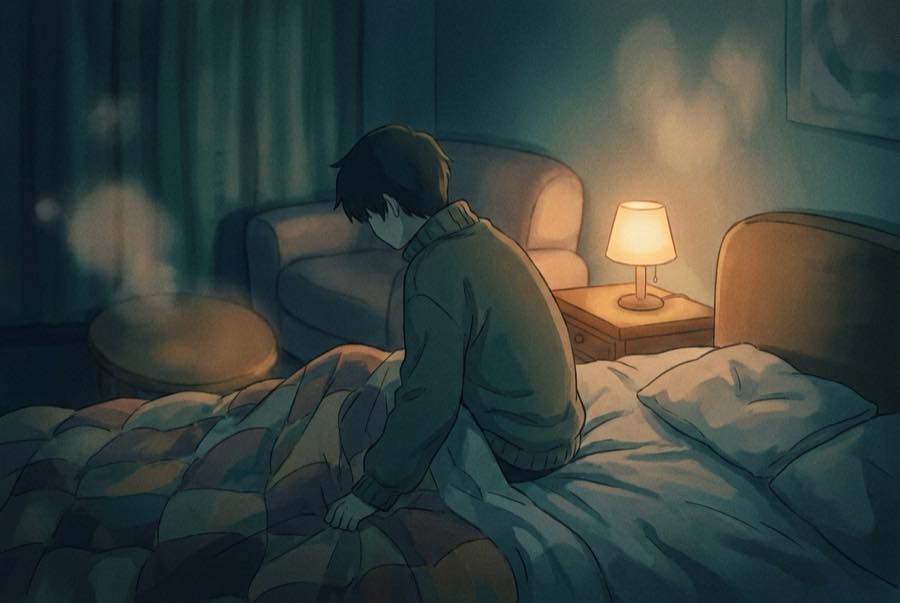
The fastest way to convince a startled body that it's home is to give it plain evidence. Sit up for a moment. Put the light on low if you have a lamp — low, not overhead. Look at four or five specific things and name them silently: the door, the chair, the glass of water, the window, the shape of the curtain. It feels almost too simple to bother with, which is exactly why people skip it and then lie there for an hour instead.
Then put your feet on the floor. Something about weight and contact settles things faster than staying horizontal in the same tangle of bedding where the dream happened. Straighten the sheet while you're up. Open a window a crack if the room feels close. You're changing the physical situation just enough that your body stops treating this as a continuation and starts treating it as afterward.
Leave the phone where it is
The pull toward the phone at this moment is strong, and it's the single decision most likely to cost you the rest of the night. A screen at 3am does three unhelpful things at once: it hits your eyes with light at the hour they're least ready for it, it hands your already-alert mind a feed of new things to react to, and it quietly tells you how long you have left before the alarm — which is the one fact guaranteed to make the next hour worse.
If you want the arithmetic of clock-watching taken apart properly, it's covered in waking up at 3am. For tonight, the short version: turn the clock face away, and let the phone stay dark. Whatever's on it will be exactly as available at seven.
Small physical resets that actually help
These are the things to reach for while your body comes down. Pick two, not all of them.
Warm water on your hands. Run the tap warm and hold your hands under it for thirty seconds or so. It's oddly effective. Warm hands and feet are one of the more commonly reported wind-down cues, and either way it hands you a small, dull, pleasant task at a moment when your attention would otherwise be replaying the dream.
Something cool on your face. If you woke up hot, the opposite works: a cool cloth across your forehead and cheeks for a minute. Between warm hands and a cool face, one of them will feel obviously right, and that's the one to use.
Change the pillow side. Flip the pillow, or move to the other end of the bed, or swap which side you're lying on. A slightly different arrangement gives you a different room to fall asleep in without leaving it.
A few sips of water, not a whole glass. Enough to unstick your throat and give your hands something to do.
Don't narrate the dream. Not to yourself, not into a notes app. Going back over it to work out what it meant keeps the images live at the exact moment you want them fading. The morning is a fine time for that if you still care by then, and usually you won't.
How to sleep after a nightmare: give your ears something ordinary
A dark, silent house after a bad dream is not neutral. Every creak arrives as a discrete event with nothing around it, and a mind that's still slightly on watch will catch each one and check it — that checking is the loop that keeps you up long after the dream itself has stopped mattering. Sound interrupts it by giving the creaks something to belong to; there's more on why in why rain sounds help sleep.
What a startled body needs at this hour is a sound with no personality at all — nothing that builds, nothing that arrives, nothing it has to identify. That rules out thunder tonight, however much you like it on an ordinary evening; one crack landing in this particular state is a second startle you did not need. Soft, level rainfall is the safe choice, and Gentle Rain — No Thunder, No Surprises is named for what it leaves out: no cracks, no swells, nothing that asks for your attention, every piece of it held to the flat standard we describe in what makes a rain sound work. Set it to run continuously, so there's no moment where it ends and hands the dark back to you, and keep it soft enough to sit underneath the room rather than on top of it.
If it's playing and you're still awake twenty minutes later, that's fine and fairly common — a body takes its own time to finish standing down, and it doesn't need supervising while it does. Many sleepers find the second attempt goes easier than the first.
If sleep still doesn't come
Don't turn it into a standoff. If the bed still has the dream in it twenty minutes later, leaving the room for a while is worth far more than lying there on guard against a repeat — the full method, including why the leaving helps rather than hurts, is in how to fall back asleep.
When nightmares keep showing up
An occasional bad dream is just something brains do, especially in a stressful stretch, after a rough day, or when your sleep schedule has been knocked around. But if nightmares are arriving most weeks, if you've started dreading bedtime because of them, or if they're circling the same real event, that's worth a conversation with your doctor rather than another night of coping alone. There are recognized approaches for recurring nightmares, and a good clinician will take the problem seriously instead of telling you to relax more. The same goes if you're waking up gasping or with your heart racing regularly — get it looked at properly.
Tonight, though: lamp on low, name five things in the room, feet on the floor, warm the hands, flip the pillow, phone left dark, gentle rain on repeat at low volume. Then back to bed and let it be boring. More options for other kinds of nights are in the guide library.
This article is for general information and isn't medical advice. If sleep problems persist, talk to your doctor.