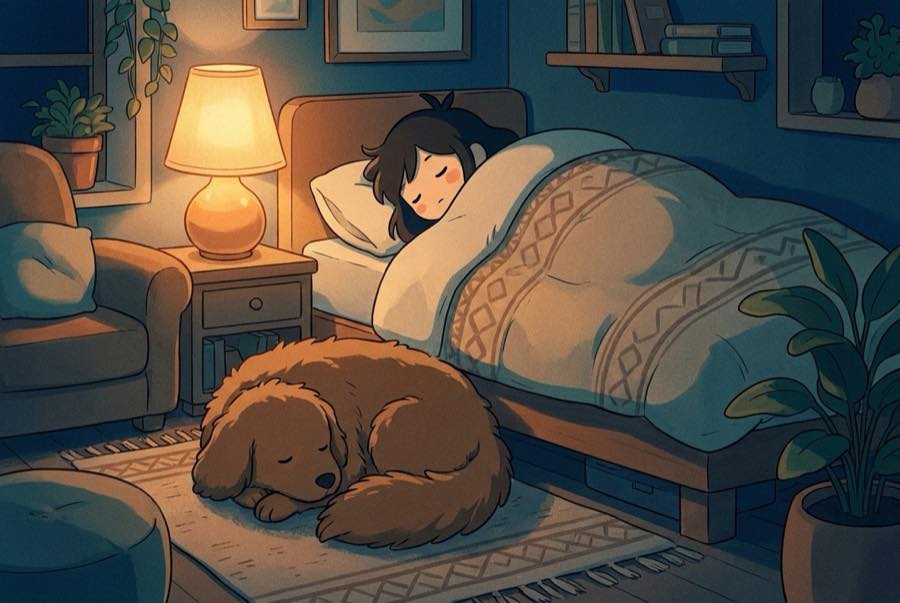
The dog is flat on his back at the foot of the bed, paws in the air, snoring like a small outboard motor. Nobody in the house is happier than he is. That is the whole difficulty with how to sleep with a snoring dog: the sound keeping you awake is coming from something you would never actually ask to leave. An elbow works on a partner. It does not work here, and most nights you do not want it to.
So the plan is not eviction. It is cover — a sound with enough body that the snore stops being the only thing happening in a quiet room — plus a few small adjustments at the dog's end that cost nothing to try.
Why a dog's snore is harder to tune out than it should be
Volume is rarely the real issue. Plenty of dogs snore at a level you could sleep straight through if it held a steady line. What keeps pulling you back is the shape of it: the long rasping inhale, the pause, the snort, then a stretch of quiet just long enough for you to start drifting before the next one arrives. A sound that keeps changing keeps asking for your attention.
There is a second layer worth naming, because it makes people feel unreasonable in the middle of the night. You are not only hearing the snore, you are listening to it — protectively. Was that pause longer than the last one. Is that normal. Should it sound like that. Monitoring is a different activity from hearing, and it is much further from sleep. If the breathing genuinely sounds labored, that is a real question with a real answer and it belongs to a vet, which we get to below. If it is ordinary snoring, the monitoring is a habit you can set down.
The practical response to both is the same: give the room a fuller, more even backdrop so the snore has to compete with something. That is masking, and the proper explanation lives in why rain sounds help sleep.
How to sleep with a snoring dog: cover it instead of fighting it
Density is what matters for this particular job. Gentle rain is lovely and full of small gaps, and a snore finds every one of them. Heavy rain has weight and very little air in it, so a rasp has nowhere obvious to poke through. That is why we reach for the heavy end of the shelf here:
Heavy Rain — Full Downpour — thick, drumming rain with almost no air left in it, which is precisely what a rasp-and-pause pattern needs and what a thinner recording will never manage against the same snore (what makes a rain sound work has the full checklist). The files are edited to run on into each other with no gap at the join, so set it to repeat and clear any sleep timer before you put the phone down. Set the volume once, while you are still awake enough to judge it well.
The volume rule for dog owners has an extra clause. Loud enough to blur the edges of the snore, quiet enough that you would still hear your alarm, a knock at the door, or your dog getting up in the night to be sick. That last one is also why we are slower to suggest earplugs underneath the sound than we would be for someone lying next to a snoring human. You want to stay reachable.
Placement is the one place we break our own default. Usually we would put a speaker across the room, where distance takes the edge off the sound for free. A snore is different: it is a specific noise arriving from a specific direction, and that is the case where bringing the sound close earns its keep. Put the phone or speaker on the nightstand between your head and wherever the dog has settled, so the rain reaches you from roughly the same direction as the snore rather than from the opposite wall — then run it at the lowest level that still does the job. It is small geometry and it makes a real difference to how much the snore stands out.
And do not chase. If you find yourself nudging the volume up every time a particularly operatic snort gets through, stop — you will end up with a loud room and exactly the same problem. The goal is to make the snore ordinary, not to make it inaudible.
Small adjustments at the dog's end
None of these are cures and none of them are medical advice. They are the free things worth trying for a week, in roughly the order they tend to pay off.
Move the spot, not the dog. A snore at the foot of the mattress and the same snore from a bed of his own a couple of feet away are noticeably different experiences, and most dogs care far more about being in the room with you than about being on the bed. Giving him one fixed place and using it every night is the change most worth making here — the how of setting that up so it actually sticks is in how to sleep with a pet in the bed.
Notice the position. Dogs often seem to snore loudest flat on their backs, much the way people do. You cannot direct a sleeping dog, but a bed with a raised edge or a rolled towel along one side tends to encourage curling rather than sprawling, and curling is quieter more often than not.
Look after your own air, not his snore. A clean floor near the bed, washed bedding and a room that is not bone-dry make the bedroom a nicer place for you to spend a night in, particularly if you tend to wake with a dry throat or a blocked nose. We are making no claim about what any of that does to the snoring — we do not know, and guessing at causes is exactly what we said we would not do. Do it because it improves your night, not because you expect it to quieten his.
Keep the door open. A snore in a small closed room feels bigger than the same snore in a room that opens onto a hallway. If your dog is happy with the door ajar, that is a free improvement.
Get in first. Some owners find it easier to fall asleep before the snoring starts than to fall asleep into it, which usually means moving your own lights-out a little earlier rather than waiting for the room to go quiet. It never will.
If the real question underneath all of this is whether the dog should be on the bed at all — the heat, the movement, the shifting before dawn — that tradeoff gets its own honest treatment on the same page linked above. And if there is a human snoring in stereo on the other side, the layering approach in how to sleep with a snoring partner works alongside everything here.
When a dog's snoring deserves a vet, not a playlist
This part matters more than any sound we could hand you. In flat-faced breeds — pugs, French and English bulldogs, boxers, Boston terriers, shih tzus — snoring and snorting are so common that they get treated as a personality trait, which is precisely why serious breathing trouble in these dogs can go unmentioned for years. Loud labored breathing, snorting or gasping while awake, breathing that gets much worse with heat, excitement, or exercise, gums with a bluish tinge, or a dog who seems to be working hard just to move air: those belong in a conversation with your vet, not under a downpour. The same goes for snoring that is new, that has grown noticeably louder, or that arrives alongside coughing, restlessness, or a change in your dog's energy during the day.
We curate sleep sounds; we are not veterinarians and we will not guess at causes. But covering a sound is only a reasonable thing to do when the sound is harmless. If part of your mind is on duty every night listening for the next breath, one appointment will do more for your sleep than any playlist ever could — and if everything checks out, you get to stop listening, which is most of the battle.
The rest of the night
Rain on your nightstand, volume set once and left alone, alarm still audible, dog exactly where he wants to be. If heavy rain turns out not to be your texture, there are other families to try in the guide library.
Let him snore. Start Heavy Rain — Full Downpour — the densest thing we have, which is the one property a rasp with pauses in it can't find a way through — keep it low, leave it on repeat with the timer off, and let the rain do the listening for you.
This article is for general information and isn't medical advice. If sleep problems persist, talk to your doctor.