A headache tends to arrive at the worst possible hour — late, after the day is already spent, right when lying down was supposed to be the reward. Sleep is often the thing that finally ends one, and the ache is the thing standing in the way. So the real question of how to sleep with a headache isn't a sleep technique at all. It's how to make the room dull enough that your head has nothing left to react to, and then how to get out of your own way.
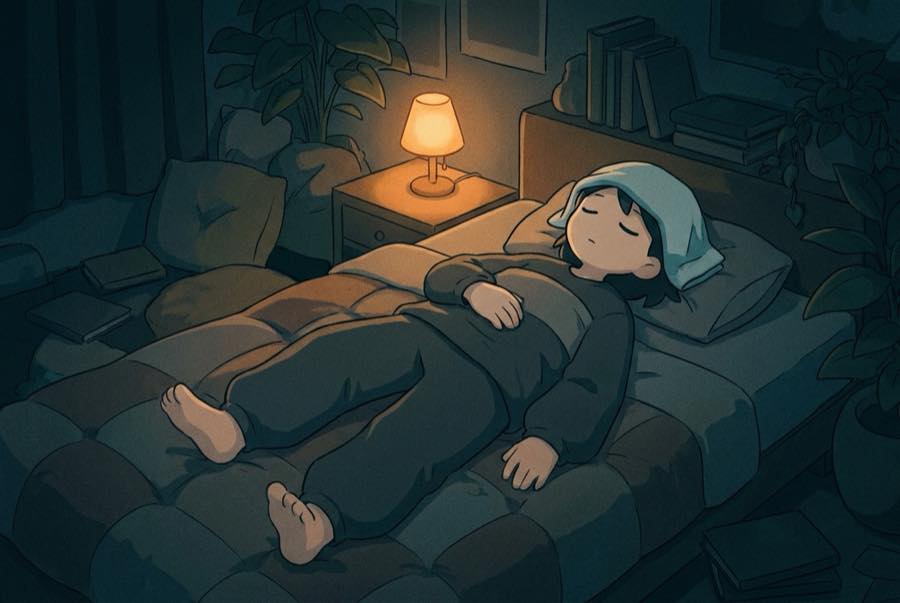
Nothing on this page will take the pain away. A dark room and a low sound can't do that, and we won't pretend otherwise. What they can do is stop the night from adding to it, which on a bad evening is most of the battle.
How to sleep with a headache: take the room down first
Start with light, because light is usually the loudest thing in a bedroom at 11pm and the easiest thing to fix.
Go darker than feels necessary. Not "lamp off" dark — actually dark. Kill the overhead light early and use one low lamp for the last stretch, then close the curtains fully and deal with the small stuff: the router's blinking blue, the charging brick, the standby dot on the TV, the clock face. A shirt draped over each one takes ten seconds. When a head is sore, every point of light in a dark room is something the eyes keep drifting back to.
Try an eye mask, loosely. A mask helps if streetlight comes through the curtains, but keep the strap slack. Anything pressing on the temples or the back of the head can make a sore head feel worse rather than better, so if it adds pressure, take it off and hang a towel over the curtain rod instead.
Take the room down a couple of degrees. Most people sleep a little better in a cool room whatever their head is doing, and temperature is one of the few dials here that is purely about comfort. Crack a window, drop the thermostat, swap a heavy duvet for something lighter, and put a glass of water where you can reach it without sitting up.
Screens off, earlier than usual. A bright phone held close to the face is a lot of light and a lot of small print. If you want something in the last half hour, make it paper under a dim lamp, or nothing at all.
Sort the pillows out while you can still see. Not as a treatment for anything — purely so you aren't rebuilding the bed at 2am, in the dark, one-handed, with a sore head. Decide now how many pillows you want under you and put the spares somewhere you can reach without switching a light on. Same for the water, the earplugs, and the mask: anything you might want later should already be within arm's reach.
You'll notice there's nothing here about compresses, pressure points, stretches, or anything else applied to your head or neck. That's deliberate rather than an oversight. Whatever you'd normally take or do for a headache is a conversation for you and your doctor or pharmacist, not for a sleep site. We'll stick to the room, because the room is the part we actually know something about.
Keep the sound under the pain
Here's where sound needs handling with more care than usual. For some people a headache brings a real sensitivity to noise, and on those nights the correct volume for anything at all is zero. If your ears feel raw and the fridge sounds like a machine shop, skip the audio, use earplugs, and let the room stay silent. That's a legitimate answer and it's the right one more often than you'd think.
But a lot of headache nights aren't like that. The ache is dull rather than sharp, and the actual problem is that the house won't hold still — a door downstairs, a car pulling in, a neighbor's television. Every one of those little jolts pulls your attention straight back to your head. A steady, even sound raises the floor of the room so those spikes have less to cut through, which is the whole idea behind masking and is explained properly in why rain sounds help sleep.
If that's your night, the sound has to be genuinely featureless. No thunder, no swells, nothing that builds or arrives — a sore head will flinch at all of it, and a flinch costs you the next twenty minutes. That's why we'd reach for Gentle Rain — No Thunder, No Surprises: a deep pool of soft, level rainfall with every rumble and crack taken out of it, which on this particular night is the only quality that matters. The tracks end at level rather than fading down, so put the playlist on repeat and switch off any sleep timer your app has armed — a sound that stops by itself at 1am is a change in the room, and a change in the room is the thing you're trying to avoid tonight. If soft rain is your usual thing, the longer tour of that family is in gentle rain sounds for sleeping, and the other families are in the guide library.
Volume is the part to get right, and to get right before the lights go out. Set it while you're still upright and can judge it honestly: quiet enough that it sits underneath the room rather than on top of it, quiet enough that you'd still hear your alarm, a child, or a door. If you find yourself listening to it, it's too loud. If you have to strain to notice it, that's about perfect. There's more on finding that line in what volume for sleep sounds.
One practical note: on a headache night, prefer a speaker across the room over headphones. Earbuds press into the side of your head against the pillow, and over-ears clamp. If a shared room means headphones are the only option, keep them loose, keep them low, and take them off the moment they start to ache.
If you're already lying there awake
Sometimes the room is right and the pain still won't let you go under. Don't turn that into a contest — lying in the dark negotiating with a headache tends to wind both of you up. Leave the sound running, get up into dim light for a while, and come back when you feel less braced; the general version of that move, and when it's worth making, is in how to fall back asleep.
And take the pressure off the night itself. You don't need eight perfect hours to be functional tomorrow; you need to stop bracing. Bodies are more forgiving of one poor night than 2am gives them credit for.
When a headache needs more than a dark room
This part matters more than anything else on this page, so we'll be plain about it.
If a headache comes on suddenly and severely — the worst you've ever had, arriving in seconds — don't try to sleep it off. Get medical help right away. The same goes for a headache that follows a blow to the head, or one that comes with a fever, a stiff neck, confusion, weakness, trouble speaking, or changes to your vision. A headache that simply doesn't feel like your usual headaches deserves the same urgency: unusual is the signal, not just severe.
And if headaches are becoming a regular feature of your evenings, that's worth a real appointment rather than a better bedtime setup. A doctor can look at patterns, triggers, and treatments in a way a dark room never will. Getting that checked is not an overreaction — it's the sensible version of taking your sleep seriously.
This article is for general information and isn't medical advice. If sleep problems persist, talk to your doctor.